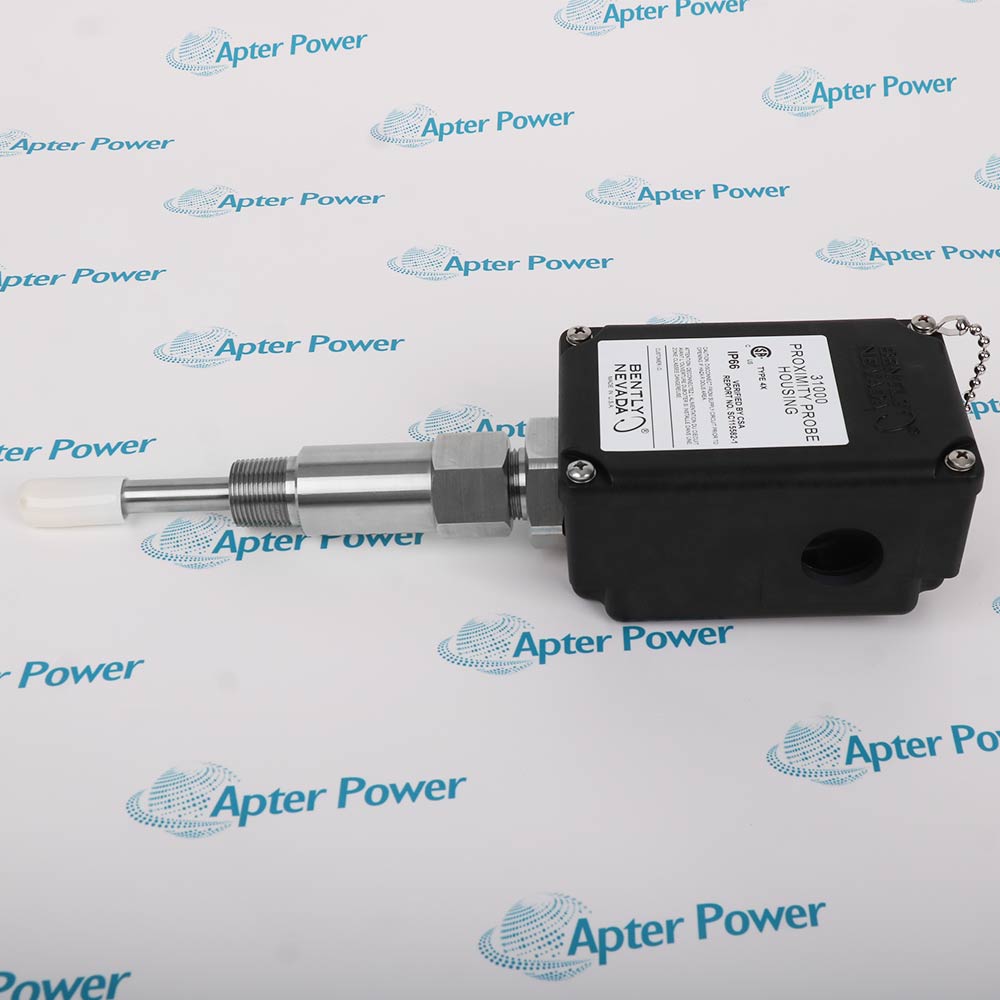
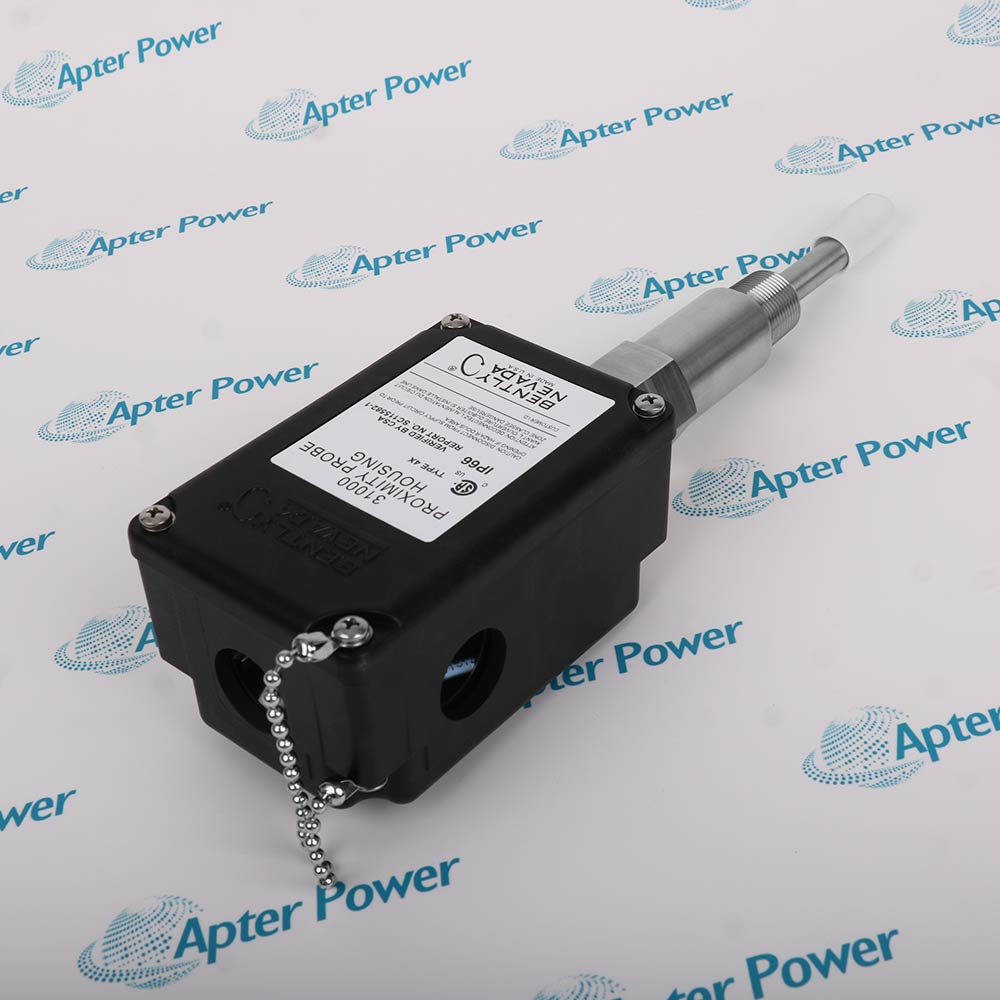
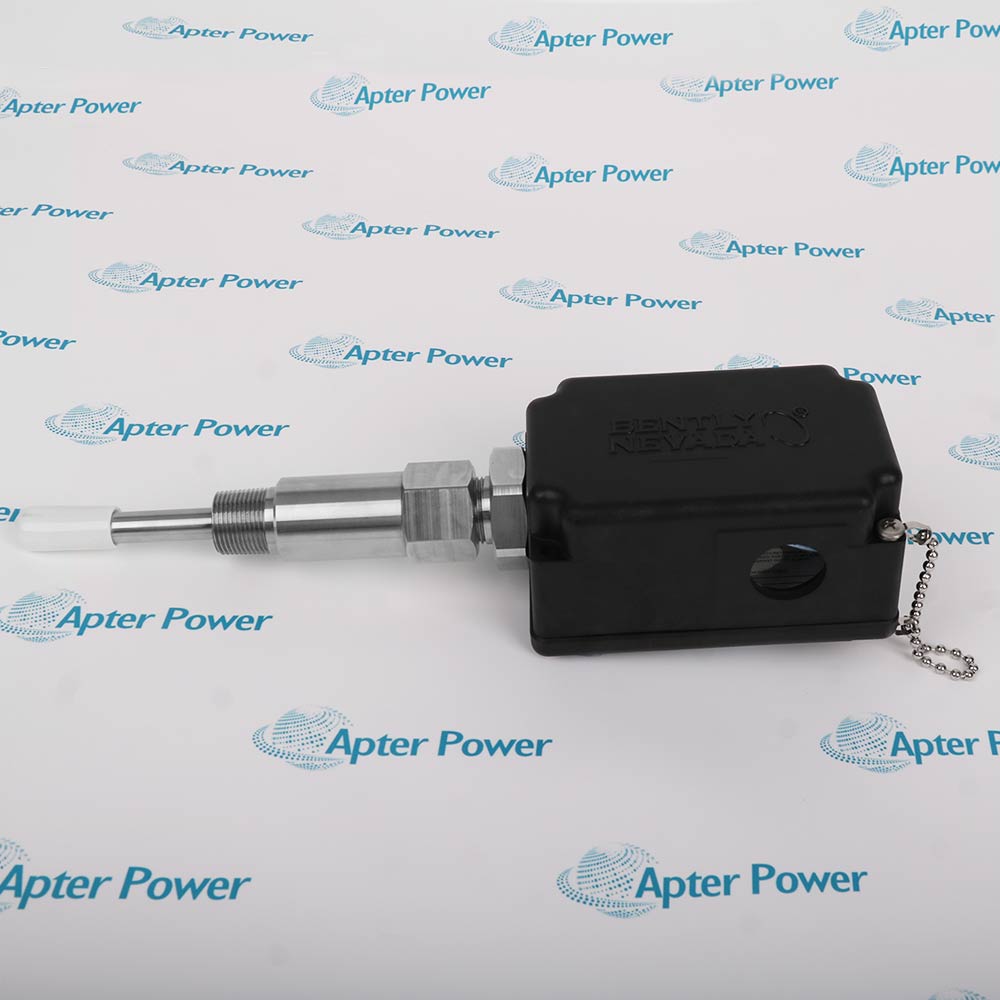
Features:
- Allows gap adjustment and probe replacement through the housing without dismantling the machine case; reduces maintenance downtime.
- Fully meets American Petroleum Institute Standard 670 for externally mounted proximity probe housings; suitable for refinery and petrochemical applications.
- Housing made of PPS (polyphenylene sulfide) thermoplastic; fittings made of stainless steel; excellent resistance to harsh industrial environments.
The 31000-28-05-00-056-01-02 is designed for turbomachinery where access to the shaft for vibration monitoring is through the machine casing. Traditionally, if a proximity probe failed or required gap adjustment, the machine casing would need to be partially disassembled – a costly and time-consuming process. This housing solves that problem. It mounts through a threaded port in the casing and provides external access to the probe and its extension cable. The technician can remove the probe, inspect it, adjust the gap by turning the housing, or replace a failed probe entirely without ever opening the machine.
The American Petroleum Institute's API 670 Standard is the definitive document for machinery protection systems in the oil, gas, and petrochemical industries. It specifies requirements for proximity probe housings, including materials, installation, and performance. The 31000-28-05-00-056-01-02 is fully compliant with API 670 for externally mounted proximity probe housings. This compliance gives engineers confidence that the housing will perform reliably in demanding refinery and offshore applications. For plant operators subject to API compliance audits, using certified components simplifies the approval process. The housing meets rigorous standards for corrosion resistance, mechanical strength, and environmental sealing.
Industrial environments, especially in chemical plants, refineries, and offshore platforms, expose equipment to corrosive agents: salt spray, hydrogen sulfide, moisture, and acidic vapors. Standard metal housings can corrode, seize threads, and eventually fail. The 31000-28-05-00-056-01-02 is built to resist these conditions. The main housing body is made of polyphenylene sulfide (PPS), an advanced high-strength thermoplastic. PPS has exceptional chemical resistance, low moisture absorption, and high thermal stability (continuous use up to 200°C). It will not rust or corrode, even after years of exposure. All other components – fittings, plugs, and hardware – are made of corrosion-resistant stainless steel.
The 31000-28-05-00-056-01-02 Bently Nevada Proximity Probe Housing
Assemblies may still be available for purchase and support from Apter Power beyond
End-Of-Life (EOL)by the manufacturer (OEM).
Bently Nevada 31000-28-05-00-056-01-02 Proximity Probe Housing
Assemblies Manuals,
Datasheets,Drivers,Link
Important Notice:Other accessories,manuals,cables,calibration data,software,etc.are not
included with this equipment unless listed in the above stock item description.All prices are
shown in USD.
Bently Nevada 31000-28-05-00-056-01-02 Proximity Probe Housing Assemblies Specs
General
- Manufacturer GE /Bently Nevada
- Model 31000-28-05-00-056-01-02
- Condition New Original ready stock
- Product Family
31000-33-05-00-056-01-02,31000-35-05-00-056-01-02,31000-28-10-00-056-01-02
Important Notice:Other accessories,manuals,cables,calibration data,software,etc.are not
included with this equipment unless listed in the above stock item description.All prices are
shown in USD.
- Steam Turbines and Gas Turbines: Monitoring radial vibration (shaft vibration) and axial displacement (thrust displacement) of the rotating shaft.
- Centrifugal Compressors and Pumps: Detecting bearing wear, imbalance, or misalignment.
- Generators and Motors: Preventing friction between rotating parts and the stator.
- Fans and Gearboxes: Monitoring axial stability under high-speed operation.
- Extreme Temperature: Supports operation within a range of -51°C to +177°C.
- Extension Cord and Preamplifier: Designed to withstand the erosion of chemicals, oil stains, and industrial fluids.
- Physical Protection: Excellent sealing performance prevents lubricating oil, moisture, and dust from entering the probe.
- Explosion-proof Certification: Typically meets Ex ia (intrinsically safe) or Div 1/Div 2 certifications, allowing installation in flammable and explosive petrochemical and natural gas environments.
- Signal Principle: Utilizing the "Eddy Current principle," the change in distance between the probe and the rotating shaft is converted into a proportional voltage signal (typically 200 mV/mil or 7.87 V/mm).
- Static Monitoring: Used for "axial displacement" monitoring; a shutdown alarm is triggered when axial displacement exceeds the safety threshold.
- Dynamic monitoring: Used for radial vibration, capturing changes in the shaft trajectory and identifying early signs of bearing failure.
- Fault detection: The monitoring system automatically checks the "OK circuit." If the probe cable is broken or short-circuited, the system will issue a fault alarm to prevent accidental shutdown.