2026-09-15
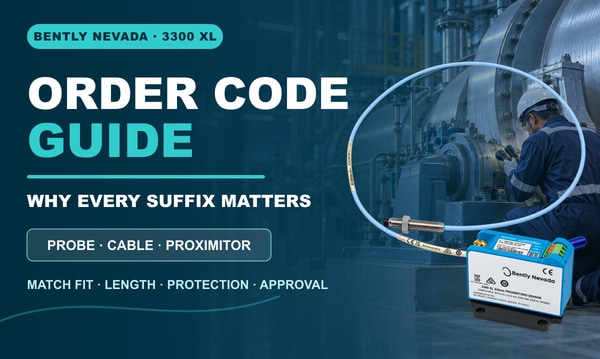
Why Bently Nevada 3300 XL Probe Ordering Codes Matter: A Practical Guide to 330101, 330102, 330103 and 330104
Learn why every Bently Nevada 3300 XL probe suffix matters. This practical guide explains 330101–330104 ordering codes, mounting threads, case dimensions, cable protection, agency approvals, and how to match probe, extension cable and Proximitor system length before purchase or replacement.
.ap-code-guide{--ink:#113547;--navy:#002e3e;--cyan:#31cccd;--cyan-soft:#e9fbfb;--line:#d7e7eb;--paper:#fff;--muted:#58727e;max-width:1040px;margin:0 auto;color:var(--ink);font-family:Arial,Helvetica,sans-serif;font-size:16px;line-height:1.72;background:#fff}
.ap-code-guide *{box-sizing:border-box}.ap-code-guide a{color:#007e92;text-decoration:none;overflow-wrap:anywhere}.ap-code-guide a:hover{text-decoration:underline}
.ap-article-header{margin-bottom:34px}.ap-cover{display:block;width:100%;height:auto;border-radius:20px;box-shadow:0 18px 44px rgba(0,46,62,.17)}
.ap-title{margin:30px 0 10px;color:var(--navy);font-size:44px;font-weight:900;line-height:1.14;letter-spacing:-.025em}.ap-byline{margin:0;color:var(--muted);font-size:15px;font-weight:700}.ap-byline:before{content:'';display:inline-block;width:28px;height:4px;margin:0 10px 3px 0;background:var(--cyan);border-radius:2px}
.ap-intro{margin:0 0 34px;padding:30px 34px;border:1px solid var(--line);border-left:6px solid var(--cyan);border-radius:0 16px 16px 0;background:linear-gradient(135deg,#f7fcfd,#fff)}.ap-code-guide .ap-intro p{margin:0 0 17px!important;color:#163d4e!important;font-family:Arial,Helvetica,sans-serif!important;font-size:17px!important;line-height:1.78!important}.ap-code-guide .ap-intro p:first-child{color:#00394d!important;font-size:18px!important;font-weight:600!important;line-height:1.72!important}.ap-code-guide .ap-intro p:last-child{margin-bottom:0!important}
.ap-section{margin:0 0 48px;scroll-margin-top:20px}.ap-section h2{position:relative;margin:0 0 20px;padding:0 0 12px;color:var(--navy);font-size:27px;line-height:1.25}.ap-section h2:after{content:'';position:absolute;left:0;bottom:0;width:72px;height:4px;background:linear-gradient(90deg,var(--cyan),#0c7da0);border-radius:2px}
.ap-section p{margin:0 0 18px}.ap-section ol,.ap-section ul{margin:14px 0 22px;padding-left:24px}.ap-section li{margin:7px 0;padding-left:4px}
.ap-priority,.ap-compatibility{padding:28px 32px;border-radius:16px;background:var(--cyan-soft);border:1px solid #c2eeee}.ap-code-guide .ap-priority ol{display:grid;grid-template-columns:repeat(6,minmax(0,1fr));gap:12px;margin:18px 0 22px!important;padding:0!important;list-style:none!important;counter-reset:ap-priority}.ap-code-guide .ap-priority li{grid-column:span 2;position:relative;min-height:118px;margin:0!important;padding:48px 16px 16px!important;color:#183f50!important;font-size:15px!important;line-height:1.55!important;background:#fff;border:1px solid #c9e8eb;border-radius:12px;box-shadow:0 6px 16px rgba(0,46,62,.05);counter-increment:ap-priority}.ap-code-guide .ap-priority li:nth-child(4){grid-column:2/span 2}.ap-code-guide .ap-priority li:nth-child(5){grid-column:4/span 2}.ap-code-guide .ap-priority li:before{content:counter(ap-priority);position:absolute;left:16px;top:14px;width:25px;height:25px;color:#00394d;font-size:13px;font-weight:900;line-height:25px;text-align:center;background:#31cccd;border-radius:50%}
.ap-scenario{padding-top:4px}.ap-scenario h2{padding-left:54px}.ap-scenario h2:before{content:'FIELD';position:absolute;left:0;top:2px;padding:4px 7px;color:var(--navy);font-size:10px;line-height:1;letter-spacing:.12em;background:var(--cyan);border-radius:4px}.ap-scenario h2:after{left:54px}
.ap-figure{margin:24px 0 30px}.ap-figure img{display:block;width:100%;height:auto;border-radius:14px;border:1px solid var(--line);box-shadow:0 14px 34px rgba(0,46,62,.12)}.ap-figure figcaption{margin:10px 8px 0;color:var(--muted);font-size:14px;line-height:1.55}
.ap-table-wrap{width:100%;margin:20px 0 28px;overflow-x:auto;border:1px solid var(--line);border-radius:12px;box-shadow:0 8px 24px rgba(0,46,62,.06)}.ap-code-guide table{width:100%;min-width:680px;border-collapse:collapse;background:#fff;font-family:Arial,Helvetica,sans-serif;font-size:16px;line-height:1.6}.ap-code-guide .ap-table-wrap table thead tr th{padding:14px 15px!important;text-align:left!important;color:#fff!important;background:#00394d!important;background-color:#00394d!important;border-color:#00394d!important;font-family:Arial,Helvetica,sans-serif!important;font-size:16px!important;font-weight:800!important;line-height:1.45!important;letter-spacing:.01em!important;white-space:normal!important}.ap-code-guide .ap-table-wrap table tbody td{padding:13px 15px!important;vertical-align:top!important;color:#183f50!important;font-family:Arial,Helvetica,sans-serif!important;font-size:16px!important;line-height:1.6!important;border-top:1px solid #d7e7eb!important}.ap-code-guide tbody tr:nth-child(even){background:#f4fafb}.ap-code-guide td:first-child{font-weight:800;color:#075d70;letter-spacing:.01em}
.ap-table-compact{max-width:760px}.ap-code-guide .ap-table-compact table{min-width:520px}.ap-code-guide .ap-table-compact table thead tr th{padding:11px 14px!important}.ap-code-guide .ap-table-compact table tbody td{padding:9px 14px!important;line-height:1.48!important}.ap-code-guide .ap-table-length th:first-child,.ap-code-guide .ap-table-length td:first-child{width:150px}
.ap-scenario3-layout{display:grid;gap:18px;margin:22px 0 28px}.ap-system-length-card,.ap-parts-panel{min-width:0;padding:22px;border:1px solid #cfe4e8;border-radius:14px;background:#fff;box-shadow:0 9px 24px rgba(0,46,62,.07)}.ap-match-heading{display:flex;align-items:center;gap:11px;margin-bottom:10px}.ap-match-heading>span{display:inline-flex;flex:0 0 31px;width:31px;height:31px;align-items:center;justify-content:center;color:#00394d;font-size:12px;font-weight:900;background:#31cccd;border-radius:9px}.ap-match-heading h3{margin:0!important;color:#00394d!important;font-size:22px!important;font-weight:850!important;line-height:1.28!important}.ap-code-guide .ap-panel-lede{margin:0 0 16px!important;color:#4b6975!important;font-size:15px!important;line-height:1.6!important}.ap-system-length-grid{display:grid;grid-template-columns:minmax(0,1.18fr) minmax(340px,.82fr);align-items:stretch;gap:18px}.ap-system-length-card .ap-table-compact{max-width:none;height:100%;margin:0}.ap-system-length-card .ap-table-compact table{height:100%}.ap-build-panel{display:grid;grid-template-rows:auto 1fr;gap:10px;min-width:0}.ap-formula{display:grid;gap:4px;padding:14px 16px;color:#fff;background:linear-gradient(135deg,#00394d,#006c80);border-radius:10px}.ap-formula span{color:#7de7e6;font-size:12px;font-weight:800;letter-spacing:.08em;text-transform:uppercase}.ap-formula strong{font-size:15px;line-height:1.45}.ap-formula em{font-size:14px;font-style:normal;line-height:1.45}.ap-length-list{display:grid;grid-template-rows:repeat(3,minmax(0,1fr));gap:10px}.ap-part-list{display:grid;grid-template-columns:repeat(2,minmax(0,1fr));gap:10px}.ap-length-item,.ap-part-item{display:grid;align-content:center;gap:3px;padding:12px 14px;border-left:4px solid #31cccd;border-radius:8px;background:#f3f9fa}.ap-length-item strong,.ap-part-item strong{color:#00566b;font-size:16px;line-height:1.4}.ap-length-item span,.ap-part-item span,.ap-part-item em{color:#183f50;font-size:15px;line-height:1.55}.ap-part-item em{color:#526f7b;font-style:normal}.ap-match-conclusion{margin:20px 0 18px;padding:18px 20px;border-left:5px solid #31cccd;border-radius:0 12px 12px 0;background:#e9f7f8}.ap-match-conclusion>span{display:block;margin-bottom:5px;color:#00677a;font-size:12px;font-weight:900;letter-spacing:.1em;text-transform:uppercase}.ap-code-guide .ap-match-conclusion p{margin:0!important;color:#00394d!important;font-size:16px!important;font-weight:700!important;line-height:1.6!important}
.ap-cta{position:relative;margin:34px 0;padding:28px 30px;color:#fff;border-radius:16px;background:linear-gradient(135deg,#00394d,#006c80);overflow:hidden}.ap-cta:after{content:'';position:absolute;right:-45px;top:-45px;width:160px;height:160px;border:28px solid rgba(49,204,205,.18);border-radius:50%}.ap-cta p{position:relative;z-index:1;margin:6px 0 20px}.ap-cta a{color:#fff;text-decoration:underline}.ap-cta-kicker{position:relative;z-index:1;color:var(--cyan);font-size:12px;font-weight:700;letter-spacing:.14em;text-transform:uppercase}.ap-button-row{display:flex;flex-wrap:wrap;gap:10px}.ap-button{position:relative;z-index:1;display:inline-block;padding:11px 18px!important;color:var(--navy)!important;font-weight:700;text-decoration:none!important;background:var(--cyan);border:1px solid var(--cyan);border-radius:8px}.ap-button-ghost{color:#fff!important;background:transparent;border-color:rgba(255,255,255,.65)}
.ap-rfq{padding:30px 32px;border:2px solid var(--navy);border-radius:16px}.ap-sources{padding:28px 32px;background:#f5f8f9;border-radius:16px}.ap-sources ul{font-size:15px}.ap-note{margin-top:30px;padding:18px 22px;color:#4c626c;font-size:14px;line-height:1.6;background:#eef4f5;border-radius:10px}
@media(max-width:860px){.ap-code-guide .ap-priority ol{grid-template-columns:repeat(2,minmax(0,1fr))}.ap-code-guide .ap-priority li,.ap-code-guide .ap-priority li:nth-child(4),.ap-code-guide .ap-priority li:nth-child(5){grid-column:auto}.ap-system-length-grid{grid-template-columns:1fr}.ap-system-length-card .ap-table-compact table{height:auto}}
@media(max-width:720px){.ap-code-guide{font-size:15px;line-height:1.66}.ap-title{font-size:29px}.ap-article-header{margin-bottom:25px}.ap-cover{border-radius:12px}.ap-intro,.ap-priority,.ap-compatibility,.ap-rfq,.ap-sources{padding:22px 20px}.ap-code-guide .ap-intro p{font-size:16px!important;line-height:1.72!important}.ap-code-guide .ap-intro p:first-child{font-size:17px!important}.ap-section{margin-bottom:38px}.ap-section h2{font-size:23px}.ap-code-guide .ap-priority ol{grid-template-columns:1fr}.ap-code-guide .ap-priority li{min-height:0}.ap-table-wrap{margin-left:-4px;width:calc(100% + 8px)}.ap-code-guide .ap-table-compact{max-width:none}.ap-code-guide table{font-size:15px;line-height:1.55}.ap-code-guide .ap-table-wrap table thead tr th,.ap-code-guide .ap-table-wrap table tbody td{padding:11px 12px!important;font-size:15px!important;line-height:1.55!important}.ap-system-length-card,.ap-parts-panel{padding:18px}.ap-match-heading h3{font-size:18px!important}.ap-part-list{grid-template-columns:1fr}.ap-code-guide .ap-panel-lede,.ap-length-item span,.ap-part-item span,.ap-part-item em{font-size:15px!important}.ap-cta{padding:24px 20px}.ap-figure{margin:20px 0 26px}}
During a turbine or compressor outage, a maintenance team may need one replacement proximity probe before the machine can return to service. The request often begins with a short description: “Bently Nevada 3300 XL, 8 mm probe, one-metre cable.” That sounds specific, but it is not enough to identify the correct product.
A visually similar probe may have the wrong mounting thread. A cable may be mechanically connectable but produce the wrong total electrical length. An armored probe may be supplied where the installation requires an unarmored lead, or an approval suffix may not match the site documentation. Each of these differences is contained in the ordering code.
This is why understanding the full code matters. It is not only a task for instrumentation engineers. Maintenance planners need it to avoid extending an outage, buyers need it to compare quotations correctly, and suppliers need it to identify the exact configuration rather than quote a similar-looking product.
Is the Ordering Code Really Important?
Yes. For a Bently Nevada 3300 XL 8 mm probe, the ordering code answers five practical questions:
Will the probe fit the existing threaded hole or mounting bracket?
Is the probe body long enough to reach the target at the correct installation depth?
Will the probe and extension cable match the electrical length of the Proximitor Sensor?
Does the cable have the required mechanical and environmental protection?
Does the ordered configuration carry the approval option required by the project?
The probe tip diameter alone cannot answer any of these questions. Even when two products are both described as “3300 XL 8 mm probes,” their complete codes may describe different mounting, cable and approval configurations.
Start with the Measurement Chain, Not the Probe Alone
A standard 3300 XL 8 mm proximity transducer system contains:
A proximity probe.
An extension cable, except in a one-metre probe-only system.
A Proximitor Sensor.
The probe observes a conductive target without contact. The Proximitor Sensor converts the change in probe-to-target distance into a proportional voltage used for static position and dynamic vibration measurement. Common duties include radial shaft vibration, axial position, Keyphasor phase reference and speed measurement on fluid-film bearing machines.
The three components form one calibrated measurement chain. Selecting the probe correctly is essential, but it is only the first part of the job.
The 3300 XL Probe Code in One View
Read the model as a structured specification: base number, body dimensions, total probe length, cable option and approval option.
The standard forward-mount threaded probe uses this format:
Part Number – AA – BB – CC – DD – EE
Consider the photographed model 330101-00-20-10-02-00:
Code position
Value
What the value tells the buyer
Part number
330101
3/8-24 UNF forward-mount probe without armor
AA
00
0.0 in unthreaded length
BB
20
2.0 in overall case length
CC
10
1.0 m total probe length
DD
02
Standard cable with ClickLoc connector; factory-installed connector protector not selected
EE
00
Agency approval not required
Instead of treating the number as one long string, read it as a short technical specification. The following application scenarios show why each section matters.
Scenario 1: Replacing a Probe in an Existing Bearing Housing
The base number is the first compatibility gate: it determines the mounting thread, armor and dimensional unit system.
Suppose a maintenance engineer removes a damaged probe from a compressor bearing housing. The replacement has the correct 8 mm tip, but its thread is M10 × 1 while the installed bracket is 3/8-24 UNF. The probe cannot be treated as equivalent simply because the outside diameters appear close.
The six-digit base number identifies the thread system and whether the standard probe lead has armor:
Base number
Mounting thread
Cable armor
AA and BB unit system
330101
3/8-24 UNF
Without armor
Inches
330102
3/8-24 UNF
With armor
Inches
330103
M10 × 1
Without armor
Millimetres
330104
M10 × 1
With armor
Millimetres
This table gives the first selection decision:
Choose 330101 or 330102 for a 3/8-24 UNF installation.
Choose 330103 or 330104 for an M10 × 1 installation.
Choose the armored version when the lead requires additional mechanical protection.
Armor protects the cable against physical damage. It is not the same as a connector protector, FluidLoc cable or an underwater probe construction. Those features solve different problems and should not be used as interchangeable descriptions.
Scenario 2: The Thread Is Correct, but the Probe Cannot Reach the Target
A probe may have the correct thread and still be unsuitable for the machine. The unthreaded length and overall case length determine how the probe passes through a housing, bracket or standoff and whether sufficient thread remains for secure adjustment.
For 330101 and 330102 imperial probes:
Code
Meaning
Ordering range
Example
AA
Unthreaded length
0.0 to 8.8 in, in 0.1 in increments
30 = 3.0 in
BB
Overall case length
0.8 to 9.6 in, in 0.1 in increments
60 = 6.0 in
The unthreaded length must be at least 0.8 in shorter than the overall case length.
For 330103 and 330104 metric probes:
Code
Meaning
Ordering range
Example
AA
Unthreaded length
0 to 230 mm, in 10 mm increments
06 = 60 mm
BB
Overall case length
20 to 250 mm, in 10 mm increments
13 = 130 mm
The unthreaded length must be at least 20 mm shorter than the overall case length.
The unit change is easy to miss. In 330104-00-06-05-01-05, BB = 06 means a 60 mm case. It does not mean 0.6 in or 6 mm. Reading the base number before AA and BB prevents this common mistake.
Scenario 3: The Probe Fits, but the Measurement Chain Is the Wrong Length
A 1.0 m probe plus an 8.0 m extension cable makes a 9.0 m chain—not a 5.0 m system.
This is one of the most important compatibility checks in the entire 3300 XL system.
01
Decode the CC Code and Build the System Length
The CC group identifies the total probe length, including its integral lead. Use it with the extension-cable length to build the Proximitor Sensor system length.
CC code
Total probe length
05
0.5 m
10
1.0 m
15
1.5 m
20
2.0 m
30
3.0 m; available only on 330101 and intended for a 9 m system
50
5.0 m; intended for a 5 m Proximitor Sensor
90
9.0 m
Matching rule Probe total length + extension-cable length = Proximitor Sensor system length
1.0 m system 1.0 m probe + no extension cable
5.0 m system 0.5 m + 4.5 m, or 1.0 m + 4.0 m
9.0 m system 0.5 m + 8.5 m, or 1.0 m + 8.0 m
02
Check the Photographed Parts
The four real products illustrate why matching the family and total electrical length matters.
330101-00-20-10-02-00 1.0 m unarmored UNF probe With an 8.0 m cable, it forms a 9.0 m system.
330104-00-06-05-01-05 0.5 m armored M10 × 1 probe Requires a 4.5 m cable for 5 m, or an 8.5 m cable for 9 m.
330130-080-02-00 8.0 m standard extension cable with connector protector Use with a 1.0 m probe and a 9 m Proximitor option.
330180-50-00 5.0 m panel-mount Proximitor Sensor; approval not required Probe and extension cable must total 5.0 m.
Key compatibility result
The key conclusion is that the four photographed products do not form one complete matched chain. The 1.0 m 330101-00-20-10-02-00 plus the 8.0 m 330130-080-02-00 totals 9.0 m. The photographed 330180-50-00 is a 5.0 m sensor, so it is not the correct Proximitor Sensor for that combination.
Likewise, the 0.5 m 330104-00-06-05-01-05 plus the 8.0 m cable totals 8.5 m, which does not match a standard 1 m, 5 m or 9 m Proximitor system. A compatible 9 m chain would require an 8.5 m extension cable with this probe.
This is exactly why three products that share the same platform and connectors should not automatically be photographed, quoted or installed as one compatible set.
Configuration check
Need Apter Power to check an installed measurement chain? Send the complete probe, extension-cable and Proximitor Sensor part numbers, together with clear label photographs and the target material. Request a configuration review and quotation at https://www.apter.com/contact .
Request a configuration review
Scenario 4: Selecting Cable Protection for the Machine Environment
After the mechanical and electrical-length decisions are correct, the DD group defines connector protection and cable construction for standard probes:
DD code
Factory-installed connector protector
Cable construction
01
Included
Standard cable
02
Not selected
Standard cable
11
Included
FluidLoc cable
12
Not selected
FluidLoc cable
These options address different installation risks:
Armor, selected through the probe base number, protects the lead against mechanical damage.
A connector protector improves environmental protection around the ClickLoc connection.
FluidLoc is intended to reduce oil or other liquid migration through the cable interior.
Underwater service requires a separate underwater probe design.
For connections exposed to turbine oil, the Bently Nevada datasheet advises against using silicone tape as a substitute for the connector-protection arrangement. The cable option should therefore be selected from the actual installation environment, not simply from price or appearance.
Scenario 5: The Plant Requires Hazardous-Area Documentation
The EE group identifies the agency approval option in the standard ordering table:
EE code
Meaning
00
Agency approval not required
05
CSA, ATEX and IECEx approvals
Code 05 does not by itself approve every installation. The final design still depends on the exact system components, barriers, wiring, installation drawing and site area classification. When an existing label carries a regional or document-controlled suffix such as CN, BR or RU, do not automatically replace that suffix with 05. The exact certificate and current ordering documentation should be reviewed before quotation or installation.
What About Reverse-Mount, Smooth-Case and High-Temperature Probes?
The five-suffix format described above applies to the common forward-mount 330101, 330102, 330103 and 330104 probes. Other constructions use different base numbers:
Construction
Standard-temperature base numbers
Extended-temperature base numbers
When it is considered
Forward mount, 3/8-24 UNF
330101 / 330102
330191 / 330192
Common imperial threaded mounting
Forward mount, M10 × 1
330103 / 330104
330193 / 330194
Common metric threaded mounting
Reverse mount
330105 / 330106
330195 / 330196
Rear-access or sleeve-based mounting
Smooth case
330140 / 330141
330197 / 330198
Clamp-bracket installation rather than a threaded case
The extended-temperature-range probe is rated up to 218 °C, and the ETR extension cable is rated up to 260 °C. ETR components can be used with the standard 3300 XL Proximitor Sensor, but when an ETR component is included, the system is subject to the ETR accuracy limits. This is a permitted system configuration, not a reason to assume that the standard-temperature accuracy specification remains unchanged.
Compatibility: What Can Be Mixed and What Must Stay Matched?
Within the 3300 XL 8 mm family, probes, extension cables and Proximitor Sensors are designed to be interchangeable when the correct family, calibration and total electrical length are maintained. Individual standard components do not require bench matching for the standard AISI 4140 steel calibration.
The 3300 XL 8 mm family is also electrically and physically interchangeable with earlier non-XL 3300-series 5 mm and 8 mm components, subject to the published installation conditions. When XL and non-XL components are mixed, system performance is limited to the older non-XL specification. Mechanical connection therefore does not mean that every XL performance claim is retained.
Standard systems are calibrated to an AISI 4140 steel target. Other target-material calibrations are available, but the published standard accuracy and interchangeability specifications do not apply in the same way to those systems. If the shaft, collar or observed target is not AISI 4140 steel, include the target material and existing calibration information in the RFQ.
Different proximity-probe families must remain correctly matched. An 8 mm probe should not be connected to an NSv, 11 mm, 25 mm or 50 mm Proximitor Sensor merely because a connector appears similar. Bently Nevada also advises against combining probes, extension cables and drivers from different manufacturers. A mixed system may change scale factor or linearity and can affect the effective alarm or trip response.
Which Bently Nevada Probe Family Should Be Considered?
Probe family
Nominal linear range
Nominal scale factor
Typical selection reason
3300 5 mm
2.0 mm
7.87 V/mm
The 8 mm body is physically too large for the available mounting space
3300 XL 8 mm
2.0 mm
7.87 V/mm
Normal starting point for shaft vibration, position, Keyphasor and speed measurement where the probe fits
3300 XL NSv
1.5 mm
7.87 V/mm
Side-view, rear-view, counterbore or small-target clearance restricts a standard 5/8 mm system
3300 XL 11 mm
4.0 mm
3.94 V/mm
A longer measurement range is required
3300 XL 25 mm
12.7 mm
0.787 V/mm
Differential-expansion measurement on medium to large steam turbine generators
The 8 mm probe is recommended where its dimensions fit because its larger probe body and thicker tip encapsulation provide greater resistance to physical abuse than the smaller 5 mm construction. That does not make the 8 mm family a universal substitute: mounting space, measurement range, side-view clearance and the matching Proximitor family still govern the decision.
How to Read an Actual Nameplate
Real label example supplied by Apter Power: confirm the full P/N together with the serial number and visible construction.
The photographed label for 330101-00-20-10-02-00 provides a complete example:
330101: forward-mount 8 mm probe, 3/8-24 UNF, without armor.
00: 0.0 in unthreaded length.
20: 2.0 in overall case length.
10: 1.0 m total probe length.
02: standard cable and ClickLoc connector, without the selected factory-installed connector protector.
00: agency approval not required.
A useful acceptance photograph should show more than the code alone. Include the complete part number, manufacturer marking, serial number or date code where present, probe tip, thread, armor or unarmored lead and ClickLoc connector. A close-up label confirms identity, while an overall photograph confirms the visible mechanical configuration and product condition.
Six Ordering Mistakes That Cause Avoidable Delays
Ordering by “8 mm probe” without checking the complete part number.
Reading AA and BB as inches on a metric base number, or as millimetres on an imperial base number.
Treating CC as a convenient routing length rather than part of the calibrated system length.
Confusing armor, connector protection, FluidLoc and underwater construction.
Treating an approval suffix as approval of the entire hazardous-area installation.
Combining different electrical lengths, probe families or manufacturers because the connectors fit.
Related Bently Nevada 3300 XL Models Listed by Apter Power
The following related models were listed on Apter Power when this article was prepared. Availability, exact label, approval documents, condition and delivery time should be reconfirmed when the quotation is issued.
Model
Ordering-code snapshot
Apter Power page
330101-00-16-05-02-00
UNF, no armor, 1.6 in case, 0.5 m lead, standard cable, approval not required
https://www.apter.com/Bently-Nevada/3300-XL-8mm-Proximity-Transducer-System/3300-XL-8-mm-Probe/330101-00-16-05-02-00
330101-00-20-10-02-00
UNF, no armor, 2.0 in case, 1.0 m lead, standard cable, approval not required
https://www.apter.com/Bently-Nevada/3300-XL-8mm-Proximity-Transducer-System/3300-XL-8-mm-Probe/330101-00-20-10-02-00
330102-00-40-05-01-00
UNF, armored, 4.0 in case, 0.5 m lead, standard cable with connector protector
https://www.apter.com/Bently-Nevada/3300-XL-8mm-Proximity-Transducer-System/3300-XL-8-mm-Probe/330102-00-40-05-01-00
330104-00-06-05-01-05
M10 × 1, armored, 60 mm case, 0.5 m lead, connector protector, approval option 05
https://www.apter.com/Bently-Nevada/3300-XL-8mm-Proximity-Transducer-System/3300-XL-8-mm-Probe/330104-00-06-05-01-05
330194-05-13-10-05
Metric armored ETR probe, 50 mm unthreaded length, 130 mm case, 1.0 m lead, approval option 05
https://www.apter.com/Bently-Nevada/3300-XL-8mm-Proximity-Transducer-System/3300-XL-8-mm-Probe/330194-05-13-10-05
330130-080-02-00
8.0 m standard extension cable with connector protector, approval not required
https://www.apter.com/Bently-Nevada/3300-XL-8mm-Proximity-Transducer-System/3300-XL-Extension-Cable/330130-080-02-00
330180-50-00
5.0 m panel-mount Proximitor Sensor, approval not required
https://www.apter.com/Bently-Nevada/3300-XL-8mm-Proximity-Transducer-System/3300-XL-Proximitor-Sensor/330180-50-00
What to Send with a Bently Nevada 3300 XL RFQ
An accurate quotation should begin with:
The complete probe part number from the label.
The extension-cable part number and length.
The Proximitor Sensor part number and mounting option.
The shaft or target material and any special calibration information.
The required hazardous-area or country approval.
Quantity, destination and clear photographs of the labels, probe body, cable and connectors.
Quote with confidence
Apter Power can decode the complete ordering number, compare it with the installed measurement chain, review related stock and prepare a configuration-specific quotation. Contact Apter Power at https://www.apter.com/contact , email info@apterpower.com , or use WhatsApp at +86 181 0690 9650 .
Send your RFQ Email Apter Power
Official Technical Sources
Bently Nevada, 3300 XL 8 mm Proximity Transducer System Datasheet, 141194 Rev. AM: https://dam.bakerhughes.com/m/23d2a1de24360b13/original/3300-XL-8mm-Proximity-Transducer-System-Datasheet-141194-pdf.pdf
Bently Nevada, Proximity Probes, Sensors & Transducer Systems: https://www.bakerhughes.com/bently-nevada/sensors/proximity-sensors
Bently Nevada, Proximity Probe System Interchangeability—Don’t Build a “Frankenstein” System: https://www.bakerhughes.com/bently-nevada/orbit-home/orbit-article/proximity-probe-system-interchangeability-dont-build
Bently Nevada, 3300 5 mm Transducer System Datasheet, 172036: https://dam.bakerhughes.com/m/3048672186f80f8/original/3300-5-mm-Transducer-System-Datasheet-172036-pdf.pdf
Bently Nevada, 3300 XL NSv Proximity Transducer System Datasheet, 147385 Rev. R: https://dam.bakerhughes.com/m/7a79b853504f738/original/3300-XL-NSv-Proximity-Transducer-System-Datasheet-147385-pdf.pdf
Bently Nevada, 3300 XL 11 mm Proximity Transducer System Datasheet, 146256 Rev. T: https://dam.bakerhughes.com/m/27a2d91f28aadd41/original/3300-XL-11mm-Proximity-Transducer-System-Datasheet-146256-pdf.pdf
Bently Nevada, 3300 XL 25 mm Proximity Transducer System Datasheet, 163236 Rev. M: https://dam.bakerhughes.com/m/69ee6d965e942dae/original/3300-XL-25mm-Proximity-Transducer-System-Datasheet-163236-pdf.pdf
Ordering tables and approvals can change with document revisions. Check the current Baker Hughes/Bently Nevada publication and the exact certificate set before releasing a purchase order.