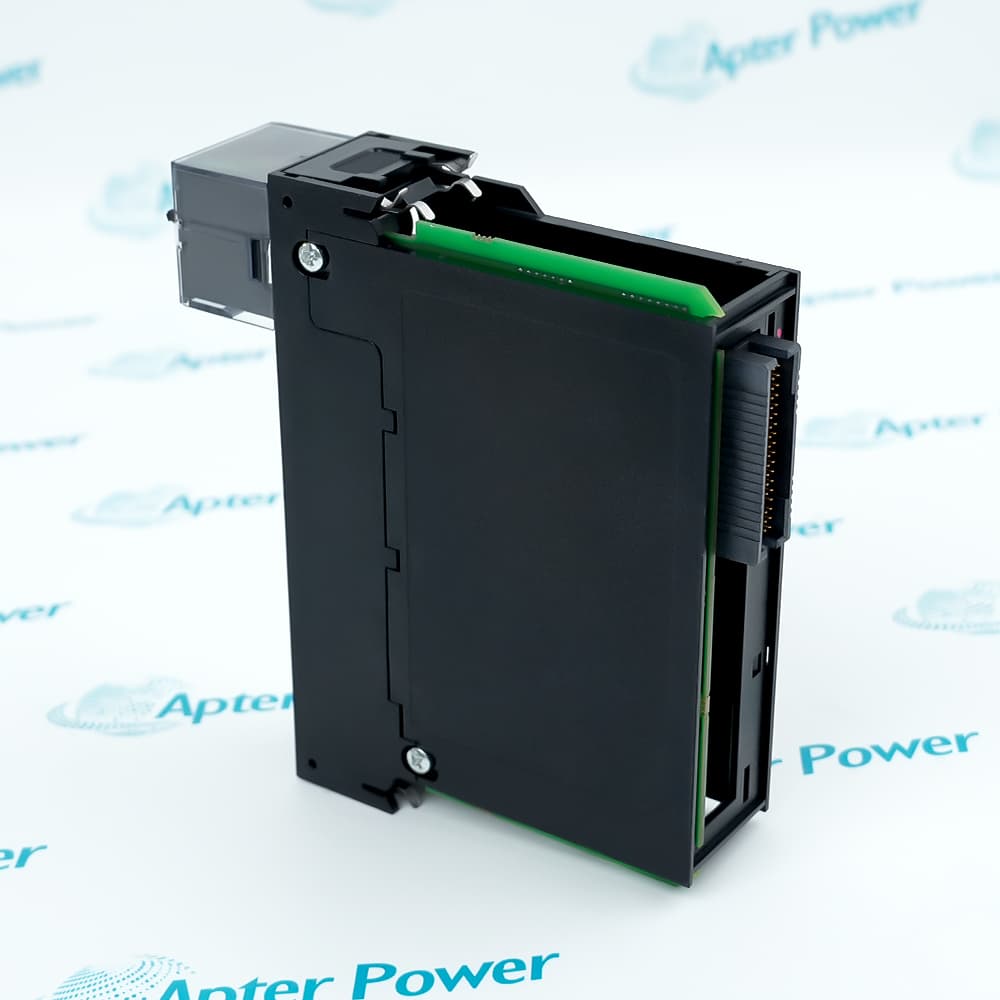
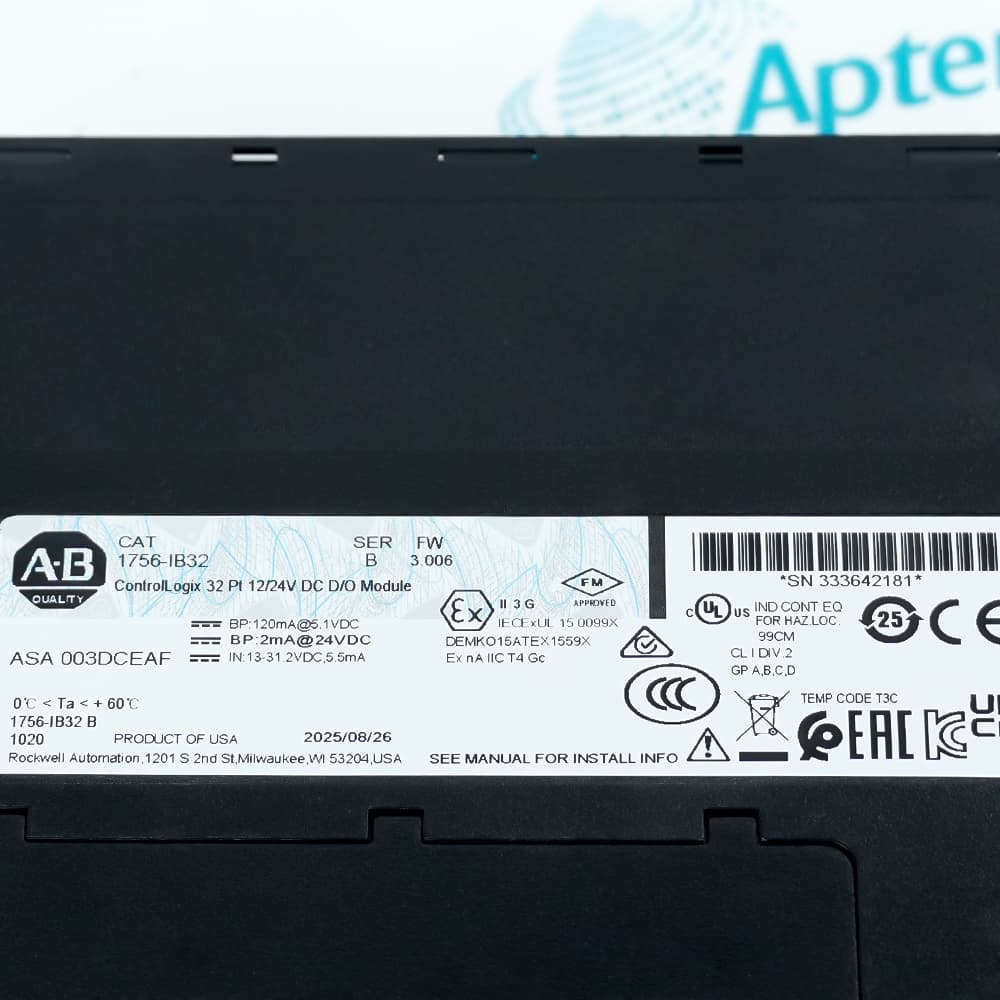
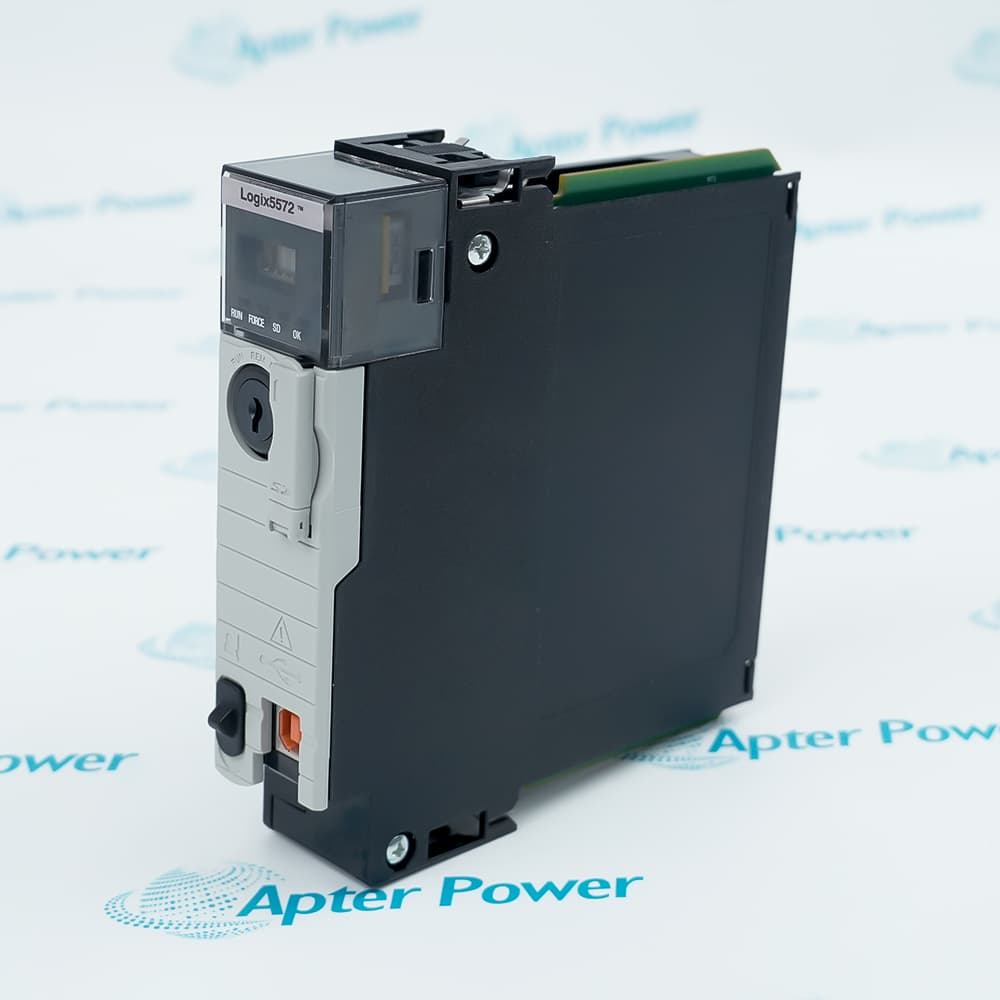
1756-IB32
1756-IB32
1756-IB32
1756-IB32
1756-IB32
1756-IB32
Ask our team:
  • Phone: +86 181 0690 9650
  • E-Mail sales1@apterpower.com
  • Lifecycle status

    Active / Available from OEM
    Apter Power coordinates official documents, identity checks, quotation, sourcing, and shipment review.

1756-IB32

/ 4.9
1001 reviews | Need a Specific Revision?
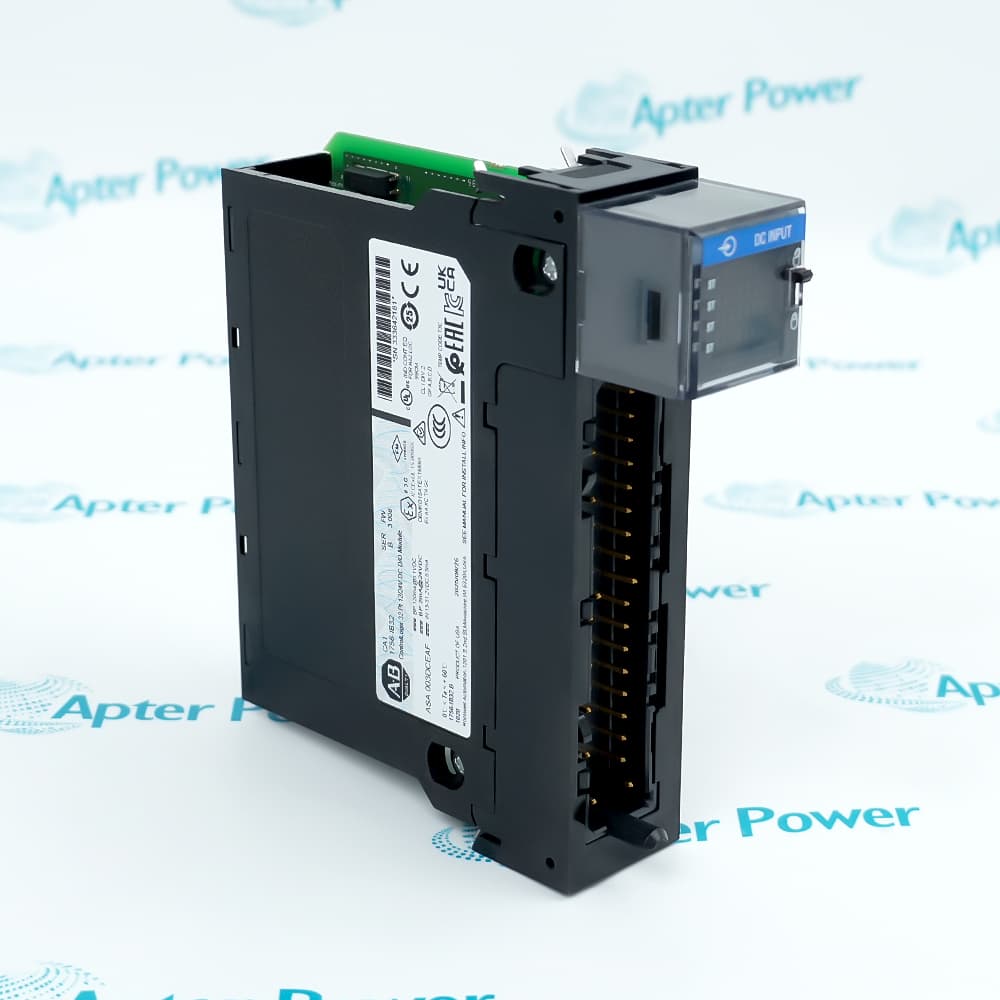
Allen-Bradley 1756-IB32 is a high-density ControlLogix module with thirty-two 12/24 V DC sinking inputs in two groups of sixteen.
In Stock
Ships by Wednesday, October 28
Fast Shipping Available
Get a quick price for 1756-IB32
Quantity
*E-mail
Company
*Mobile
*Content
Upload (gif, jpg, jpeg, png, bmp, doc, docx, xls, xlsx, ppt, pdf, csv)

Technical specifications for 1756-IB32

  • Manufacturer:
    Allen-Bradley
  • Part Number:
    1756-IB32
  • Product Family:
    ControlLogix
  • Product Type:
    ControlLogix 32-Point DC Digital Input Module
  • Stock:
    1
  • Input points:
    32, two groups of 16
  • Voltage category:
    12/24 V DC sinking
  • Operating voltage:
    10...31.2 V DC
  • Input filters:
    User-selectable off-to-on and on-to-off
  • Change of state:
    Software configurable
  • Input timestamp:
    ±200 µs
  • Isolation:
    250 V inputs-to-backplane; 250 V group-to-group; none within a group
  • Backplane draw:
    120 mA at 5.1 V DC; 2 mA at 24 V DC
  • Power dissipation:
    6.2 W maximum at 60 °C
  • Removable terminal block:
    1756-TBCH or 1756-TBS6H
  • Weight:
    0.3 kg
  • Estimated shipping dimensions:
    23.3x18.2x5.3cm
  • Tariff Code:
    Please confirm the destination before shipping
  • Country of origin:
    USA
  • Place of shipment:
    Xiamen,Fujian,China
By purchasing this item, you agree to the Terms & Conditions, ApterPower is not an authorized distributor for listed manufacturers or tradenames and therefore the manufacturer's warranty does not apply. All our products come with ApterPower's 1-year warranty.

More Information

Overview Manuals Point Mapping Event Capture Thermal & Isolation Product Applications

Features:

  • Thirty-two input points: high-density acquisition uses one ControlLogix slot
  • Two sixteen-point groups: separate group commons define the field-wiring boundary
  • Thirty-six-position RTB: 1756-TBCH or 1756-TBS6H supports the complete terminal map
1756-IB32 is intended for cabinets where a large number of discrete states must be concentrated without expanding chassis width.

Density shifts the acceptance burden toward wire numbering, group-common integrity, and a complete controller tag cross-check.

The most useful service record combines the Series B label, RTB catalog, filters, point map, project slot, and tested status for all thirty-two inputs.

Availability of 1756-IB32 is subject to Apter Power inventory and sourcing confirmation.
Allen-Bradley 1756-IB32 ControlLogix 32-Point DC Digital Input Module Manuals, Datasheets, Links
Important Notice: Other accessories, manuals, cables, calibration data, software, etc. are not included with this equipment unless listed in the above stock item description. All prices are shown in USD.
  • Terminal schedule: preserve all input, common, and unused terminal assignments.
  • Group boundary: separate points 0...15 from points 16...31 in the cabinet record.
  • Wire identity: compare conductor labels with the controller tag database.
  • RTB selection: match the installed screw-clamp or spring-clamp housing.
  • Filter set: retain the approved response time for each signal class.
  • Change of state: confirm only required points generate configured state events.
  • Timestamp review: compare event order with the application sequence.
  • Load test: exercise every point rather than sampling one input per group.
  • Backplane demand: include 120 mA at 5.1 V DC and 2 mA at 24 V DC in the chassis review.
  • Heat load: account for the published maximum dissipation at the cabinet temperature.
  • Group separation: maintain the two common domains defined by the wiring diagram.
  • Open style: provide the enclosure and spacing required by the system design.
  • High-density machine inputs: collect thirty-two switches or discrete sensors.
  • Status aggregation: return two grouped banks of 12/24 V DC conditions.
  • ControlLogix expansion: increase digital input capacity with one chassis position.
Description
1756-IB32 concentrates thirty-two 12/24 V DC sinking inputs into one ControlLogix slot. The two groups of sixteen operate across a documented 10...31.2 V DC range.

High-density wiring makes 1756-IB32 dependent on the correct 36-position 1756-TBCH or 1756-TBS6H removable terminal block. The input groups are isolated from one another and from the backplane, while points inside the same group are not individually isolated.

Commissioning 1756-IB32 should include filter recovery, point-by-point tag reconciliation, change-of-state checks, and a 36-terminal inspection. This method limits the risk that a crossed conductor or common fault is misdiagnosed as a module failure.
Revisions

Revision Part #

Also known as

1756-IB32 Series B
1756-IB32/B, Series B
Alternative Names
Allen-Bradley 1756-IB32 input module Rockwell Automation 1756-IB32 AB 1756 IB32 1756IB32 high-density input ControlLogix 32-point sinking input 1756-IB32 1756-IB32 Series B module
Technical notes
The dense 36-terminal interface is the main service risk for 1756-IB32. Preserve both sixteen-point common groups, wire labels, filter values, project profile, electronic keying, and a complete point test before releasing the module.
Exceptional Service

Our Mission

  • 100% Satisfaction

    We believe expertise is priceless. With over 20 years of experience, and top engineers on staff, we can help you solve or avoid problems that threaten your business.
  • Trust Guaranteed

    Not only do we have a vast inventory, our team makes sure every piece of equipment is in working condition. Your purchases are also backed by our Warranty.
  • Expertise

    Time is money, especially when your equipment is down. We work quickly to get your equipment on its way so you can get it back up and running.

FAQS

The following is a list of questions commonly asked by our customers. Please contact us if you have a question about our process that is not answered below.
Why does 1756-IB32 require a full point map during replacement?
Thirty-two inputs share one 36-position RTB, so a shifted conductor or group-common error can affect many controller tags even when the replacement module itself is healthy.
How can a group-common problem be identified on 1756-IB32?
Compare field voltage at several points in the same sixteen-input group, inspect its common terminals, and contrast local indicators with module data and the unaffected group.
What should be checked before changing the filter values of 1756-IB32?
Review signal bounce, required event timing, the approved controller project, timestamp use, and downstream logic before selecting a faster or slower response.
Which RTB choices are documented for 1756-IB32?
Use the 36-position 1756-TBCH screw-clamp or 1756-TBS6H spring-clamp RTB, with the terminal map and mechanical keying matched to the installation.
How should the heat contribution of 1756-IB32 be handled in a crowded chassis?
Include its published maximum dissipation and backplane draw in the enclosure calculation, then confirm ventilation, adjacent-module loading, and ambient temperature.
What acceptance test best supports a sourced 1756-IB32?
Exercise all thirty-two points, verify both group commons, compare LEDs with controller tags, and retain the catalog, Series B, RTB, filter, and project records.