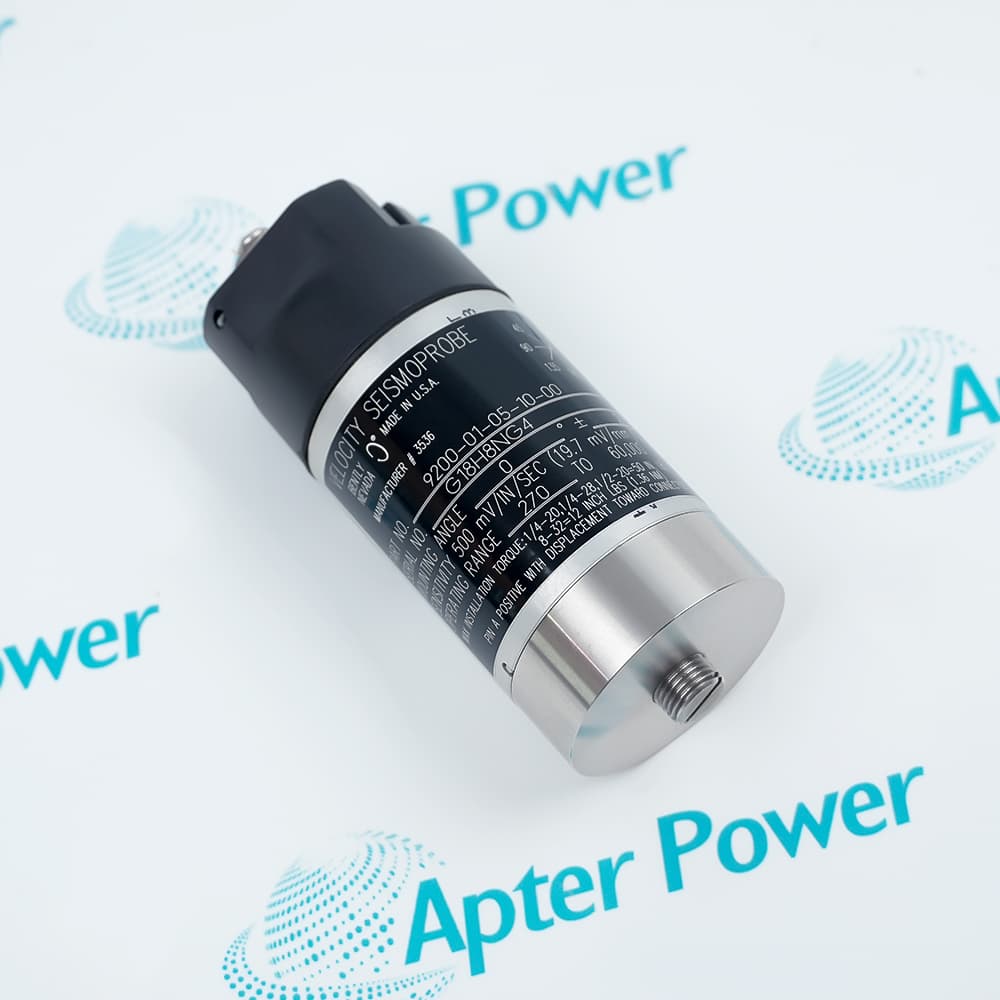
Features:
- Passive two‑wire design; no external power required; voltage output proportional to vibration velocity; less sensitive to impact excitation than solid‑state sensors.
- Electrical isolation (1/4-20 UNC stud) prevents ground loops; reduces electrical noise in vibration signal; simplifies installation on machine casings with different ground potentials.
- 10 ft (3.0 m) hardline cable; top mount connector for easy attachment; cable operating temperature -50°C to 120°C; compatible with 3300/3500 monitors.
The 9200-06-02-10-00 uses moving‑coil technology, a mature and reliable method for absolute casing velocity measurement. Inside the transducer, a coil moves within a magnetic field relative to the housing. This motion generates a voltage directly proportional to the vibration velocity. The output is 20 mV/mm/s (500 mV/in/s) with a 10 kΩ load. Because the sensor has no built‑in electronics, it requires no external power – a significant advantage for portable measurement applications and for installations where running power cables is difficult.
The 9200-06-02-10-00 features an isolated circular mounting base (option 06) with a 1/4-20 UNC stud. The isolation provides galvanic separation between the transducer body and the machine casing. This is essential when the casing has a different ground potential than the monitoring system, which is common in large industrial facilities with multiple power sources or cathodic protection systems. Without isolation, ground loops can form, inducing 50/60 Hz noise and other interference into the vibration signal. This noise can obscure actual vibration, cause false alarms, or make diagnostic interpretation difficult. The isolated base breaks the electrical path while maintaining a rigid mechanical connection for accurate vibration transmission. The mounting torque is 5.6 N·m (50 in·lb).
The 9200-06-02-10-00 comes with a 10‑foot (3.0 meter) integral hardline cable (option 10). The cable is 2‑conductor twisted, shielded, 22 AWG, with a moisture‑resistant female connector at the transducer end and terminal lugs at the monitor end. The top mount connector (option 02) allows the cable to be attached vertically, which is convenient for routing and reduces stress on the cable entry. The cable operating temperature range is -50°C to 120°C, matching the transducer’s -29°C to +121°C range. This integral cable eliminates the need for a separate connector at the transducer, reducing potential failure points. The maximum lead wire length between the transducer and a 3300 or 3500 monitor is 305 meters (1,000 feet), allowing the monitor to be located in a control room while the sensor is on the machine.
The 9200-06-02-10-00 Bently Nevada Two-wire Transducer may still be available for purchase and support from Apter Power beyond
End-Of-Life (EOL)by the manufacturer (OEM).
Bently Nevada 9200-06-02-10-00 Two-wire Transducer Manuals, Datasheets,Drivers,Link
Important Notice:Other accessories,manuals,cables,calibration data,software,etc.are not included with this equipment unless listed in the above stock item description.All prices are shown in USD.
Bently Nevada 9200-06-02-10-00 Two-wire Transducer Specs
General
- Manufacturer GE /Bently Nevada
- Model 9200-06-02-10-00
- Condition New Original ready stock
- Product Family
9200-01-02-10-00,9200-06-05-10-00,74712-03-10-02-00
Important Notice:Other accessories,manuals,cables,calibration data,software,etc.are not
included with this equipment unless listed in the above stock item description.All prices are
shown in USD.
- Low-to-Medium Speed Turbomachinery: Fans, blowers, and pumps.
- Reciprocating Compressors: Monitoring casings prone to high vibration.
- Hydroelectric Power: Monitoring runner vibrations.
- Field Testing: Self-powered, allowing use in portable, route-based data collection.
- Environmental Protection: High resistance to humidity (up to 95% non-condensing).
- Mechanical Integrity: Engineered for robust operation with substantial shock resistance.
- Directional Accuracy: High axial sensitivity with minimal cross-axis interference.
- Self-Generating Voltage Output: As the machine casing vibrates, the internal coil moves through a permanent magnetic field. This generates an analog AC voltage directly proportional to the vibration velocity without needing an external proximity driver or charge amplifier.
- Low Sensitivity to Impulse Noise: Unlike solid-state piezoelectric velocity sensors (which integrate an internal accelerometer signal), this moving-coil mechanism is physically less sensitive to impact-induced spiking or high-frequency transient noise. It provides a cleaner fundamental tracking signal on rough or reciprocal machinery.
- Signal Polarity Logic: The terminal configuration uses a strict directional standard where Pin A becomes positive with respect to Pin B when the casing moves towards the orientation connector.