Features:
- Supports vibration, position, and buffered output signals for machinery condition monitoring.
- Approved hardware combinations for hazardous locations enhance installation flexibility.
- Wide operating temperature capability improves reliability in industrial environments.
Condition monitoring systems frequently rely on General Electric IS220PVIBH1A vibration monitor module for collecting vibration and position signals from rotating equipment. Input power requirements are 28 Vdc with a maximum current of 0.98 A. The module provides vibration input capability from -20 to 15.6 Vdc and position input capability from -20 to -0.5 Vdc. Buffered outputs ranging from -20 to 4.5 Vdc with -3 mA dc output current support signal transmission to connected systems. Probe excitation is supplied at -24 Vdc and 12 mA dc.
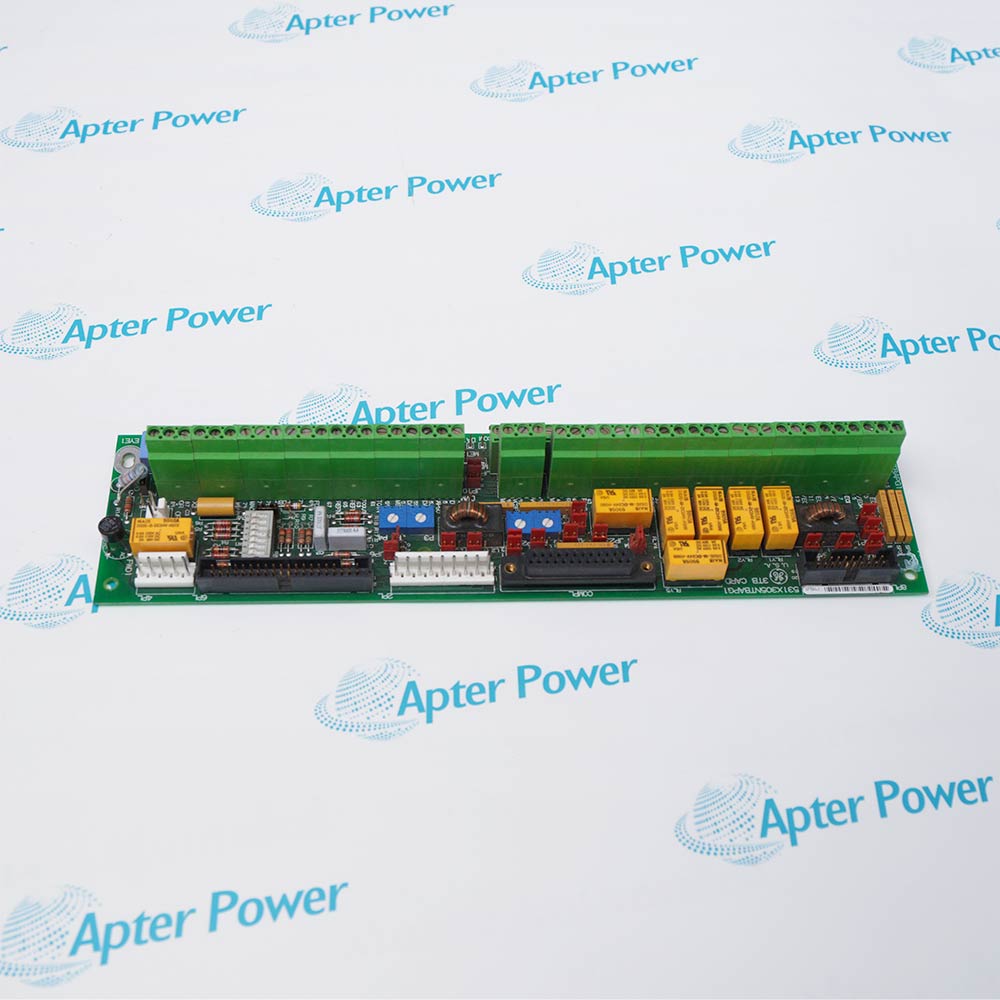
Hazardous location applications can employ General Electric IS220PVIBH1A vibration monitor module together with accessory terminal board IS200TVBAH2A and three IS200WNPSH1A daughterboards. Such combinations are approved for use with PVIB and YVIB vibration monitor modules. Historical product development separated IS220PVIBH1A and IS420PVIBH1B, while an additional terminal board was added for compatibility with IS420PVIBH1B. General Electric IS220PVIBH1A vibration monitor module therefore remains compatible with established Mark VIe architectures. Industrial facilities benefit from easier maintenance and component replacement.
General Electric IS220PVIBH1A vibration monitor module operates within ambient temperatures from -30 to +65°C, supporting installations in demanding environments. Applications include turbines, generators, compressors, and process machinery where continuous vibration supervision is essential. Signal conditioning and monitoring functions help maintenance personnel identify abnormal operating conditions before major failures occur. Integration with Mark VIe systems simplifies implementation of machinery protection strategies. Reliable operation contributes to enhanced plant availability and reduced downtime.
The IS220PVIBH1A General Electric Vibration Monitor Module may still be available for purchase and support from Apter Power beyond End-Of-Life (EOL) by the manufacturer (OEM).
General Electric IS220PVIBH1A Vibration Monitor Module Manuals,Datasheets,Link
Important Notice: Other accessories, manuals, cables, calibration data, software, etc. are not included with this equipment unless listed in the above stock item description. All prices are shown in USD.
General Electric IS220PVIBH1A Vibration Monitor Module Specs
General
- Manufacturer General Electric
- Model IS220PVIBH1A
- Condition New Original ready stock
- Product Family IS220PTURH1B,IS220PTURH1A,IS220PTCCH1B
Important Notice: Other accessories, manuals, cables, calibration data, software, etc. are not included with this equipment unless listed in the above stock item description. All prices are shown in USD.
- Gas Turbine Rotor Monitoring: Real-time capture of bearing vibration in heavy-duty gas turbine units.
- Steam Turbine Eccentricity Measurement: Closely monitors the main shaft bending during startup.
- Generate Axial Displacement: Prevents fatal axial collisions between the generator rotor and stator.
- High-pressure compressor key phase: Phase speed is calculated via the key phase signal input through channel 13.
- Network Status LED: Real-time display of IONet redundant network communication via dual-color indicator lights.
- Hardware Overheat Monitoring: Built-in temperature sensor monitors the temperature rise of internal components in real time.
- Sensor Disconnection Detection: Automatically diagnoses open circuits, short circuits, and bias voltages in the input circuit.
- Software Watchdog Reset: The hardware watchdog forces a safe restart of the module in the event of a microprocessor crash.
- Electromagnetic Compatibility Protection: Meets industrial-grade high-intensity common-mode and differential-mode surge voltage suppression requirements.
- Dual-Network Redundancy Architecture: Equipped with two independent Ethernet paths to ensure protection is not lost in the event of communication failure.
- Intrinsically Safe Current Limiting: Enables current limiting for sensors in hazardous areas in conjunction with specific terminal blocks.
- Limited-Range Interlock Output: Provides overspeed and over-vibration emergency protection interlock signal output.