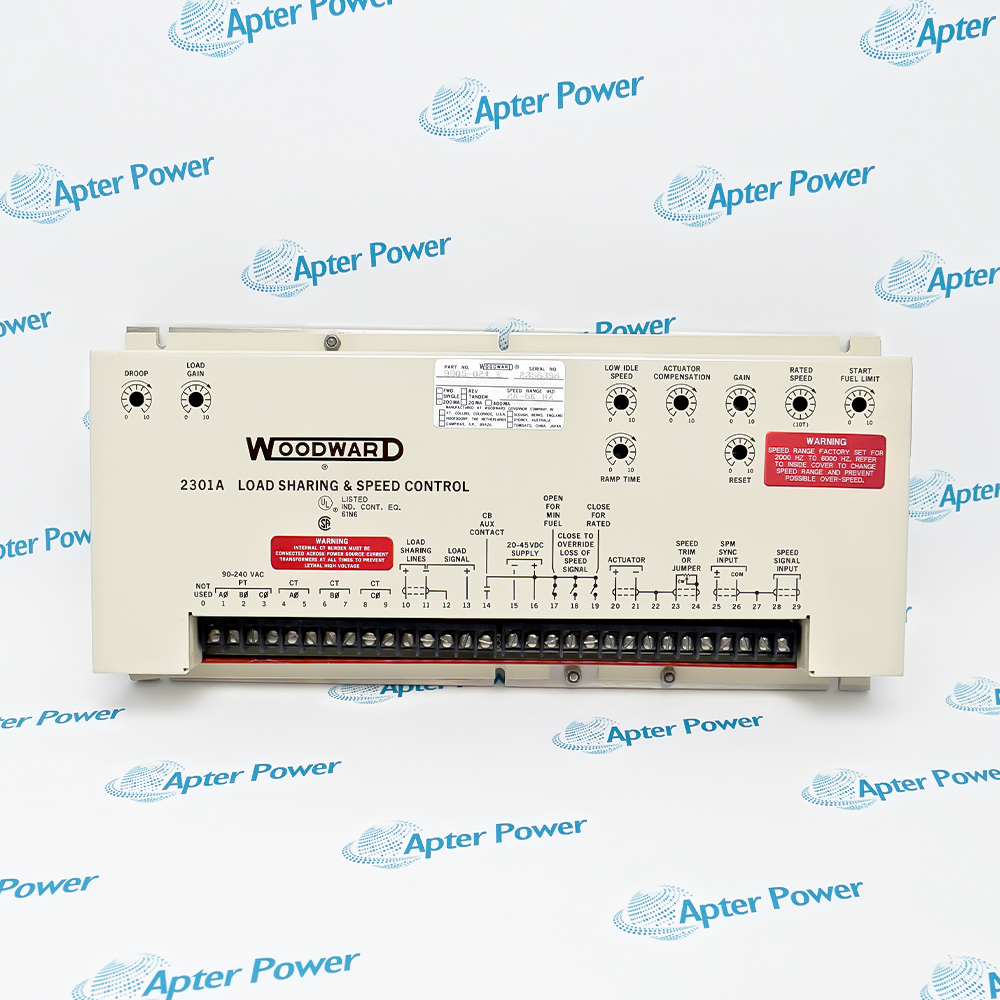
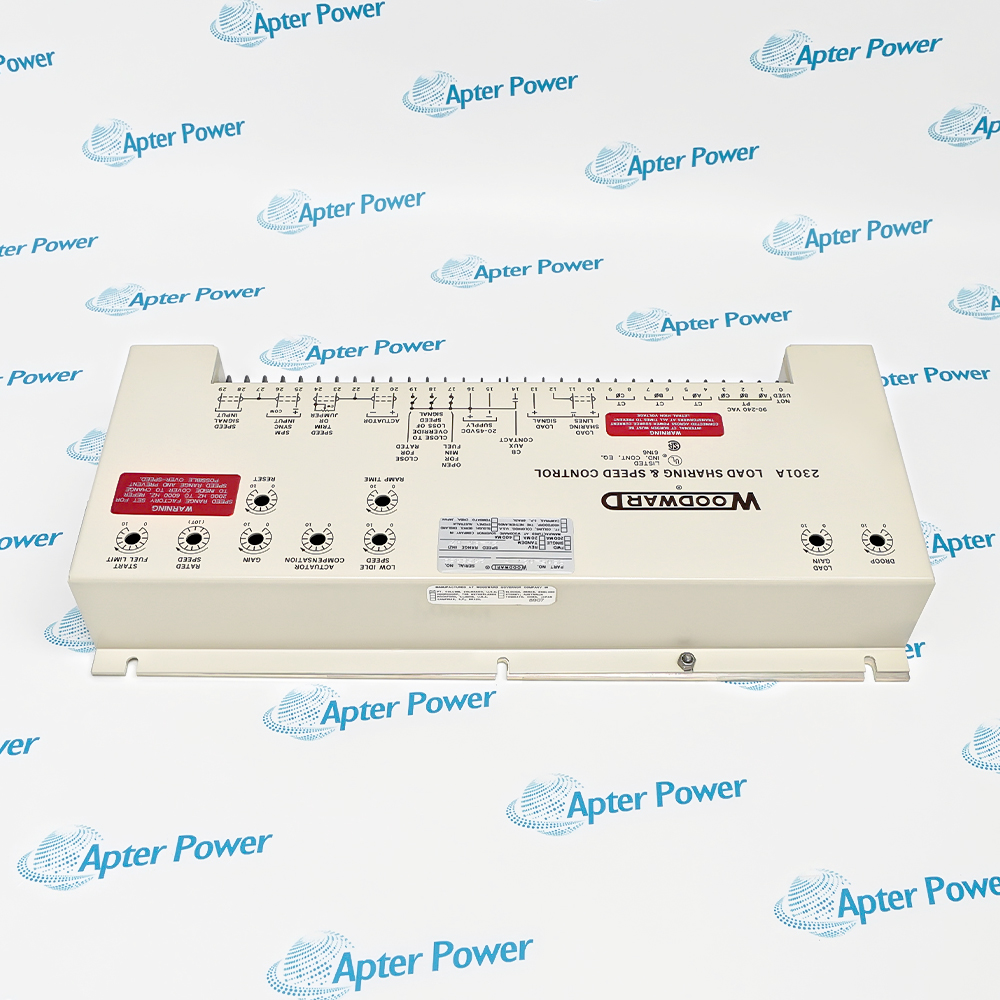
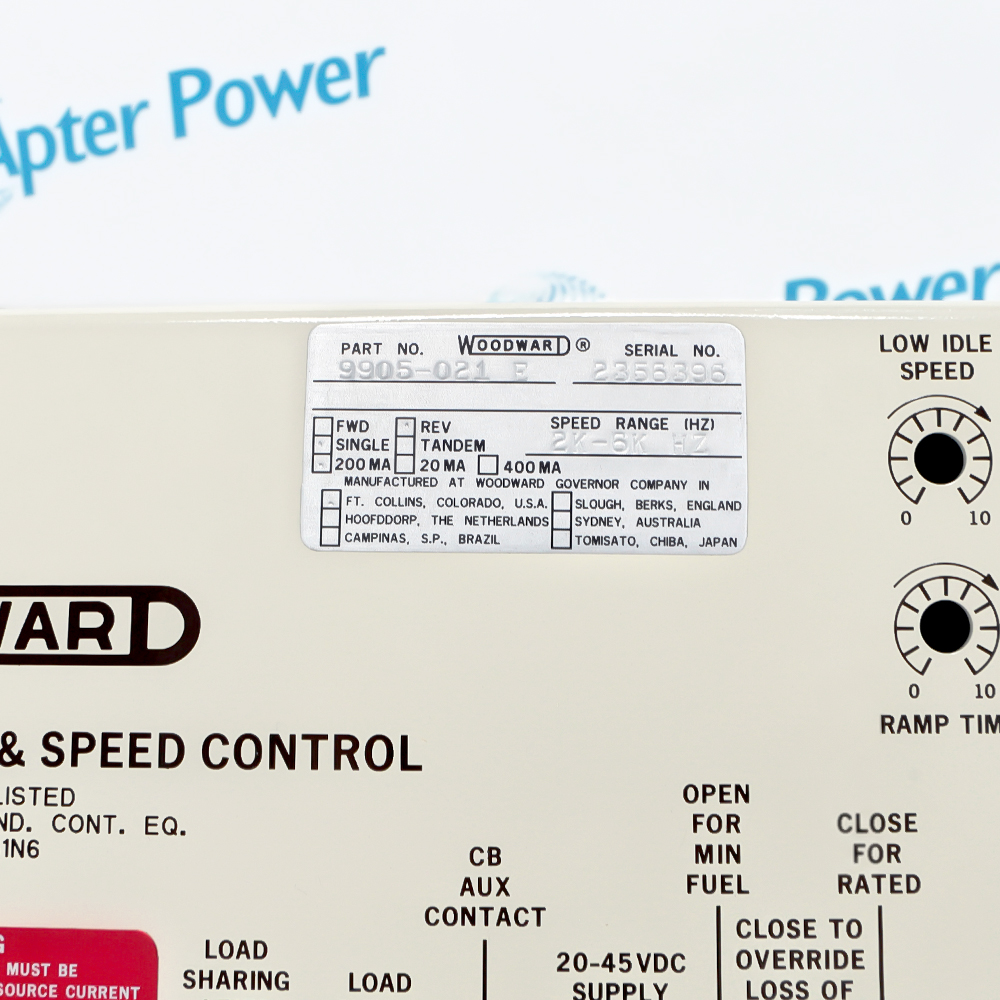
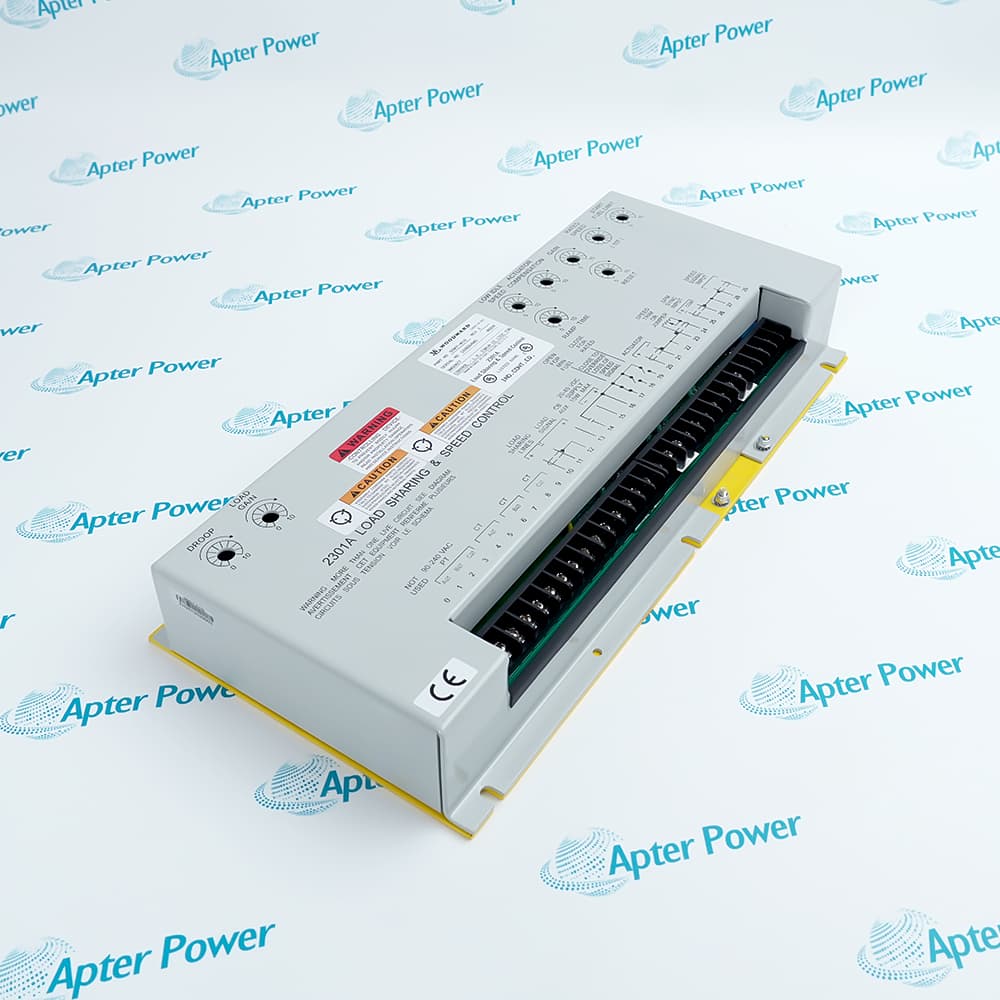
Features:
- Low-voltage supply: uses the documented 20–40 Vdc input range.
- Reverse-acting output: drives one 0–200 mA actuator.
- Generator governing: supports speed control and load-sharing operation.
The complete part number selects a specific 2301A hardware configuration rather than a generic governor family member.
Reverse-acting behavior, actuator-current range and the absence of a deceleration ramp directly affect wiring and operating response.
A controlled commissioning sequence proves pickup input, actuator response, speed stability and load-sharing signals while retaining independent overspeed protection.
Apter Power can help review the actuator, supply and generator-governor context for Woodward 9905-021 enquiries.
Woodward 9905-021 2301A Load Sharing and Speed Control Manuals,Datasheets,Link
Important Notice: A qualified Woodward English manual covering exact model 9905-021 was identified; a branded PDF requires preview approval before attachment.
- Speed-range selection: places the rated-speed set point inside the controller's usable adjustment span, leaving room for commissioning rather than forcing the control to an end stop.
- Gain response: determines how strongly 9905-021 reacts to a speed or load error; excessive gain promotes hunting, while insufficient gain slows recovery.
- Stability damping: works with gain to settle actuator movement after a disturbance, so the two adjustments are tuned as a pair at operating conditions.
- Load-gain alignment: scales the load-sharing path to generator output, preventing a correctly governed machine from carrying the wrong share of parallel load.
- Isochronous operation: holds the selected speed on an isolated generator or in a compatible load-sharing scheme instead of allowing steady-state droop.
- Droop operation: creates a defined load-versus-speed relationship for operation against an independently governed source or an infinite bus.
- Idle and rated references: provide separate operating targets for warm-up and normal generation, making the transition part of the governor sequence rather than a wiring-only event.
- Reverse-acting control: matches 9905-021 to an actuator system whose required fuel-command direction is opposite that of a forward-acting 2301A configuration.
- Magnetic-pickup input: supplies the shaft-speed feedback from which the controller forms speed error; a weak or lost pickup signal breaks that control path.
- Actuator command: the single 0–200 mA path converts the controller's correction into fuel-actuator movement, so actuator direction and travel determine the physical response.
- Load-sharing input: adds generator-load information to speed control when units operate in parallel, allowing the governor to coordinate loading rather than speed alone.
- Low-voltage supply: the 20–40 Vdc version must remain on its intended supply class; a different 2301A supply variant is not created by changing settings.
- Isolated generator sets: isochronous speed control where one governor establishes the frequency reference.
- Paralleled generator sets: coordinated speed and load sharing in a compatible 2301A scheme.
- Engine-driven generation: governing for documented diesel or gasoline prime-mover applications.
- Turbine-driven generation: speed control for documented steam- or gas-turbine generator applications.