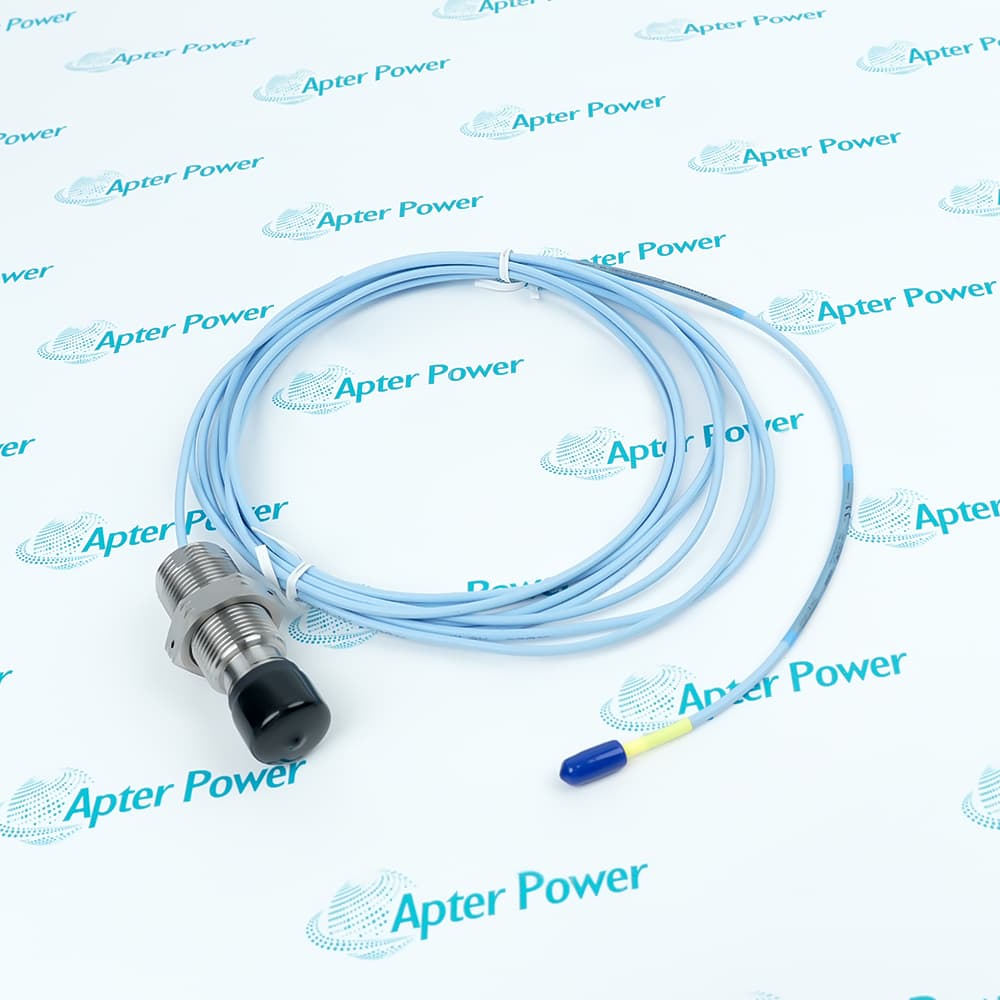
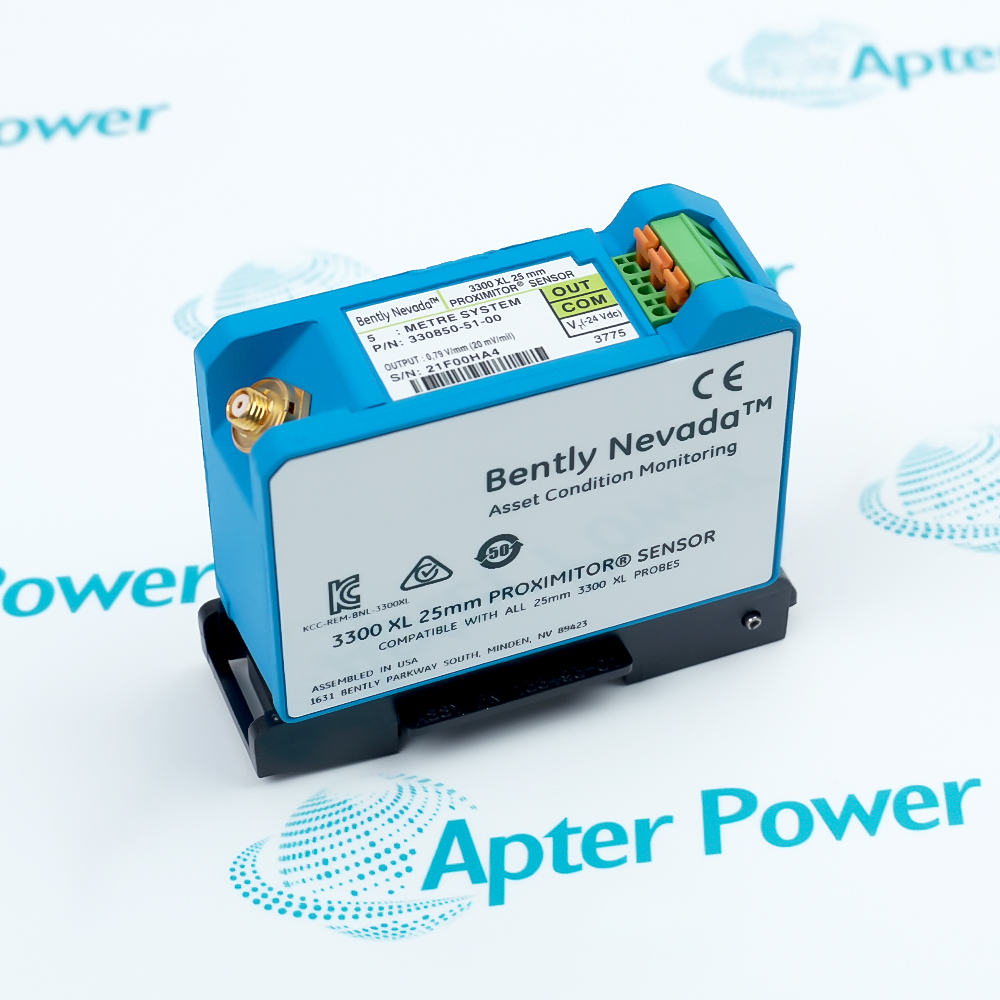
Features:
- Specifically designed for DE monitoring on mid-size to large steam turbine generators, measuring thermal growth differences between rotor and stator with 12.7mm linear range.
- Continuous operation up to 200°C (392°F) and intermittent up to 250°C (482°F). Features front/rear seals and FluidLoc cable to prevent moisture ingress in harsh turbine environments.
- Carries CSA, ATEX, and IECEx certifications for installation in explosive atmospheres (Zone 0, 1, 2; Division 1, 2). Includes high-temperature gold-plated ClickLoc connectors with removable collar for tight clearance routing.
The 330851-02-010-140-10-00-05 is specifically engineered for differential expansion (DE) monitoring in steam turbine generators, one of the most critical measurements for turbine supervisory instrumentation (TSI). During startup and load changes, the turbine rotor and casing expand at different rates due to differences in mass, material, and steam contact. If the differential expansion exceeds design limits, internal rubbing between rotating blades and stationary diaphragms can occur, leading to catastrophic damage.
The 330851-02-010-140-10-00-05 is built to survive the extreme conditions found inside steam turbine casings. Unlike standard proximity probes rated at 177°C, this 25 mm probe continuously operates at up to 200°C (392°F) and can withstand intermittent temperature spikes up to 250°C (482°F) during turbine transients. This high-temperature capability is achieved through specialized materials including PEEK (polyetheretherketone) probe tip material and high-temperature PFA cable insulation. Moisture ingress is a common failure mode in turbine DE probes, as steam condensation can damage the sensing coil.
The 330851-02-010-140-10-00-05 with agency approval option 05 carries comprehensive hazardous area certifications including CSA (North America), ATEX (Europe), and IECEx (international). These certifications allow the probe to be installed in Zone 0, Zone 1, and Zone 2 (ATEX/IECEx) as well as Class I, Division 1 and Division 2 (CSA) explosive atmospheres commonly found in power generation facilities where hydrogen-cooled generators or natural gas fuel systems are present. The probe's temperature classification ranges from T1 to T5 depending on ambient temperature, with T5 (-55°C to +40°C) and T4 (-55°C to +80°C) ratings.
The 330851-02-010-140-10-00-05 Bently Nevada Proximity Probe may still be available for purchase and support from Apter Power beyond
End-Of-Life (EOL) by the manufacturer (OEM).
Bently Nevada 330851-02-010-140-10-00-05 Proximity Probe Manuals, Datasheets, Drivers, Link
Important Notice: Other accessories, manuals, cables, calibration data, software, etc. are not included with this equipment unless listed in the above stock item description. All prices are shown in USD.
Bently Nevada 330851-02-010-140-10-00-05 Proximity Probe Specs
General
- Manufacturer GE / Bently Nevada
- Model 330851-02-010-140-10-00-05
- Condition New Original ready stock
- Product Family
330851-02-010-140-10-00-RU,330851-02-010-140-10-00-CN,330851-05-000-040-50-01-05
Important Notice: Other accessories, manuals, cables, calibration data, software, etc. are not
included with this equipment unless listed in the above stock item description. All prices are
shown in USD.
- urbine Differential Expansion (DE) Monitoring: This is the primary role for this probe. During startup, warm-up, and loading phases of heavy steam turbines, the rotor and the outer casing (stator) expand thermally at vastly different rates and times.
- Hydro-Turbine Shaft Runout: Deployed on low-speed hydro units that exhibit large structural clearances and slow, broad dynamic wobbling.
- Heavy Machinery Structural Shift: Used on massive industrial blowers and heavy-duty axial compressors to monitor axial rotor float or frame structural shifting under extreme load pressures.
- The Probe Itself Has "No Firmware": The Bently Nevada 330851 probe is a purely analog, passive hardware component composed of a stainless-steel casing, a PEEK/PPS plastic tip, and an internal high-frequency induction coil.
- 330850 Proximitor Sensor: This is also a pure analog signal-conditioning circuit block without firmware, though its hardware circuitry is factory-calibrated to match the 25 mm probe characteristics.
- Bently Nevada 3500 Monitoring Rack: If the probe output is tied into a 3500/45 Position Monitor Module, this specific chassis card runs an embedded microcontroller. When upgrading plant industrial networks or performing cyber-hardening routines, engineers utilize the Bently Nevada 3500 Rack Configuration Software over an Ethernet/Serial link to flash the latest factory-authorized firmware patch onto the 3500 monitor card.
- Establishing the correct mechanical baseline gap is the most crucial configuration step. The optimal operational center point (bias voltage) for the 25 mm system is -9.0 Vdc, which corresponds to a physical standoff distance of approximately 7.0 mm (275 mils).
- Field Tuning Procedure: Screw the probe into the bracket while measuring the DC voltage at the Proximitor output terminals using a multimeter (or observing the live gap voltage in the 3500 configuration utility). When the meter reads exactly -9.0 Vdc, the probe is sitting precisely at the geometric mid-point of its 12.7 mm linear scale. Once verified, torque the locknuts down tight on the M30x2 threads to secure the probe body.
- Channel Sensor Selection: Under the 3500/45 module setup screen, configure the designated channel's Sensor Type to 3300 XL 25 mm Proximity Transducer.