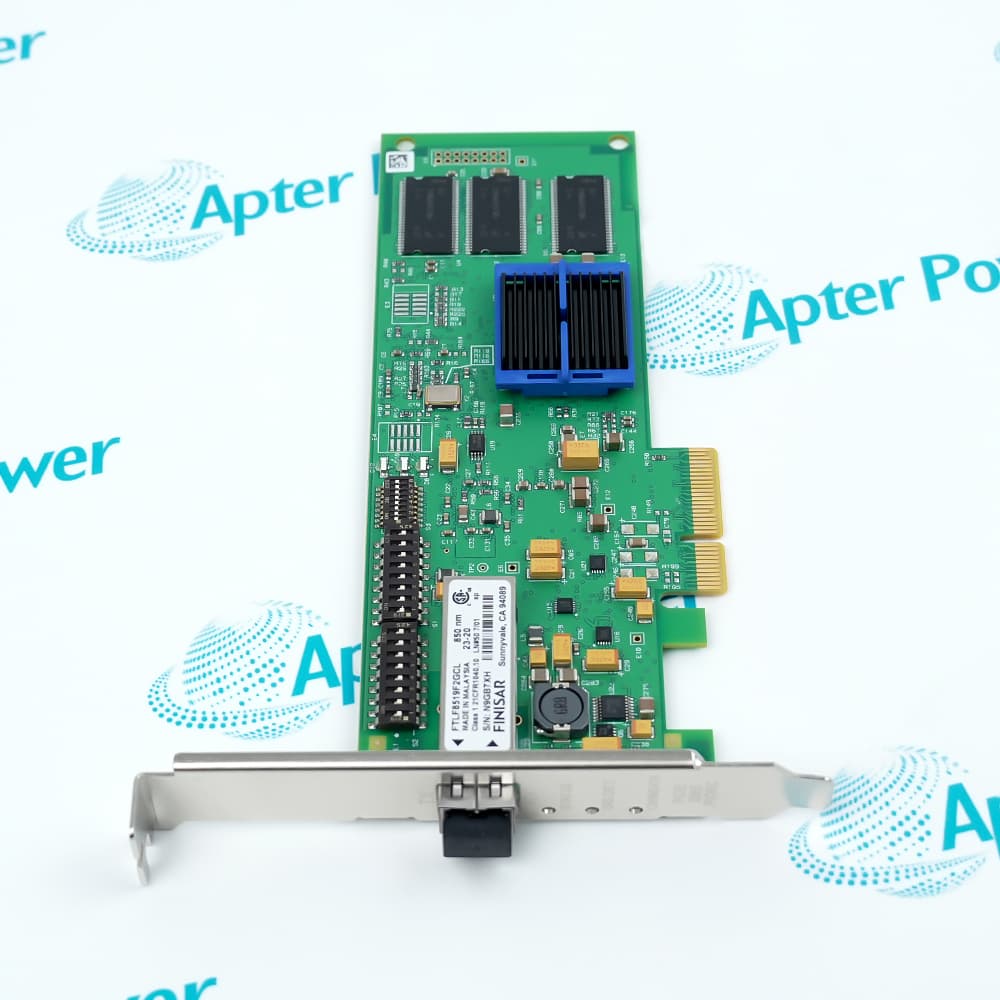
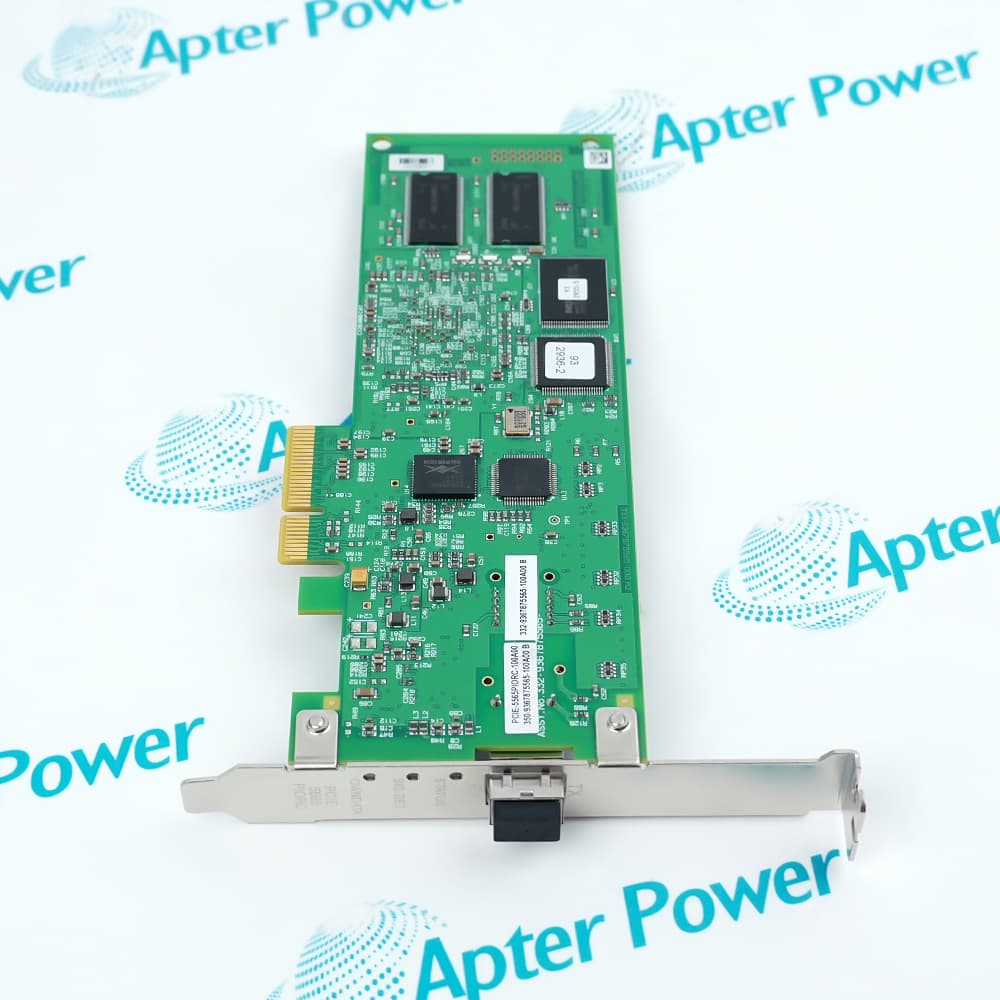
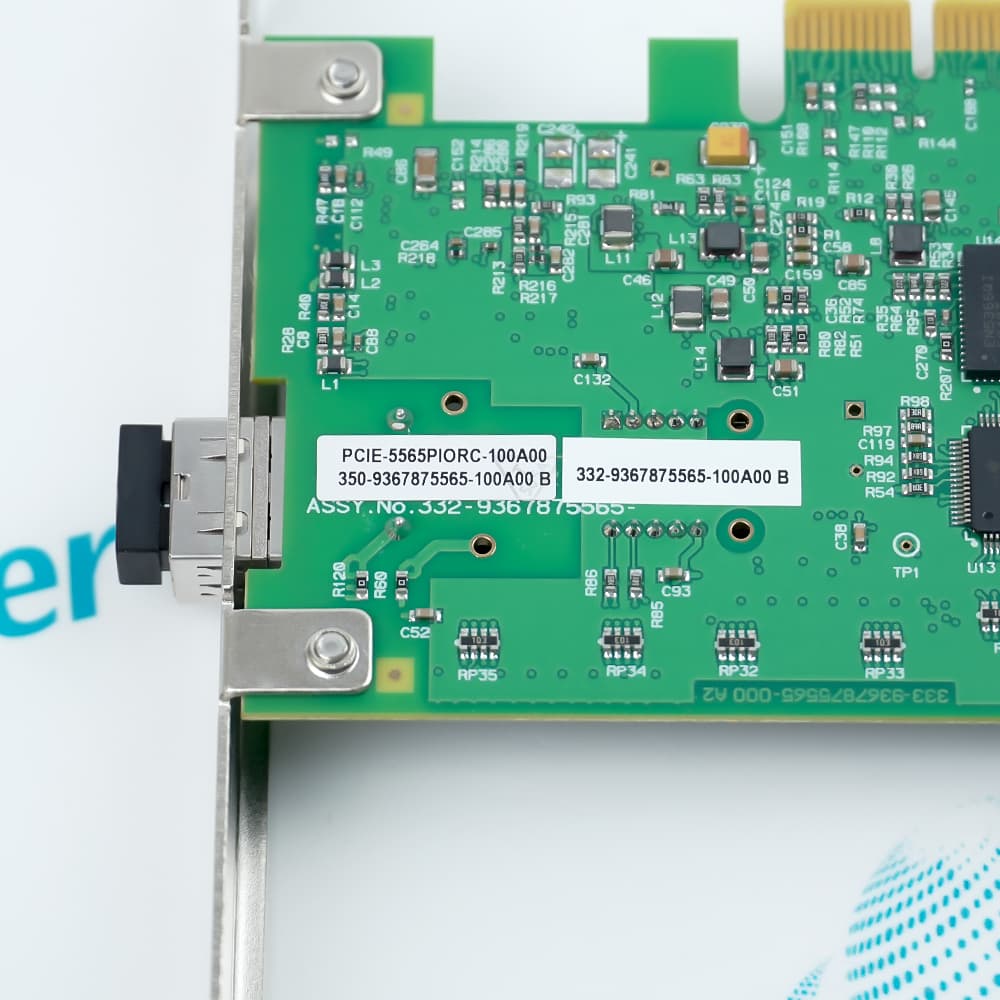
Features:
- Ultra-High-Speed Optical Connection for Distributed PCIe Node Systems
- Delivers 2.12 Gbaud Fiber Transmission alongside 128 MB Onboard SDRAM
- Works Independently of Host CPUs, Bus Structures, and Operating Systems
The GE PCIE-5565PIORC-100A00 Reflective Memory PCI Express Node Card serves as a high-performance communication interface within distributed processing systems, transferring real-time data across high-speed optical links. It operates at 2.12 Gbaud serial transmission speeds using multimode optical fiber and provides 128 MByte of onboard SDRAM for local data buffering. When a host system writes data to its local card memory, the GE PCIE-5565PIORC-100A00 automatically updates the memory buffers of all other nodes on the fiber network, ensuring continuous, low-latency synchronization without requiring CPU intervention or network protocol stacks.
The GE PCIE-5565PIORC-100A00 provides essential deterministic data sharing across the entire network and represents a critical component of real-time control architectures, directly impacting overall loop performance and system response times. Designed to fit low-profile or standard expansion slots, the card includes both short and tall bracket options to accommodate diverse PC chassis designs. It is widely deployed in demanding applications such as flight simulators, power plant simulators, engine test benches, aluminum rolling mills, automated testing systems, high-speed data acquisition, and PLC networks.
For large-scale processing applications, the GE PCIE-5565PIORC-100A00 supports network expansion up to 256 independent nodes. In addition to standard point-to-point or ring transfers, the Reflective Memory system maintains active error management and detection to protect against lost dataspace during high-speed broadcasts. Using this hardware-driven architecture, the system continually monitors transmission integrity across all nodes; if an error occurs or a data transfer fails, integrated detection logic helps maintain data consistency across the shared memory space.
The PCIE-5565PIORC-100A00 General Electric Reflective Memory PCI Express Node Card may still be available for purchase and support from Apter Power beyond End-Of-Life (EOL) by the manufacturer (OEM).
General Electric PCIE-5565PIORC-100A00 Reflective Memory PCI Express Node Card Manuals,Datasheets,Link
Important Notice: Other accessories, manuals, cables, calibration data, software, etc. are not included with this equipment unless listed in the above stock item description. All prices are shown in USD.
General Electric PCIE-5565PIORC-100A00 Reflective Memory PCI Express Node Card Specs
General
- Manufacturer General Electric
- Model PCIE-5565PIORC-100A00
- Condition New Original ready stock
- Product Family PCIE-5565PIORC-200A00,PCIE-5565PIORC
Important Notice: Other accessories, manuals, cables, calibration data, software, etc. are not included with this equipment unless listed in the above stock item description. All prices are shown in USD.
- Aerospace & Defense Simulation: Used in aircraft, ship, and submarine flight simulators where Hardware-in-the-Loop (HIL) testing requires deterministic replication of pilot inputs and environmental visual graphics across distributed computer systems.
- Industrial Process Control: Deployed in high-performance manufacturing environments, such as aluminum rolling mills and power plant simulators, to synchronize heavy machinery and safe shutdown protocols.
- High-Speed Data Acquisition (DAQ): Enables massive sensor arrays to stream data simultaneously into localized tracking hardware without dropping packets or introducing software latency.
- Automated Testing Systems: Facilitates immediate feedback loops during rigorous stress testing of automotive, marine, and aeronautic propulsion units on engine test stands.
- Hardware Compatibility: Features a low-profile x4 lane PCI Express form factor, making it compatible with standard PCIe slots in modern servers and industrial PCs.
- Testing Platform Integration: Fully compatible with automated real-time testing frameworks such as NI VeriStand and LabVIEW using standard NI-VISA driver palettes.
- Operating System Independence: Natively supports and bridges data communication across heterogeneous systems running Linux, VxWorks, and Windows. This allows multi-architecture setups (e.g., PCs, PLCs, and VME embedded controllers) to share a singular address space.
- Deterministic Synchronization: Transfers data at a 2.12 Gbaud serial connection speed, sustaining up to 170 MB/s network throughput with an ultra-low latency of only 450 to 500 nanoseconds between network nodes.
- Interrupt Generation: Any single node on the RFM network can trigger a direct hardware interrupt in another specific node—or globally across all 256 network nodes simultaneously—with a single execution command.
- Network Node Identification: Employs onboard mechanical switches to customize and establish a unique Node ID for individual system addressing during multi-node architecture assembly.
- Hardware Error Management: Incorporates a specialized Redundant Transfer Mode for error suppression and automated packet validation to guarantee data integrity across the fiber ring without data loss.
- FIFO Buffers: Built-in Transmit and Receive FIFO modules temporarily buffer peak data bursts to prevent bottlenecking on the host system bus, maximizing sustained throughput.