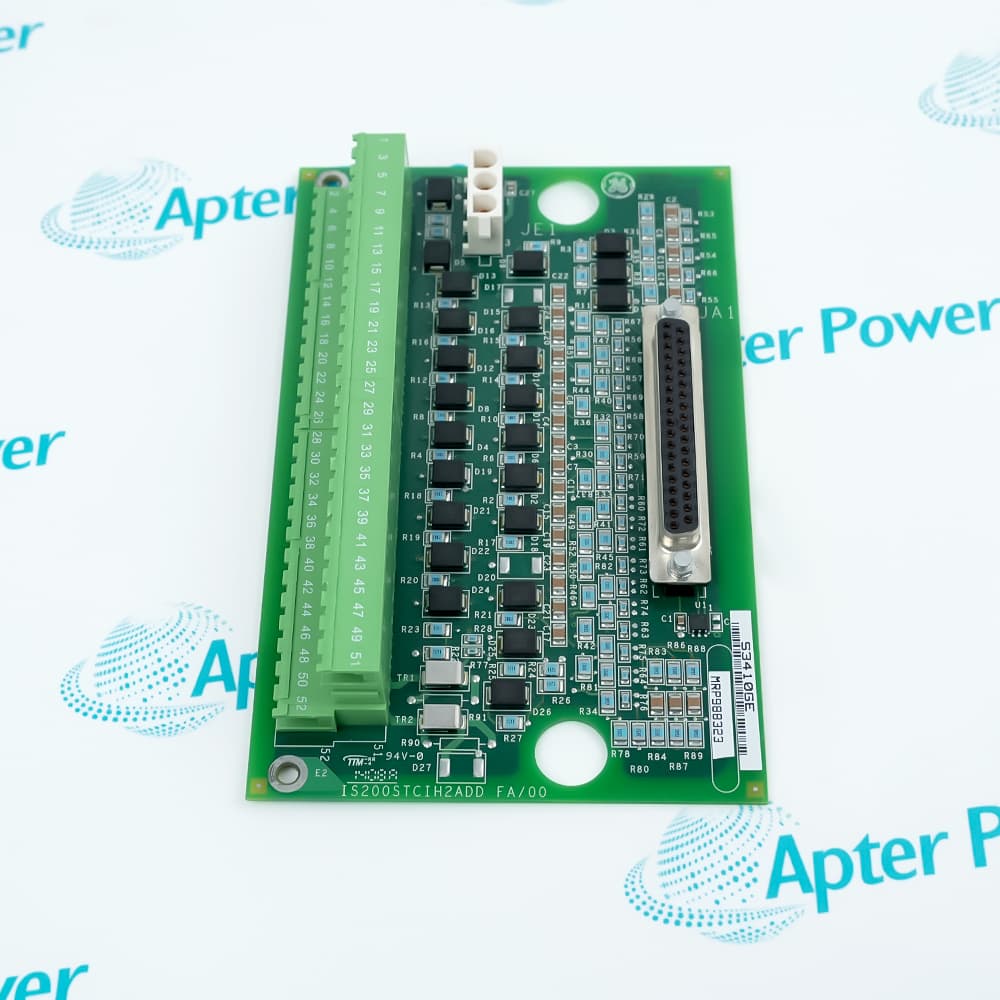
Features:
- Serves as a critical signal conditioning interface between the exciter controller and field devices in GE's Speedtronic turbine control architecture
- Built on a 6-layer fiberglass epoxy PCB with conformal coating for moisture, dust, and chemical resistance in harsh environments
- Handles analog inputs (4-20 mA, 0-10V) and digital I/O signals for generator excitation regulation and protection functions
The IS210AEBIH1BED is a dedicated Bridge Interface Board (BIB) engineered for GE's Mark VI and Mark VIe Speedtronic turbine control systems. Its primary function is to condition and route analog and digital signals between the exciter controller and field devices such as potential transformers (PTs), current transformers (CTs), and protection relays. This signal conditioning is essential for generator excitation regulation, which maintains stable voltage output and reactive power control. The board processes analog inputs including 4-20 mA process signals and 0-10V feedback from sensors, ensuring accurate monitoring of generator field current, terminal voltage, and power factor.
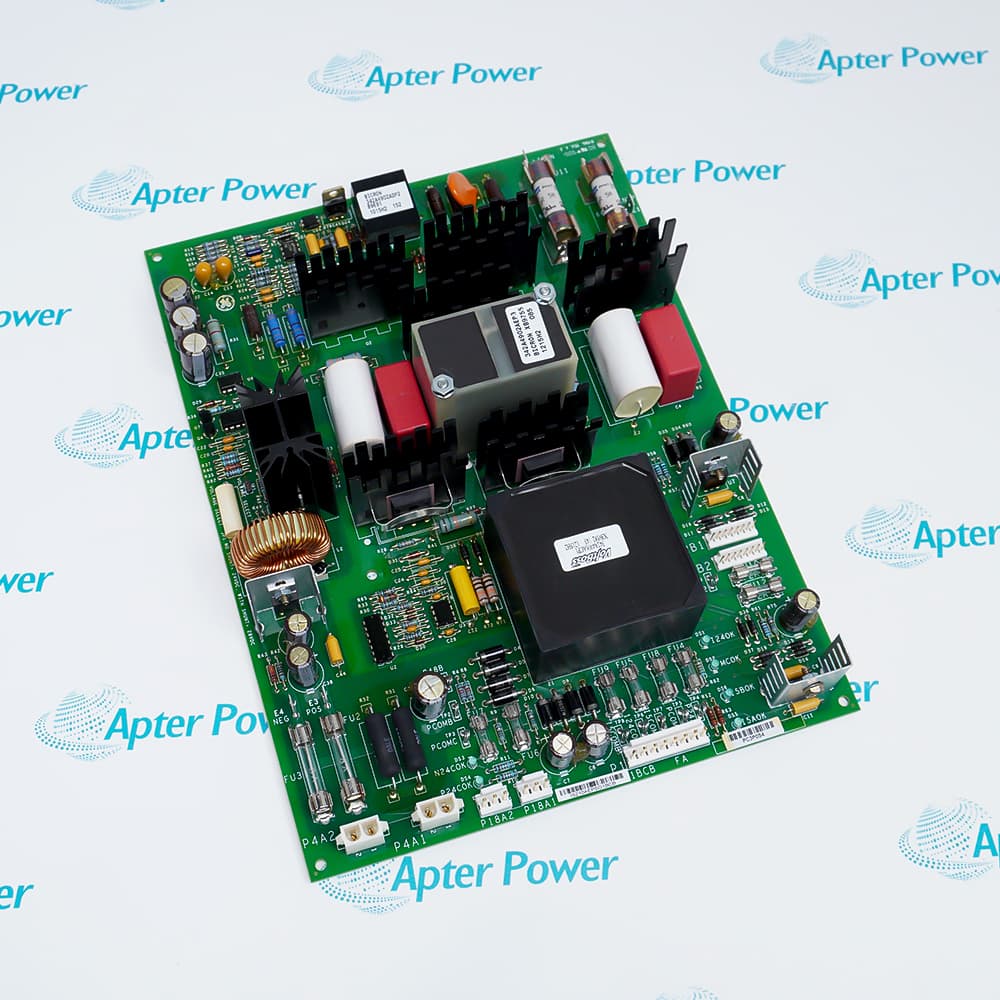
The IS210AEBIH1BED is built on a robust 6-layer fiberglass epoxy printed circuit board, which provides superior mechanical strength, reduced electromagnetic interference, and improved thermal management compared to standard 2-layer or 4-layer boards. The multi-layer construction allows for dedicated power and ground planes, reducing noise coupling between sensitive analog signal paths and digital logic circuits. The PCB includes a protective conformal coating that shields sensitive components from moisture, dust, salt spray, and chemical contaminants.
The IS210AEBIH1BED is specifically designed to handle both analog and digital I/O signals required for generator excitation control. Analog inputs include 4-20 mA signals from current transformers and 0-10V signals from potential transformers, used for monitoring generator terminal voltage, field current, and real/reactive power. The board also processes digital I/O for contact status (e.g., breaker position, protection relay trips) and control commands (e.g., raise/lower voltage setpoint). The conditioned signals are transmitted to the exciter controller, which calculates the required firing angle for the thyristor bridges.
The IS210AEBIH1BED GE Digital Input Module may still be available for purchase and support from Apter Power beyond
End-Of-Life (EOL) by the manufacturer (OEM).
GE IS210AEBIH1BED Digital Input Module Manuals,
Datasheets, Drivers, Link
Important Notice: Other accessories, manuals, cables, calibration data, software, etc. are not
included with this equipment unless listed in the above stock item description. All prices are
shown in USD.
GE IS210AEBIH1BED Digital Input Module Specs
General
- Manufacturer GE
- Model IS210AEBIH1BED
- Condition New Original ready stock
- Product Family
IS210AEAAH3BKE,IS210AEBIH3BED,IS210AEDBH4AGD,
Important Notice: Other accessories, manuals, cables, calibration data, software, etc. are not
included with this equipment unless listed in the above stock item description. All prices are
shown in USD.
- Wind Power Conversion Systems: Deployed inside utility-scale wind turbine nacelles to act as the communication and bridging interface between the main turbine control unit and the power inverter/converter bridge system.
- Thermal Power Generation: Leveraged in GE Speedtronic Mark VI/VIe frameworks to coordinate auxiliary subsystems for heavy-duty gas and steam turbines.
- Substation Grid Isolation: Interfaces with dry-contact field instrumentation—such as protective relays, circuit breakers, and sub-station disconnects—to manage discrete feedback loops.
- Operating Range: Wide-spectrum tolerance engineered to run stably from -40°C to +85°C (or -20°C to +50°C depending on frame/rack thermal limits).
- Storage Range: -40°C to +70°C.
- Isolation Voltage: Provides a robust galvanic barrier rated up to 1500 V RMS to protect low-voltage microprocessor circuits from industrial line surges and ground loops.
- Input Rating: Typically draws control power from a standard industrial 24 V DC backbone with ultra-low consumption (around 5W typical).
- High-Density Channel Monitoring: Provides multi-channel isolated input monitoring (handling up to 32 isolated dry-contact input channels in specific I/O rack variants) to track the status of E-stops, valve switches, and relay closures simultaneously.
- Multi-Protocol Communication Management: Embedded with high-speed serial networks, CAN, and 10BaseT Ethernet (IONet) interfaces. This allows the module to route raw input telemetry directly to the 32-bit RISC controller processors with minimal data latency.
- Bridge Diagnostics & Protection: Dynamically monitors internal variables such as power rail compliance, overcurrent spikes, and connection consistency. If a bridge network or sensor wire goes open-circuit, the onboard diagnostics flag a channel fault within the master configuration software (such as ToolboxST).