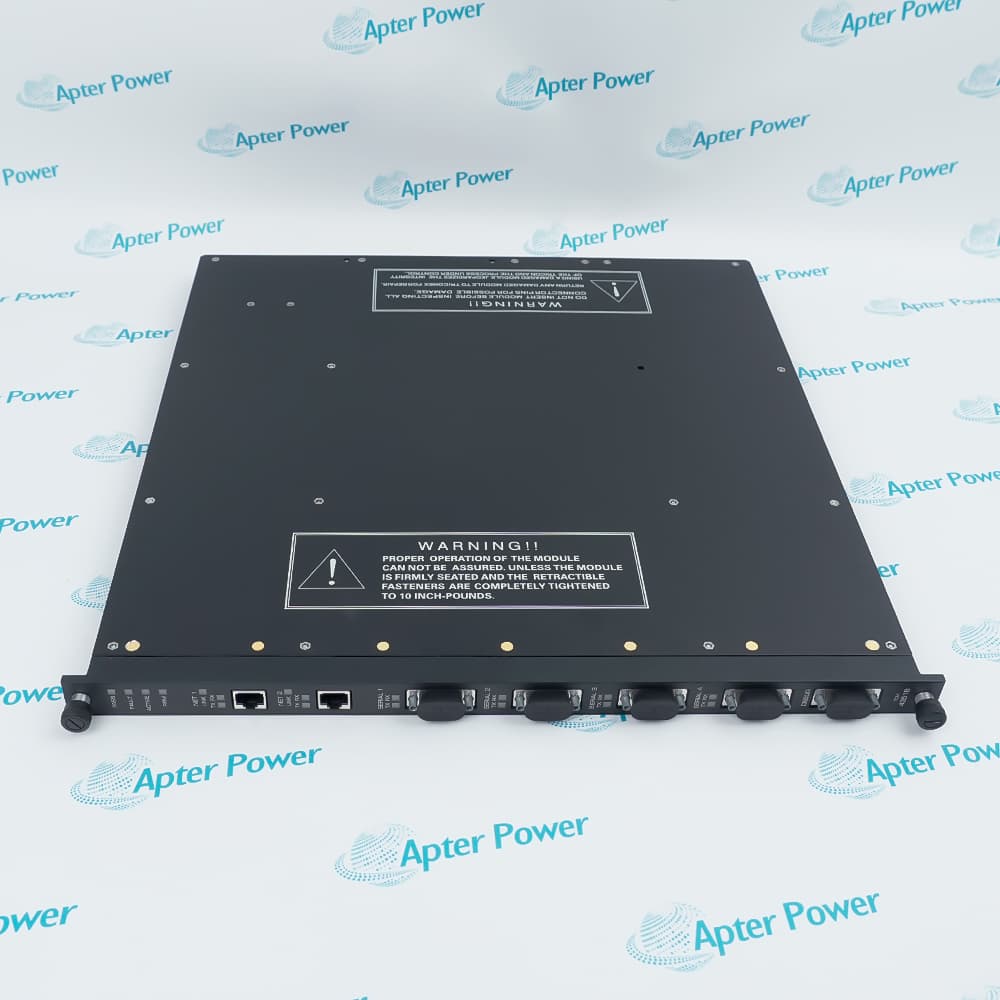
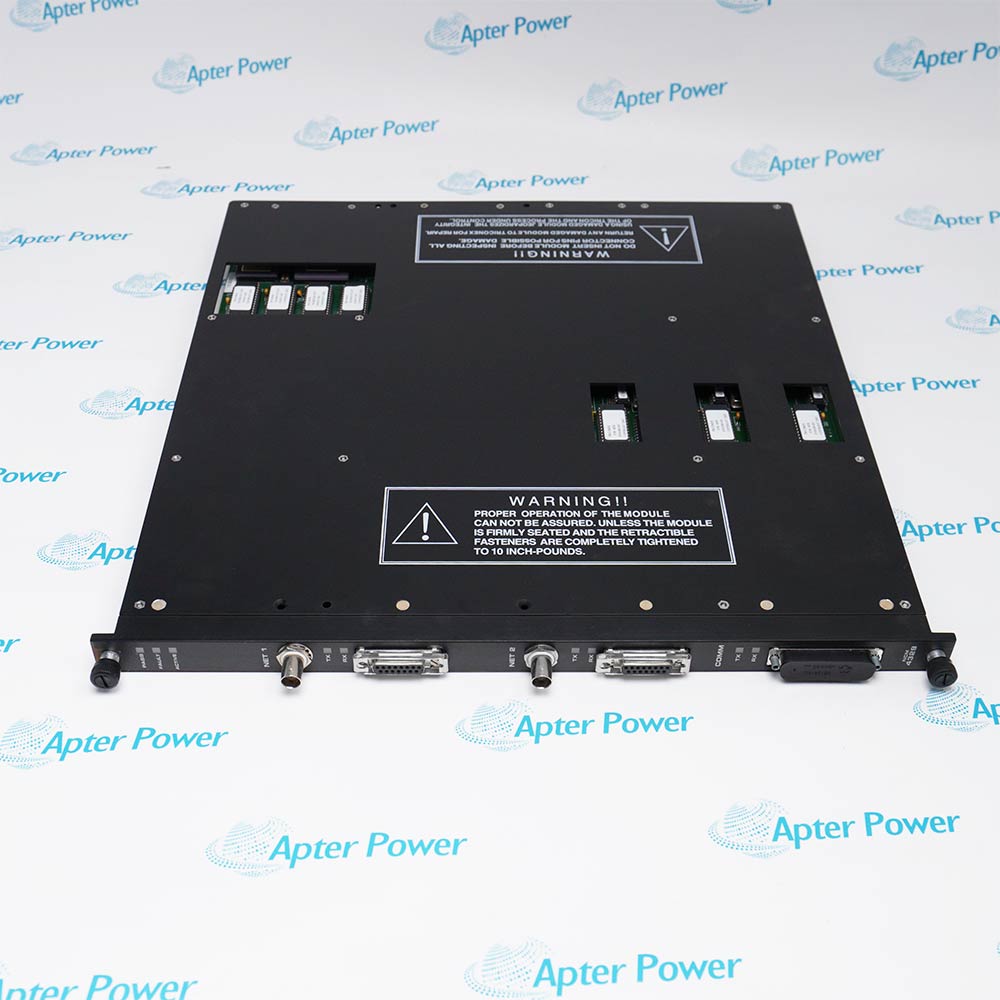
Features:
- True TMR Voting for Fail-Operational Continuity
- Advanced On-Demand Auto-Calibration
- Intelligent Fault Annunciation Without Module Shutdown
Each of the 32 channels on the Invensys Triconex 3706A contains three independent measurement circuits. The module hardware performs a mid-value select algorithm per scan, so even if one circuit fails, the output remains correct. The module continues normal operation with up to two faulty channels, eliminating single points of failure.
The Invensys Triconex 3706A uses internal precision voltage references to execute auto-calibration per channel. This compensates for ambient temperature drift and long-term component aging, ensuring thermocouple accuracy remains within ±5.0°F over the entire 0-60°C cold-junction range without manual intervention.
Unlike conventional I/O, the Invensys Triconex 3706A distinguishes between a channel fault and a module failure. The front-panel FAULT indicator activates for any diagnostic failure on any channel, but the module continues operating properly. The chassis alarm signal is triggered only when necessary, allowing maintenance to plan repairs without immediate process shutdown.
The 3706A Invensys Triconex TMR Thermocouple Input Module may still be available for purchase and support from Apter Power beyond End-Of-Life (EOL) by the manufacturer (OEM).
Invensys Triconex 3706A TMR Thermocouple Input Module Manuals,Datasheets,Link
Important Notice: Other accessories, manuals, cables, calibration data, software, etc. are not included with this equipment unless listed in the above stock item description. All prices are shown in USD.
Invensys Triconex 3706A TMR Thermocouple Input Module
General
- Manufacturer Invensys Triconex
- Model 3706A
- Condition New Original ready stock
- Product Family 3700A,3703E,3708E
Important Notice: Other accessories, manuals, cables, calibration data, software, etc. are not included with this equipment unless listed in the above stock item description. All prices are shown in USD.
- Upstream Oil & Gas – Wellhead ESD:The Invensys Triconex 3706A monitors wellhead flowline temperatures on critical gas lift and high-pressure oil wells. Its TMR voting ensures that a single thermocouple or input circuit failure does not trigger a false emergency shutdown, preserving production revenue while maintaining safety integrity.
- Refinery & Petrochemical – Catalytic Reformer Temperature Profiling:In reformer furnaces with multiple tube skin temperature points, the Invensys Triconex 3706A provides 32 differential inputs to detect hot spots. The 50 ms update rate enables rapid detection of exothermic events, allowing the safety system to initiate feed cut-off or depressurization before tube rupture occurs.
- Power Generation – Gas Turbine Exhaust Monitoring:The Invensys Triconex 3706A is deployed in combined-cycle plants to monitor turbine exhaust temperature spreads. Its -85 dB common mode rejection at 60 Hz rejects electrical noise from high-voltage ignition systems and generators, delivering stable temperature readings for turbine protection logic.
- LNG & Cryogenic Storage – Tank Temperature Monitoring:For LNG storage at -250°F (-157°C), the Invensys Triconex 3706A supports Type T thermocouples (copper-constantan) with specified accuracy down to -250°F. The cold-junction compensation range (32°F to 140°F) is maintained in the termination panel located in a warmer junction box, not inside the cryogenic tank.
- Ambient Temperature Range for Cold-Junction Compensation:The Invensys Triconex 3706A achieves rated accuracy only when the external termination panel (where the triplicated cold-junction transducers reside) is kept between 32°F and 140°F (0°C to 60°C). If the ETP exceeds these limits, thermocouple linearization errors increase beyond published tables.
- Electrical Noise Immunity:With common mode rejection of -85 dB minimum (0-60 Hz) and normal mode rejection of -17 dB at 60 Hz, the Invensys Triconex 3706A reliably operates in environments with nearby variable frequency drives, switchgear, and radio transmitters. The ±10 VDC maximum common mode range allows small ground potential differences between thermocouple junctions and the Tricon chassis.
- Storage & Transport Conditions:When not installed, the Invensys Triconex 3706A can be stored from -40°F to 158°F (-40°C to 70°C). However, powering the module outside the 32-140°F (0-60°C) operating ambient voids the cold-junction compensation accuracy specification.
- Physical & Mechanical Installation:The Invensys Triconex 3706A is mechanically keyed to prevent insertion into an incorrect Tricon chassis slot. Its tan color code differentiates it from isolated thermocouple modules (deep yellow for 3708E). The module occupies one slot in a Tricon backplane and requires no additional airflow clearance beyond standard chassis cooling.
- Thermocouple Type Selection via TriStation 1131:Using TriStation 1131, the engineer must assign each Invensys Triconex 3706A a single thermocouple type (J, K, or T). All 32 channels on the module share the same type – the 3706A does not support mixing types on different channels within the same module.
- Burnout Detection Configuration (Upscale/Downscale):For non-isolated modules like the Invensys Triconex 3706A, upscale or downscale burnout detection is determined by the field termination panel (ETP) selection, not by TriStation software. This must be documented at the wiring design stage because changing burnout direction requires hardware modification.
- Cold-Junction Compensation Handling:The Invensys Triconex 3706A automatically uses triplicated temperature transducers residing on the field termination panel. No user calibration of cold-junction compensation is required. However, if a cold-junction transducer fails, there is no CJ FAULT indicator on the 3706A front panel (unlike the isolated 3708E model).
- Hot-Spare Behavior During Module Insertion:When inserting a spare Invensys Triconex 3706A into an online chassis, all inputs are frozen for one second. This prevents the new module from sending invalid data during its power-up self-test. System logic should account for this 1-second freeze if time-critical interlock conditions are monitored on this module.