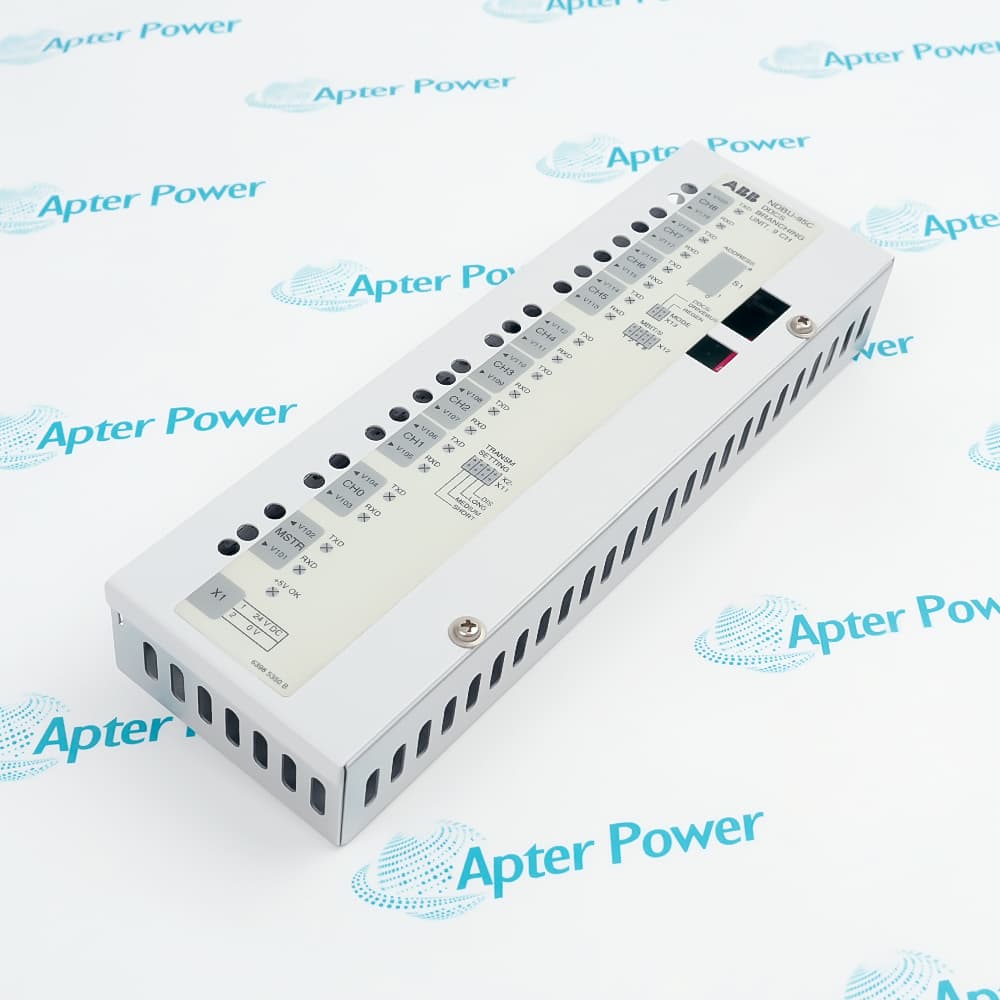
Features:
- Provides nine fiber optic channels for distributing DDCS communication across drive system connections.
- Supports a 10 Mbps data rate for communication applications involving ACS800 and DCS800 systems.
- Uses configurable addressing through DIP switch S1 to organize multiple branching units within a defined hierarchy.
ABB NDBU-95C 64008366D serves as a communication distribution component within DDCS-based drive installations. By creating multiple fiber optic communication branches from a central point, the branching unit helps organize connections between equipment in larger drive configurations. Fiber optic communication is particularly useful where drive components need to exchange data through dedicated optical links. The nine-channel arrangement makes the unit suitable for systems requiring several communication paths from one branching location.
System topology is an important consideration when integrating ABB NDBU-95C 64008366D into an existing drive network. Each branching unit occupies a defined position in the communication hierarchy, allowing installations with multiple units to maintain an organized structure. Address selection through DIP switch S1 provides a hardware-based method for establishing the required order. The branching unit located closest to the PC receives the highest address, while other units are arranged according to their positions in the hierarchy. Proper configuration therefore forms an important part of system commissioning and network organization.
In ACS800 and DCS800 applications, ABB NDBU-95C 64008366D can provide a practical way to expand and structure DDCS communication connections. The unit is useful when several drive-related devices need to participate in a fiber optic communication arrangement without relying on a single direct connection path. Its role centers on communication branching rather than drive control or power conversion, making correct network placement important during installation. With an operating range of 0°C to +55°C, storage capability from -40°C to +70°C, and 5% to 95% non-condensing relative humidity, the branching unit can be integrated into industrial control environments within the specified conditions.
The NDBU-95C 64008366D ABB DDCS Branching Unit may still be available for purchase and support from Apter Power beyond End-Of-Life (EOL) by the manufacturer (OEM).
ABB NDBU-95C 64008366D DDCS Branching Unit Manuals,Datasheets,Link
Important Notice: Other accessories, manuals, cables, calibration data, software, etc. are not included with this equipment unless listed in the above stock item description. All prices are shown in USD.
ABB NDBU-95C 64008366D DDCS Branching Unit Specs
General
- Manufacturer ABB
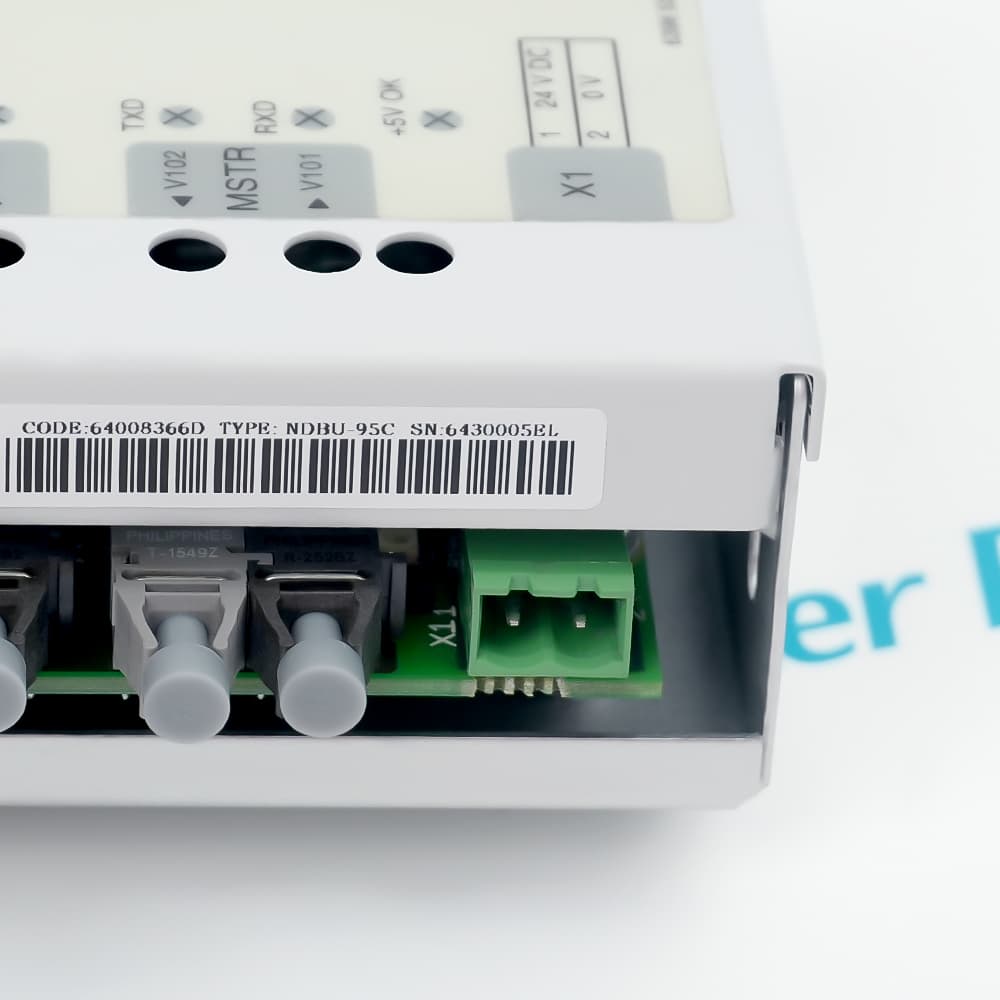
- Model NDBU-95C 64008366D
- Condition New Original ready stock
- Product Family NDBU-85,NDBU-85C,NDBU-95
Important Notice: Other accessories, manuals, cables, calibration data, software, etc. are not included with this equipment unless listed in the above stock item description. All prices are shown in USD.
- Multi-Inverter Group Control: Primarily used in the synchronous control of the inverter power panel by the main control unit in large multi-drive industrial frequency converter arrays such as ABB ACS800 and ACS600.
- Industrial Network Branch: Serving as a fiber optic repeater station between the DCS drive-level control layer and the field drive chain in large-scale distributed automated production lines in metallurgy, papermaking, and other industries.
- High-voltage, high-noise isolation: Deployed in high-voltage substation control cabinets or medium-voltage, high-power rectifier workshops, it achieves insulation between the control end and the high-voltage, high-noise interference end through optical communication.
- Drive system spare parts modification: As an original equipment manufacturer (OEM) spare part for mainstream industrial field operating systems, it is used to replace old or optical flux-attenuated data splitter cards of the same model.
- Communication Bus Allocation: Receives one DDCS communication protocol signal from the main control board and splits it into equal signals through an internal star topology network.
- Fiber Channel Expansion: Provides up to 9 independent fiber optic serial channel interfaces, enabling parallel high-speed data connections from a single master station to multiple slave stations.
- Media Physical Compatibility: Fully supports both Plastic Fiber (POF) and High-Strength Glass Fiber (HCS), using dedicated miniature fiber optic connectors for mating.
- Master-Slave Topology Adaptation: Features a proprietary optoelectronic data isolation and signal regeneration forwarding mechanism to ensure zero packet loss in long-distance, high-bandwidth optical communication links.
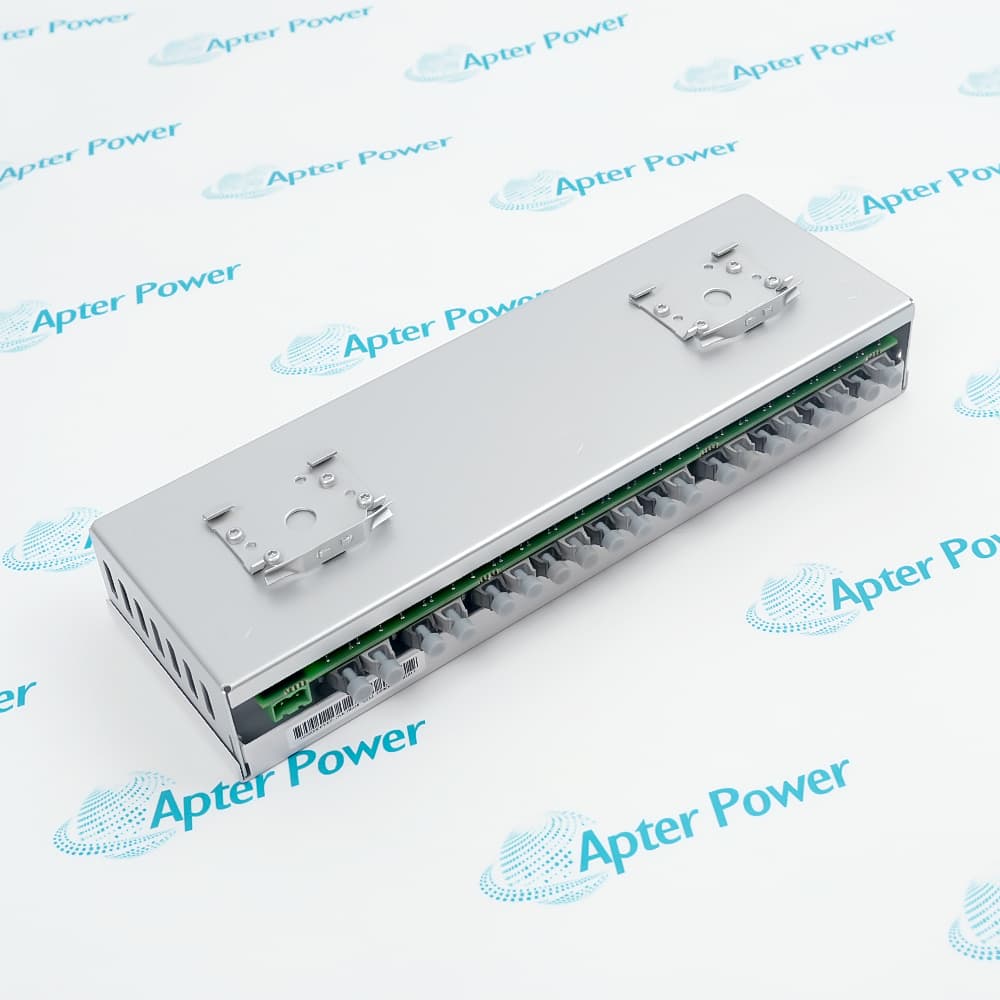
- Structural Positioning Specifications: Employs a compact physical frame design with a standard 35mm DIN rail slot integrated on the back for one-click rail clamping.
- Spatial Heat Dissipation Allowance: At least 50 mm of air convection clearance must be reserved around the module to prevent heat accumulation in the high-density fiber optic components within the sealed control cabinet.
- Wiring Stress Relief: The bending radius of the fiber optic patch cord must be strictly greater than 35 mm after connection to prevent physical damage to the internal fiber core, which could lead to excessive optical attenuation.
- Grounding Safety Shielding: The outer casing and fixed end plate have a built-in metal grounding busbar, which must be securely connected to the factory's main PE system to eliminate high-frequency noise.