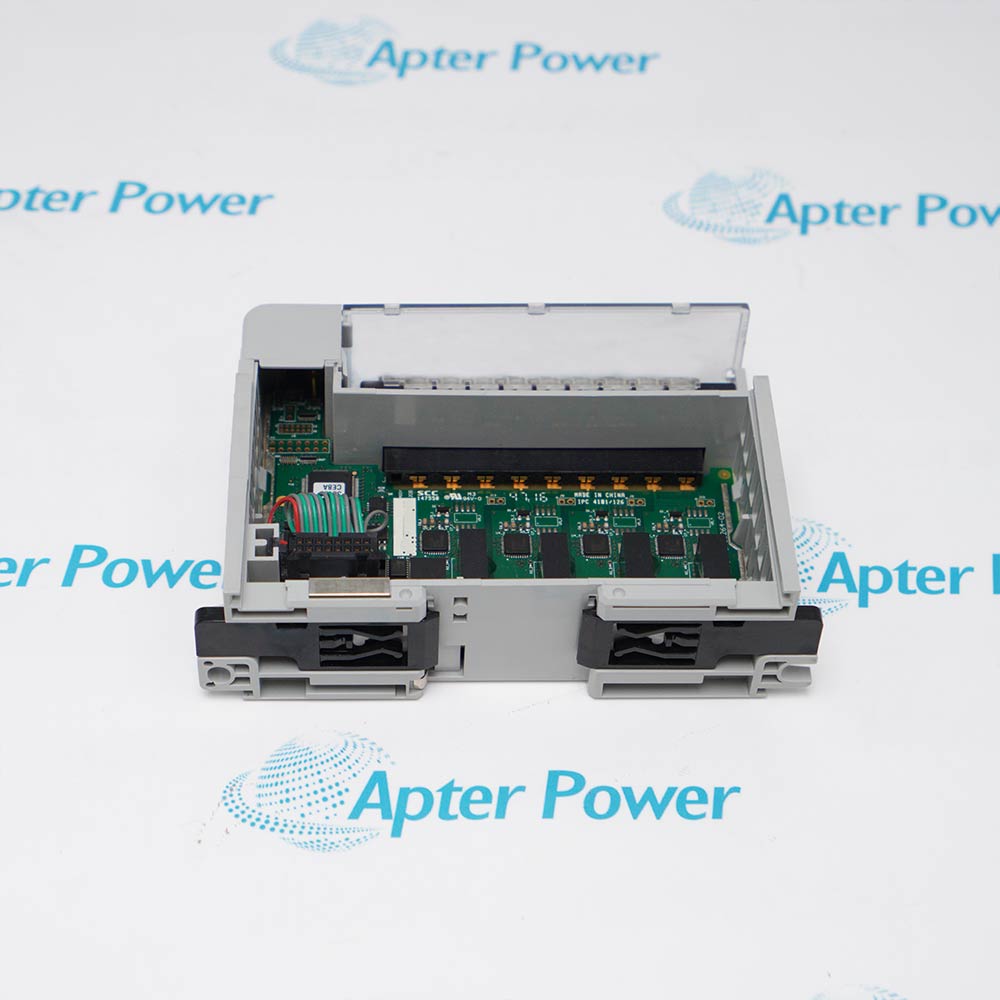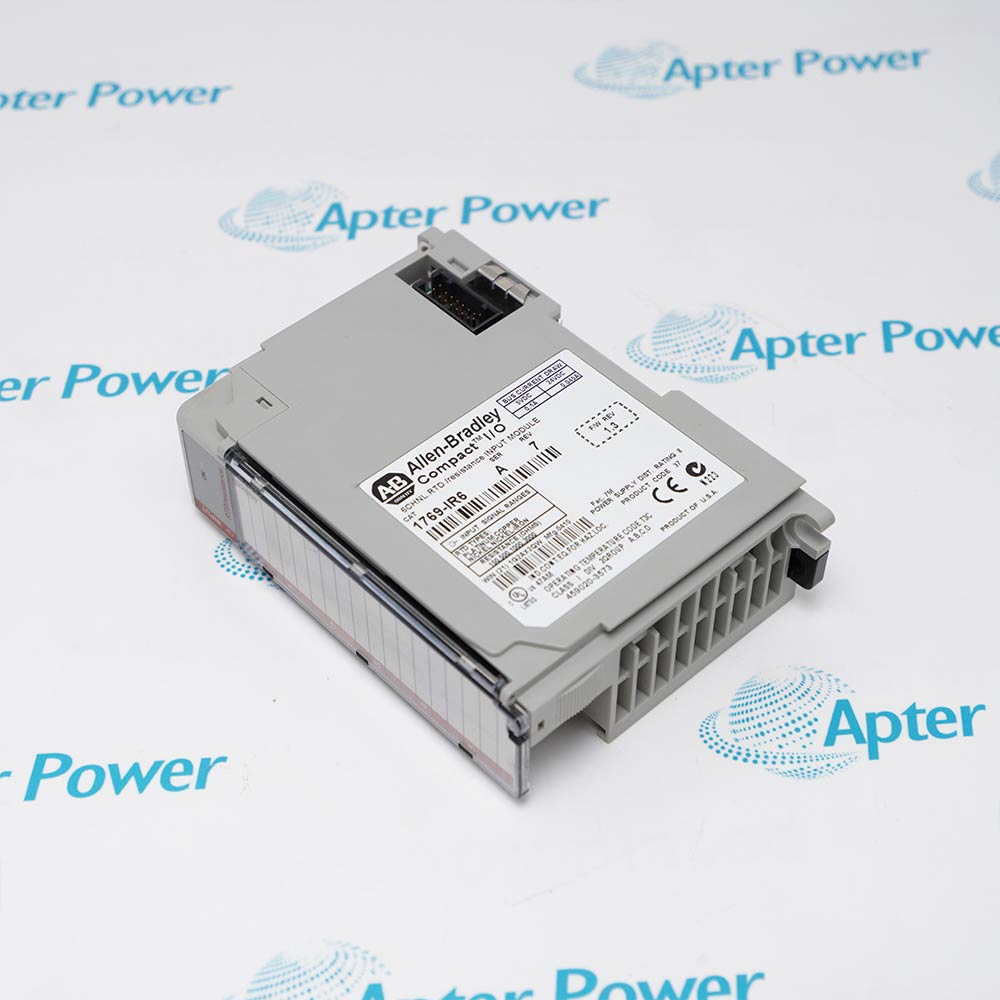
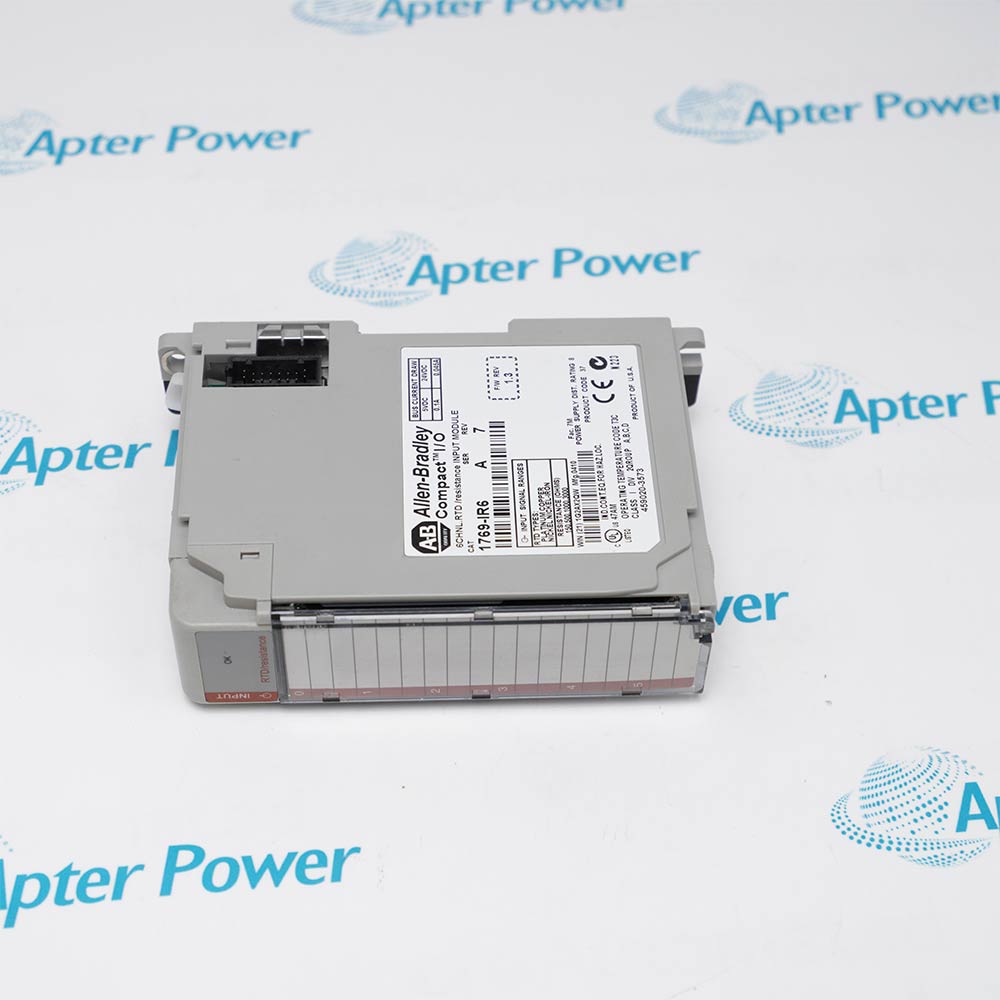
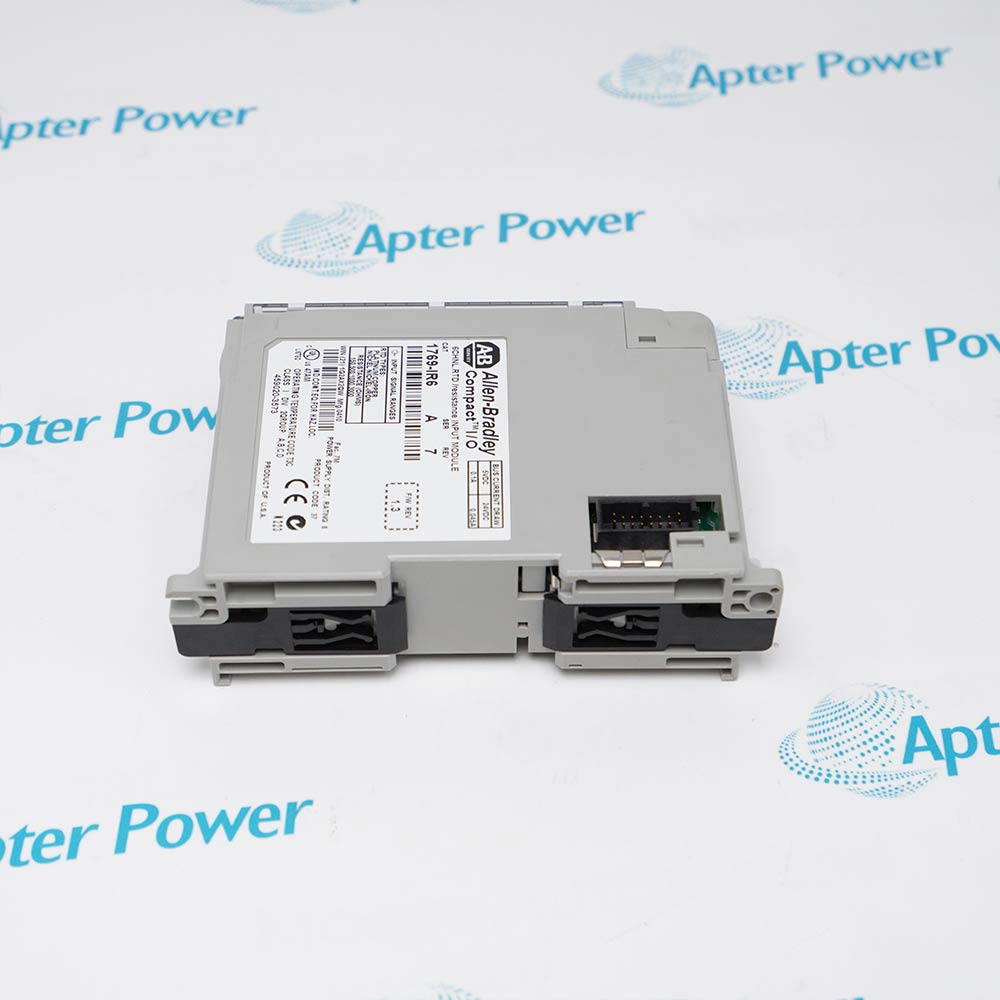
Allen-Bradley 1769-IR6
Ask our team:
  • Phone: +86 181 0690 9650
  • E-Mail sales1@apterpower.com
  • Lifecycle status

    Active Mature

1769-IR6

/ 4.9
1001 reviews | Need a Specific Revision?
Allen-Bradley 1769-IR6 brings supported RTD and resistance sensors into a Compact I/O system, allowing each channel to use its own measurement and broken-input response configuration.
In Stock
Ships by Thursday, October 29
Fast Shipping Available
Get a quick price for 1769-IR6
Quantity
*E-mail
Company
*Mobile
*Content
Upload (gif, jpg, jpeg, png, bmp, doc, docx, xls, xlsx, ppt, pdf, csv)

Technical specifications for 1769-IR6

  • Manufacturer:
    Allen-Bradley
  • Part Number:
    1769-IR6
  • Product Family:
    CompactLogix
  • Product Type:
    6-Channel RTD/Resistance Input Module
  • Stock:
    1
  • Input Channels:
    6 RTD/resistance inputs
  • Resistance Input Ranges:
    0…150 Ω, 0…500 Ω, 0…1000 Ω, and 0…3000 Ω
  • RTD Types:
    Platinum 385, Platinum 3916, Nickel 618, Nickel 672, Copper 426, and Nickel-Iron 518
  • Sensor Wiring:
    2-wire or 3-wire; 4-wire sensors are supported with the fourth sense wire unused
  • Excitation Current:
    0.5 mA or 1.0 mA
  • Selectable Filters:
    10, 50, 60, 250, 500, and 1000 Hz
  • Data Formats:
    Raw/proportional, engineering units ×1, engineering units ×10, scaled-for-PID, and percent range
  • Backplane Current:
    100 mA at 5 V DC and 45 mA at 24 V DC
  • Input Image:
    8 words
  • Configuration File:
    7 words
  • Power Supply Distance Rating:
    8 modules
  • Dimensions:
    3.5 × 8.7 × 11.8 cm
  • Weight:
    0.276 kg
  • Tariff Code:
    8538900000
  • Country of origin:
    USA
  • Place of shipment:
    Xiamen,Fujian,China
By purchasing this item, you agree to the Terms & Conditions, ApterPower is not an authorized distributor for listed manufacturers or tradenames and therefore the manufacturer's warranty does not apply. All our products come with ApterPower's 1-year warranty.

More Information

Overview Manuals Sensor Configuration Wiring Practice Diagnostics Application
  • Two-wire RTD circuits require a jumper between the channel excitation and sense terminals
  • Three-wire RTDs use separate excitation, sense, and return conductors
  • Four-wire RTDs connect as a three-wire circuit, with the second sense lead left open

1769-IR6 supports two-wire, three-wire, and four-wire RTD connections, but each sensor type requires the terminal arrangement documented for the selected channel.

For a two-wire RTD, install the required jumper between EXC and SENSE; for three-wire operation, connect EXC, SENSE, and RTN separately; a four-wire RTD is wired as a three-wire device.

Use the specified shielded cable, terminate the shield as shown in the official wiring diagrams, and keep sensor conductors separated from electrical-noise sources before validating channel readings.

Availability, condition, price, and shipping time for 1769-IR6 are confirmed during quotation.

Allen-Bradley 1769-IR6 6-Channel RTD/Resistance Input Module Manuals, Datasheets, Links

Important Notice: Other accessories, manuals, cables, calibration data, software, etc. are not included with this equipment unless listed in the above stock item description. All prices are shown in USD.

  • Each of the six channels is configured independently for RTD or resistance measurement
  • Excitation current, filter, data format, units, and broken-input response are channel selections
  • Disabled channels are not scanned, reducing the update burden on active channels
  • Two- and three-wire RTDs connect directly; a four-wire RTD uses three conductors
  • Shielded twisted-pair cable and short grounding connections reduce electrical noise
  • Lead-wire resistance should be low and closely matched for accurate compensated measurements
  • Channel status identifies open-circuit conditions
  • Over-range and under-range flags are available for each input
  • Configuration and hardware errors are reported through module status data
  • Six-channel RTD temperature measurement
  • Direct resistance and potentiometer measurement
  • Remote RTD/resistance acquisition through a 1769-ADN DeviceNet station
Description
1769-IR6 is a six-channel Compact I/O module for RTD temperature measurement and direct resistance input applications.

Each channel is individually configurable for supported RTD or resistance devices, excitation current, filter, engineering-unit format, and broken-input response, with open-, short-, over-, and under-range diagnostics.

Before installation or replacement, confirm controller support, Series A hardware, sensor type, two- or three-wire circuit, shielded cable, lead resistance, excitation current, channel configuration, and saved project data.
Revisions

Revision Part #

Also known as

1769-IR6 Ser A
1769-IR6/A, Series A, Rev A
Alternative Names
1769-IR6 1769 IR6 1769IR6 Allen-Bradley 1769-IR6 Allen Bradley 1769-IR6 Rockwell Automation 1769-IR6 CompactLogix 1769-IR6
Technical notes
1769-IR6 accepts RTD or resistance sensors only after each channel is configured for the actual element, wiring method, excitation current, and filter; incorrect lead compensation or units can produce believable but wrong temperatures.
Exceptional Service

Our Mission

  • 100% Satisfaction

    We believe expertise is priceless. With over 20 years of experience, and top engineers on staff, we can help you solve or avoid problems that threaten your business.
  • Trust Guaranteed

    Not only do we have a vast inventory, our team makes sure every piece of equipment is in working condition. Your purchases are also backed by our Warranty.
  • Expertise

    Time is money, especially when your equipment is down. We work quickly to get your equipment on its way so you can get it back up and running.

FAQS

The following is a list of questions commonly asked by our customers. Please contact us if you have a question about our process that is not answered below.
Can 1769-IR6 accept both RTD and direct resistance devices?
Yes. Each of the six channels can be configured independently for a supported RTD or direct resistance input, so mixed supported sensor types can be used in one module.
How should a 4-wire RTD be connected to 1769-IR6?
Rockwell documents that 1769-IR6 treats a 4-wire RTD as a 3-wire sensor; one of the two sense wires is left open while the remaining three conductors provide excitation, sense, and return.
What must be copied before replacing 1769-IR6?
Record each channel’s enable state, sensor type, data format, temperature units, open-circuit response, lead compensation, excitation current, filter setting, and slot position before replacement.
Which cable practice is important for 1769-IR6 accuracy?
Use the documented shielded twisted-pair cable, keep the ground connection short, route it away from motors and AC wiring, and keep lead impedance low and balanced.
Can 1769-IR6 report a broken sensor circuit?
Yes. The module provides open-circuit, short-circuit, over-range, and under-range status information, and the configured broken-input response can be upscale, downscale, last state, or zero.
Can 1769-IR6 be used behind a 1769-ADN DeviceNet adapter?
Yes. The official manual documents remote DeviceNet configuration through 1769-ADN, but module order, power supply, end cap, input size, electronic keying, and channel configuration must be correct.
Why can a new 1769-IR6 produce different readings from the removed module?
Differences usually require checking sensor wiring, lead resistance, excitation current, filter frequency, data format, temperature units, calibration state, and the downloaded channel configuration.

Product Browsing History