Ask our team:
  • Phone: +86 181 0690 9650
  • E-Mail sales1@apterpower.com
  • Lifecycle status

    Active / Available from OEM
    Apter Power coordinates series evidence, ESM checks, official literature, quotation, and dispatch verification.

1756-L74

/ 4.9
1001 reviews | Need a Specific Revision?
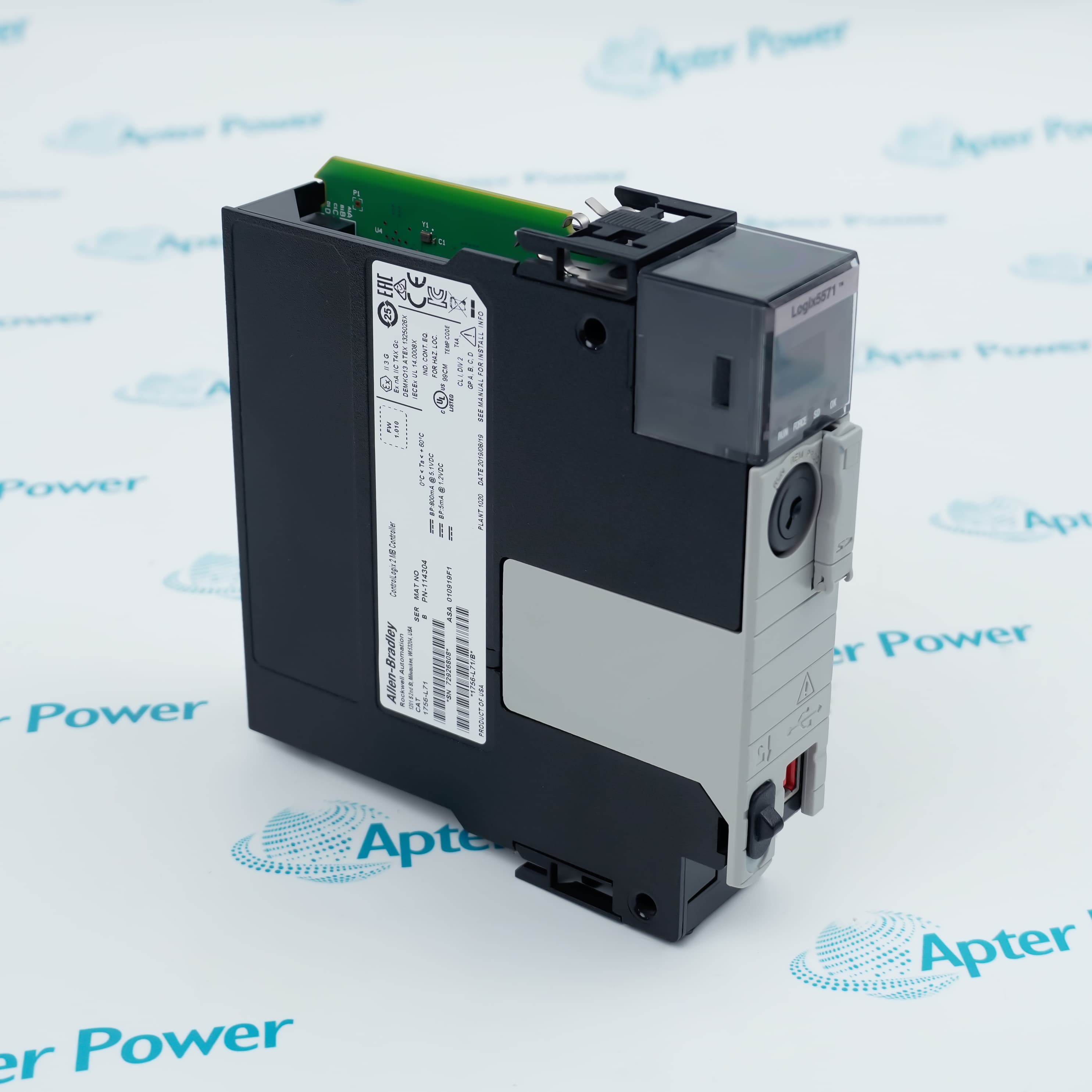
Sized for substantial installed-base projects, Allen-Bradley 1756-L74 brings 16 MB ControlLogix 5570 execution to modular-network and high-availability architectures.
In Stock
Ships by Wednesday, October 28
Fast Shipping Available
Get a quick price for 1756-L74
Quantity
*E-mail
Company
*Mobile
*Content
Upload (gif, jpg, jpeg, png, bmp, doc, docx, xls, xlsx, ppt, pdf, csv)

Technical specifications for 1756-L74

  • Manufacturer:
    Allen-Bradley
  • Part Number:
    1756-L74
  • Product Family:
    ControlLogix
  • Product Type:
    ControlLogix 5570 Controller
  • Stock:
    1
  • Product Series:
    ControlLogix 5570
  • User Memory:
    16 MB
  • I/O Memory:
    0.98 MB
  • Embedded Network Port:
    None
  • Local Programming Port:
    1 x USB 2.0
  • Controller Connections:
    500
  • Energy Storage Module:
    1756-ESMCAP supplied installed
  • Maximum Digital I/O:
    128,000 points
  • Maximum Analog I/O:
    4,000 points
  • Power Dissipation:
    2.5 W
  • Operating Temperature:
    0 to 60 °C
  • Weight:
    0.25 kg
  • Estimated shipping dimensions:
    3.46x14.52x14.29cm
  • Tariff Code:
    8537101190
  • Country of origin:
    USA
  • Place of shipment:
    Xiamen,Fujian,China
By purchasing this item, you agree to the Terms & Conditions, ApterPower is not an authorized distributor for listed manufacturers or tradenames and therefore the manufacturer's warranty does not apply. All our products come with ApterPower's 1-year warranty.

More Information

Overview Manuals Project Scale Network Modules Redundancy Product Applications

Features:

  • Project tier: 16 MB supports substantially larger 5570 applications than the 8 MB catalog
  • Communication model: external networks are supplied by modules selected for the chassis
  • Availability role: the controller is listed for supported ControlLogix redundancy architectures
1756-L74 serves established ControlLogix 5570 installations that need more application room while retaining modular communication design.

1756-L74 can coordinate multiple protocol and I/O paths, but each external route belongs to a specific communication module and connection budget.

1756-L74 acceptance should join compiled project evidence with the controller series, firmware, ESM, redundancy intent, and complete chassis inventory.

Apter Power can coordinate series checks, ESM review, official documentation, and quotation support for 1756-L74.
Allen-Bradley 1756-L74 ControlLogix 5570 Controller Manuals, Datasheets, Links Important Notice: Other accessories, manuals, cables, calibration data, software, etc. are not included with this equipment unless listed in the above stock item description. All prices are shown in USD.
  • Task framework: 32 tasks separate continuous, periodic, and event-driven execution
  • Program scaling: version 24 or later supports as many as 1,000 programs per task
  • I/O allocation: 0.98 MB of dedicated I/O memory is assessed separately from user memory
  • No embedded plant port: the operational protocol comes from the selected 1756 communication module
  • Controller budget: 500 controller connections are shared across the complete architecture
  • Service boundary: USB is reserved for temporary local programming rather than production traffic
  • Controller support: full redundancy is listed for the ControlLogix 5570 controller family
  • Paired architecture: controller firmware, chassis modules, and redundancy hardware must match the qualified design
  • Network path: separate communication modules carry the external traffic for each partner chassis
  • Large installed-base projects: ControlLogix 5570 applications that need a 16 MB controller tier
  • Multi-network control: chassis systems combining qualified industrial communication modules
  • High availability: redundant automation built from matched controller, redundancy, and network hardware
Description
With 16 MB of user memory and a separate 0.98 MB I/O allocation, Allen-Bradley 1756-L74 supports sizeable ControlLogix 5570 applications in one chassis slot. The controller uses USB for local service and relies on selected 1756 communication modules for EtherNet/IP or other operational networks.

Project structure on 1756-L74 scales to 32 tasks and, with Logix Designer version 24 or later, as many as 1,000 programs per task. Its 500 controller connections are an architecture-wide resource that must be evaluated with the chosen network modules, produced and consumed data, and update schedule.

Energy storage and availability are separate selection decisions for 1756-L74. The installed ESM governs retention and shutdown behavior, while redundant control requires matched chassis, redundancy, and communication hardware; both choices should be recorded with firmware and recovery evidence.
Revisions

Revision Part #

Also known as

1756-L74 Series A
1756-L74/A, Series A
1756-L74 Series B
1756-L74/B, Series B
Alternative Names
Allen-Bradley ControlLogix 5570 L74 Rockwell Automation 1756 L74 CPU ControlLogix 5570 16 MB Controller
Technical notes
Do not specify 1756-ESMNSE for 1756-L74: Rockwell Automation limits that no-residual-energy module to 1756-L73 or smaller memory catalogs. Record the installed 1756-ESMCAP or other supported ESM, wait for the documented OK-indicator sequence before removal, and preserve the firmware and recovery procedure with the replacement record.
Exceptional Service

Our Mission

  • 100% Satisfaction

    We believe expertise is priceless. With over 20 years of experience, and top engineers on staff, we can help you solve or avoid problems that threaten your business.
  • Trust Guaranteed

    Not only do we have a vast inventory, our team makes sure every piece of equipment is in working condition. Your purchases are also backed by our Warranty.
  • Expertise

    Time is money, especially when your equipment is down. We work quickly to get your equipment on its way so you can get it back up and running.

FAQS

The following is a list of questions commonly asked by our customers. Please contact us if you have a question about our process that is not answered below.
Why might 1756-L74 fail to resume as expected after an ESM replacement?
Verify the installed ESM is supported, confirm its retention behavior, inspect controller status, and compare the shutdown and recovery procedure with the approved maintenance record.
What should be checked when a new network module is added beside 1756-L74?
Confirm module and firmware compatibility, chassis power, slot assignment, protocol configuration, connection use, update rates, and the revised project before commissioning the added path.
Why can a converted 1756-L74 project use a different program-per-task limit?
The allowance changes with the Logix Designer generation. Verify the target release, compile the converted project, resolve messages, and test task scheduling before accepting the new organization.
How should a redundancy mismatch be diagnosed around 1756-L74?
Compare controller and redundancy firmware, chassis and module identity, project synchronization state, communication paths, and redundancy diagnostics on both partners before replacing hardware.
What can consume the controller connection budget of 1756-L74 unexpectedly?
Review I/O modules, produced and consumed tags, connected messages, HMI paths, programming terminals, and communication-module limits; remove abandoned connections before changing update demand.
Which recovery records should accompany a stored 1756-L74 spare?
Keep the catalog and series record, approved firmware, project image, SD-card identity, ESM catalog, chassis map, network configuration, and controlled load procedure together.