ABB Bailey DCS in Real Plants: Architecture, PLC Roles, Maintenance, Integration
About the author
Written by Jim, Engineering Director of Apter power
Jim has over 10 years of experience and can quickly grasp customer needs, provide feedback and solutions immediately, and efficiently help customers solve all problems. He is a trustworthy business manager.
Continuous plants are judged by stability and repeatability. When a unit rides through disturbances, maintenance work, shift handovers, and aging instruments, it is usually because the control layer stays consistent under stress. ABB Bailey systems became common in exactly that environment, and many sites still run them today alongside PLC skids and newer data platforms. The sections that follow explain what a DCS is built to do, how INFI 90 style architecture supports continuous operation, and how to maintain and integrate a legacy installation with minimal operational risk.
What Makes ABB Bailey DCS Different
A distributed control system is designed to keep a process stable and recoverable through long operating campaigns. In process industries, the hardest problems are coordination, disturbance handling, and safe operation across interacting units. That is why the ABB Bailey DCS application in process industries tends to show up where continuity and tested recovery are treated as production requirements.
Three traits explain why a Bailey-style DCS fits continuous operations and why it often stays in service.
1. Consistent operations experience: Shift teams rely on predictable graphics, alarm philosophy, faceplates, and event context. A DCS structure supports consistency across a wide area, which reduces hesitation during abnormal situations.
2. Large-scale coordination by design: Continuous units run hundreds or thousands of interacting loops. The platform is built to coordinate those interactions as a system, instead of treating control as isolated blocks.
3. Redundancy placed where it protects production: The highest risk is losing a controller path, a network interface, or a shared resource that affects an entire area. Redundancy is designed around those failure modes, so recovery is controlled rather than improvised.
A DCS becomes a strong choice when the plant has interacting unit operations, long campaigns with costly downtime, and a control room culture that depends on consistent alarm handling. If the site is dominated by packaged machines and discrete sequencing, PLC-centric control can fit better, with the DCS acting as the coordinating layer.
How ABB Bailey INFI 90 Architecture Handles Complex Processes
Engineers discussing the ABB Bailey DCS system architecture are usually describing a layered design that keeps control execution close to the process while still supporting plant-wide coordination. INFI 90 and related generations use different module names across eras, yet the roles stay consistent. Knowing those roles prevents many modernization errors, particularly during network work, controller upgrades, and I/O refits.
Control Execution Layer
Control logic runs in controller modules designed for deterministic behavior. In continuous units, determinism shows up as repeatable loop response, predictable mode handling, and consistent behavior during partial failures. Local autonomy matters because a controller should keep loops stable even if a workstation goes down or a server layer is degraded.
I/O Layer
I/O quality is judged by diagnostics, failure containment, and the ability to maintain without destabilizing the unit. Many “random” issues trace back to aging terminations, cabinet conditions, marginal power quality, and intermittent field wiring, rather than logic problems. INFI 90 style I/O designs support clear fault isolation and structured replacement practices when the maintenance program is disciplined.
Communication Layer
A Bailey system typically separates local intra-unit communication from plant-wide networking. That division supports scalability and keeps critical control execution less dependent on higher layers. In practical terms, controllers exchange peer information through defined communication paths, while operator requests, engineering updates, and plant wide coordination flow through the network layer.
Two outcomes follow from this architecture.
First, centralized engineering is deliberate. Standard naming, faceplates, alarms, and graphics remain enforceable across areas when engineering tools and governance are consistent.
Second, distributed execution protects the process. Controllers keep doing their job even when other components are degraded, which is the kind of resilience a continuous plant expects.
Where Bailey DCS and PLCs Work Together in Real Facilities
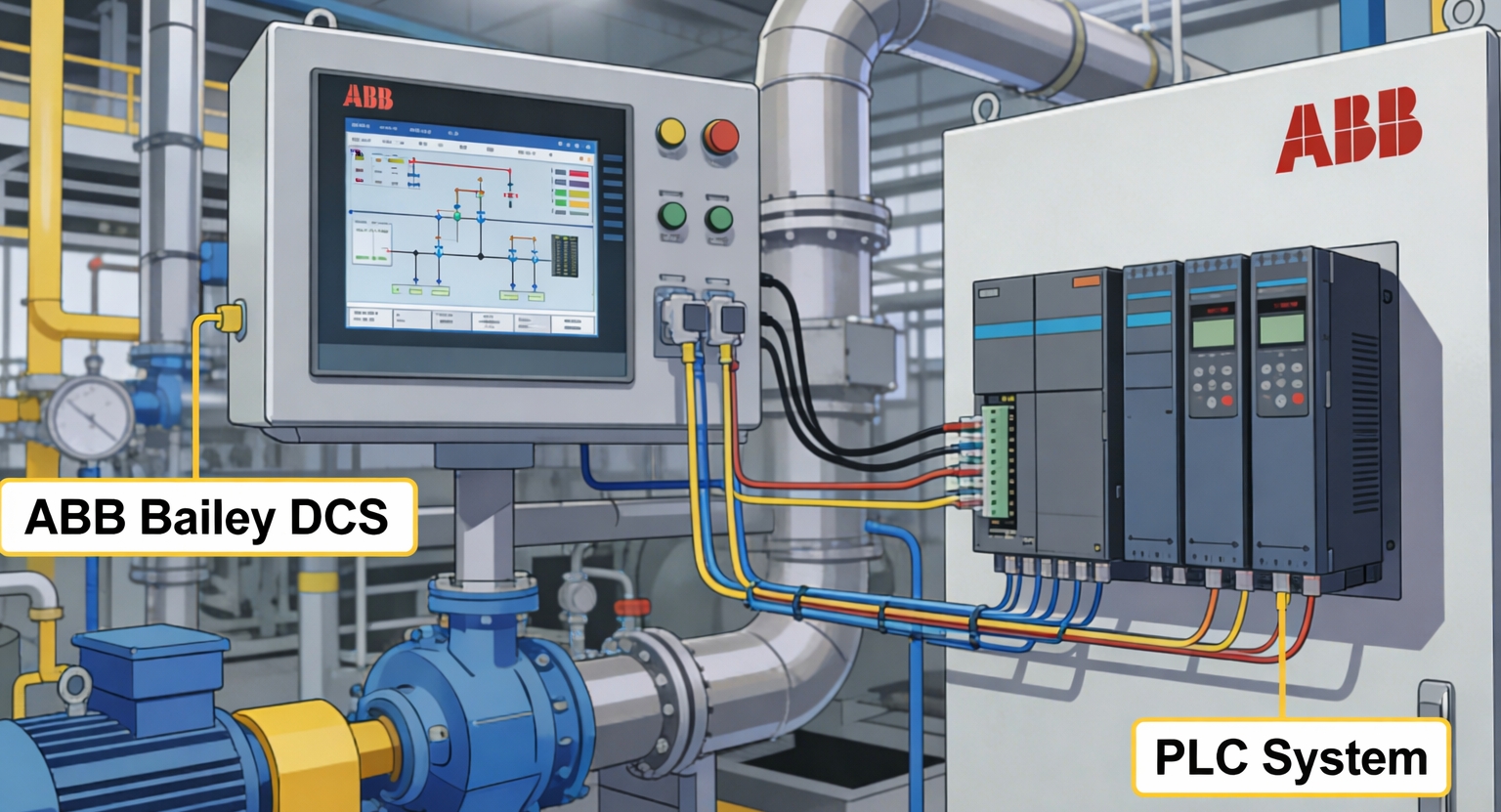
Most operating plants use both DCS and PLCs. The difference is practical: ownership, latency tolerance, and how operators are expected to work during abnormal situations. A workable pattern looks like this:
The DCS owns process stability and cross-unit coordination.
PLCs own machine-level sequencing, fast equipment interlocks, and packaged subsystems.
SCADA or historians aggregate data for visibility, reporting, and enterprise context.
When ownership is unclear, outputs get overwritten, alarms land in inconsistent places, and troubleshooting becomes slow and political. Clear boundaries reduce risk during commissioning and reduce confusion years later when people have changed, and documentation is incomplete.
In practice, this is how many plants split responsibilities in a way that stays workable year after year.
Function Area
Typical DCS Owner
Typical PLC Owner
Practical Note
Regulatory loops and coordinated control
High
Medium
Stable operator workflow is a core requirement
Packaged skid sequencing and machine logic
Low
High
Keep skid responsibility local where possible
Area wide alarming and graphics standards
High
Medium
Fragmented alarms slow response during incidents
Cross unit coordination and shared resources
High
Low
Data exchange needs clear authority rules
Reporting and enterprise dashboards
Medium
Medium
Decide the tag source of truth early
Common collaboration scenarios include packaged skids, analyzer systems, compressors, burners, and turbine auxiliaries. PLCs keep machine logic local. The DCS provides setpoints, modes, interlocks context, and a consistent operator experience. Once that division of labor is established, modernization becomes easier because integration decisions follow the process, not platform preference.
Why ABB Bailey Systems Are Still Running After 30+ Years
Legacy control systems last when they keep delivering operational value. Plants that still run an ABB Bailey installed base usually share three conditions.
1. Process fit: Continuous units reward predictable loop behavior and controlled recovery. Even as hardware ages, a stable control philosophy remains useful and familiar to operations.
2. Disciplined engineering and operations habits: Over the years, sites build standards into graphics, alarms, tuning practices, and operator routines. Replacing that institutional knowledge carries risk and rarely improves production on day one.
3. Staged modernization that avoids forced cutovers: Plants rarely get unlimited shutdown time. Workstations, network layers, controllers, and I/O are modernized in slices so the unit can keep running while changes are validated in real operation.
That leads directly to maintenance: the system stays safe and economical only when reliability is planned, not improvised.
Practical Strategies for Maintaining Legacy ABB Bailey DCS
A legacy ABB Bailey control system can remain dependable if maintenance is treated as an engineering program. Ad hoc repairs tend to accumulate hidden technical debt: undocumented changes, mismatched module revisions, and backups that cannot be restored under pressure. Effective legacy ABB Bailey DCS maintenance focuses on risk containment, configuration integrity, and recovery certainty.
Protect Power and Cabinet Conditions
Many intermittent faults trace back to power instability, heat, condensation, and cabinet contamination. A short audit of power supplies, grounding practices, cooling paths, and cabinet temperatures often reduces “ghost” failures faster than swapping modules. Treat the cabinet environment as a first-class reliability variable, then investigate modules.
Build a Risk-Based Spares Strategy
Stock spares around the failure impact, not only the failure frequency. Network interfaces, shared power elements, and key communication modules can create a large blast radius. If one fails, the plant may lose control authority or visibility for an area, not a single point. For I/O, prioritize cards tied to critical safeguards and high-consequence loops, then cover common failure modes that cause nuisance downtime.
Make Backups Verifiable
Backups matter only when restoration is predictable. Strong programs keep a versioned offline configuration aligned with the running system, verify restore capability in a lab or test node on a schedule, and document dependencies such as firmware levels and module revision constraints. This turns “we have backups” into “we can recover under pressure.”
Treat Change Control as Production Protection
Legacy platforms can run for years, then drift after a small change. Track logic edits, alarm setpoint changes, and tuning changes with a clear approval path and rollback plan. Operators should not be surprised by behavior changes during routine operation, especially around alarms, permissives, and mode handling.
Separate Stabilization Work from Modernization Work
When a unit is unstable, address stability and diagnostics first. Modernization belongs in planned windows with acceptance testing and operator validation. Mixing both increases operational risk and consumes more outage time.
Source Spares with Incoming Verification
Independent suppliers can help locate hard-to-source modules. Incoming inspection and bench testing remain valuable, particularly for high-consequence parts. Capture test evidence, record serial and revision details, and keep warranty terms explicit. This reduces the risk of installing a part that fails early and creates doubt about the entire maintenance program.
Modern Integration: Connecting Bailey DCS to New Control Systems
Modernization rarely happens in one event. New PLC skids arrive with packaged equipment, operations teams ask for unified trends, and corporate groups want data pipelines. That is why ABB Bailey DCS integration with PLC and SCADA appears in so many projects. Integration succeeds when engineers design boundaries that protect control authority, preserve operator clarity, and keep long-term support realistic.
Role of DCS as a Data and Control Hub in Mixed Environments
In many process sites, the DCS becomes the operational hub because it carries the operating discipline: tag standards, alarm priorities, graphics, and coordinated control logic. Integration is not an add-on burden that shows up late. It is built into how mixed plants stay coherent.
A practical integration approach usually addresses four areas in sequence.
Control authority: decide which system owns final outputs for each actuator and mode, then expose supporting signals cleanly.
Time and events: keep trends and events coherent so troubleshooting works across systems.
Data model: align naming, scaling, units, and alarm priorities before building hundreds of points.
Operator experience: present alarms and statuses so operators can act quickly without hunting across consoles.
When these boundaries are handled well, PLCs keep ownership of machine logic, the DCS keeps process coordination, and SCADA or historians provide wider visibility. The result feels like one plant, not a collection of islands.
Choose the Right Control System for Your Process
A control system decision holds up when it matches process reality and support reality at the same time. Continuous units with tight quality limits and costly downtime typically benefit from stable coordination and predictable recovery, which keeps a Bailey installed base relevant when operating discipline and recovery practices are already mature. Equipment-heavy areas with frequent machine changes often fit PLC ownership, with the DCS providing supervision and a consistent operator layer. Mixed sites improve results when authority is defined clearly, and modernization is staged so each change can be proven under real operating conditions.
FAQs About ABB Bailey DCS Systems
Q1: What Type of Processes Benefit Most from a DCS Architecture?
Continuous and hybrid processes benefit most, particularly where loop interactions, disturbance handling, and operator workflow determine production outcomes. Large utilities, chemical units, refining areas, and pulp and paper operations often match this profile.
Q2: Does a DCS Replace PLCs in a Plant?
No, not in most plants. PLCs still make sense for packaged skids, machine sequencing, and discrete interlocks close to equipment. A DCS is typically used to coordinate unit operations, manage alarms and operator workflow, and keep process control consistent across an area. Plants run successfully when the final output owner for each actuator is clearly defined, and alarms have a single “home” for operators.
Q3: Why Do Many Plants Continue to Operate Legacy ABB Bailey DCS Systems?
Longevity usually reflects process fit, disciplined engineering standards, and staged modernization paths that avoid high-risk cutovers. The control layer often holds decades of operational knowledge in graphics, alarm strategy, tuning, and procedures.
Q4: How Can Legacy ABB Bailey DCS Systems Be Effectively Maintained Today?
A sustainable approach combines verifiable backups, risk-based spares planning, strong change control, and attention to power and cabinet conditions. Incoming testing and documentation discipline become especially important when sourcing spares through secondary channels.
Q5: Does Legacy DCS Architecture Limit Integration or Modernization Options?
It can shape your options, but it rarely blocks them. Legacy architecture usually means you need clear ownership rules, a clean tag and data model, and an integration method that matches the site’s reliability requirements. Modernization tends to work best as a staged evolution, so you can validate each interface and cutover under real operating conditions rather than forcing a single high-risk replacement.
ABB Bailey DCS: From Design Philosophy to Modern Integration
Prioritizing Process Immunity over Individual Components
The longevity of the ABB Bailey DCS in continuous process plants stems from its foundational design philosophy: to protect the production process from operational volatility. Unlike systems focused on discrete tasks, this architecture treats stability as a non-negotiable feature. It achieves this by embedding local autonomy into controllers, ensuring that the production process remains immune to failures at the operator or server level.
Managing Hidden Liabilities
The continued operation of these legacy systems is often a testament to disciplined engineering governance rather than just hardware durability. Their survival is attributed to a pragmatic strategy of risk containment. This involves treating the physical cabinet environment (power, cooling) as a critical reliability factor, maintaining a spares inventory based on potential impact rather than failure frequency, and rigorous change control.
Defining Jurisdiction for Coexistence
In modern plants, the DCS does not operate in isolation but acts as a jurisdictional hub alongside PLCs and newer platforms. The success of integration relies on establishing clear "ownership" boundaries to prevent operational confusion.







Leave Your Comment