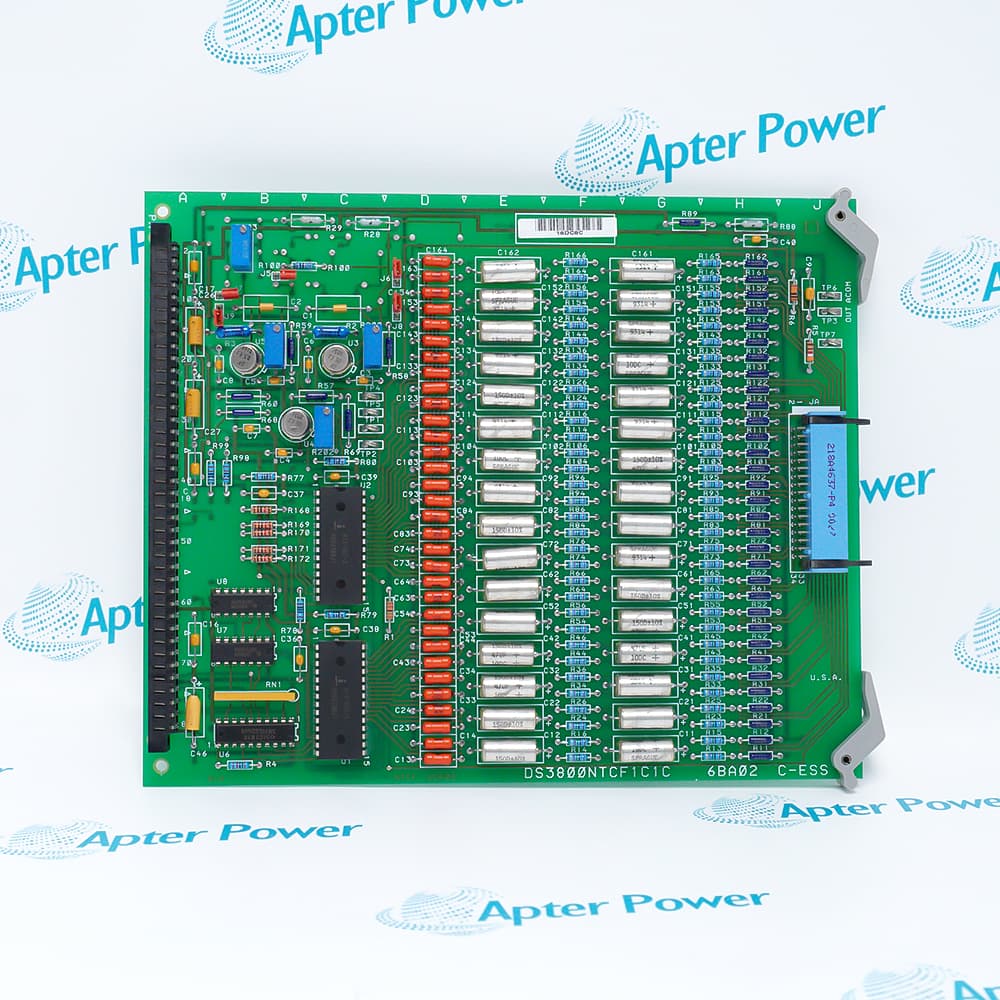
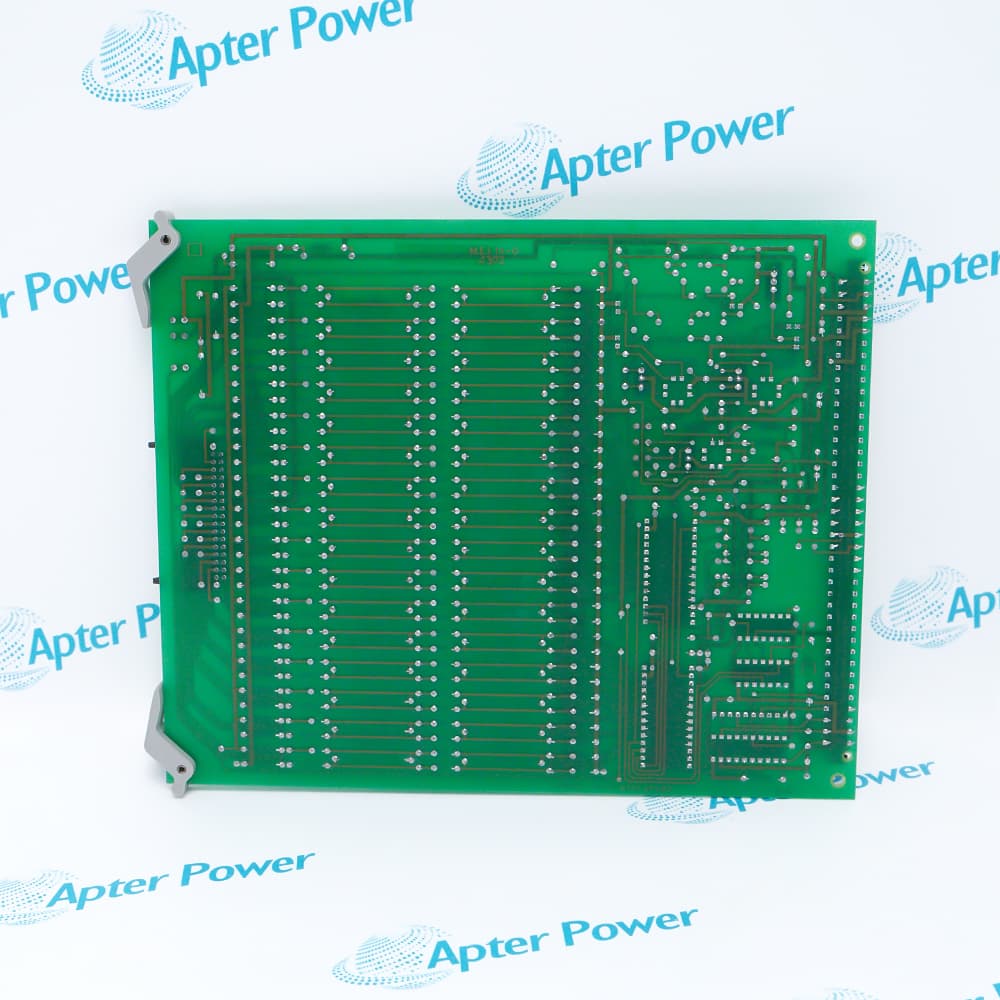
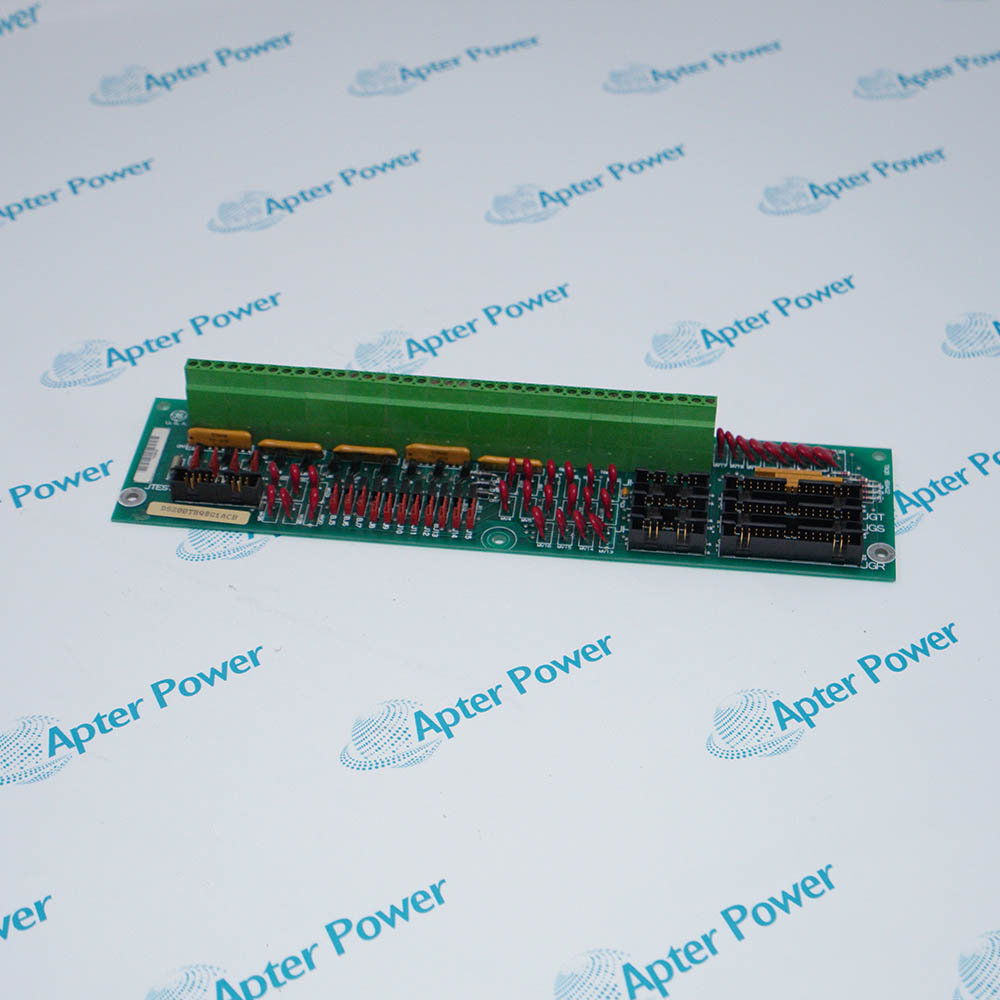
Features:
- 13 Thermocouple Input Channels – Supports 13 differential inputs with 12-bit resolution, enabling precise exhaust temperature measurement for turbine control
- Designed for GE's TMR system, using multiple cards to provide fault-tolerant temperature regulation and prevent single-point failures
- Features five jumpers, one resistor network, and four potentiometers acting as voltage dividers for flexible signal conditioning
The DS3800NTCF1C1C is engineered to interface directly with thermocouples installed in turbine exhaust paths, providing 13 input channels for comprehensive temperature monitoring. Each channel processes signals at 12-bit resolution, ensuring precise detection of temperature variations that are critical for combustion efficiency and turbine health. The card calculates the difference between the actual exhaust temperature and a pre-set reference setpoint, generating a command signal that the Mark IV system uses to manage fuel flow and exhaust temperature.
The DS3800NTCF1C1C is a core component of the Mark IV Speedtronic series, which was among the first control systems to implement Triple Modular Redundancy (TMR) for critical parameters. The Mark IV system uses thirteen of these cards simultaneously to maintain temperature control. This redundant architecture means that even if one DS3800NTCF1C1C card produces corrupted data, the system can rely on the remaining cards to provide accurate statistical input for control decisions.
The DS3800NTCF1C1C is built with extensive onboard circuitry to condition raw thermocouple signals into usable data for the Mark IV processor. It features five jumper switches that allow for hardware configuration, along with one resistor network and four potentiometers that function as voltage dividers to scale signals appropriately. The board contains eight circuits, including hex inverting gates and three-state output octal buffers/line drivers.
The DS3800NTCF1C1C GE Thermocouple Card may still be available for purchase and support from Apter Power beyond
End-Of-Life (EOL) by the manufacturer (OEM).
GE DS3800NTCF1C1C Thermocouple Card Manuals, Datasheets, Drivers, Link
Important Notice: Other accessories, manuals, cables, calibration data, software, etc. are not included with this equipment unless listed in the above stock item description. All prices are shown in USD.
GE DS3800NTCF1C1C Control Board Specs
General
- ManufacturerGeneral Electric
- ModelDS3800NTCF1C1C
- ConditionNew Original ready stock
- Product FamilyGE Mark IV Speedtronic
Important Notice: Other accessories, manuals, cables, calibration data, software, etc. are not included with this equipment unless listed in the above stock item description. All prices are shown in USD.
- Gas Turbine Exhaust Monitoring: Captures raw temperature values directly from the exhaust gas thermocouple arrays surrounding the combustion turbine frame. Accurate data processing here is critical for preventing "temperature spreads" that crack rotor blades.
- Bearing and Stator Thermal Tracking: Tracks localized internal physical temperatures inside heavy-duty generator bearings, thrust pads, and motor stators.
- Steam Turbine Controls: Monitors boiler steam feeds, extraction lines, and inlet valve casings within combined-cycle power block facilities.
- EPROM-Based Hard Coding: The operational handling algorithms, calibration curves, and mathematical coefficients for thermocouple types (e.g., Type K) are burnt permanently onto socketed EPROM (Erasable Programmable Read-Only Memory) integrated chips on the processor boards, rather than on this conditioning board itself.
- Hardware-Level Updates: Upgrades or adaptations for the DS3800NTCF1C1C are achieved solely through Hardware Revision Levels (denoted by the suffix string 1C1C). If a revision change is issued by GE, you must physically exchange the entire card assembly or move physical component components on the board.
- Component Degradation: When managing this hardware, "updating" typically refers to physical maintenance, such as replacing dried-out electrolytic capacitors or re-seating analog chips that suffer from thermal aging over decades of service.
- Hardware Jumper and Potentiometer Tuning: The board features onboard physical jumpers and adjustable potentiometers.
- Software Mapping in the MK IV Database: To read the conditioned values, the card is mapped into the central Speedtronic Mark IV core parameters database via a legacy CRT interface or terminal loader (often running a specialized DOS environment like IDOS). Points are assigned to the TMR (Triple Modular Redundant) logic networks—labeled as Core \(\langle\text{R}\rangle\), \(\langle\text{S}\rangle\), and \(\langle\text{T}\rangle\)—to ensure voting logic can cross-verify temperature signals.