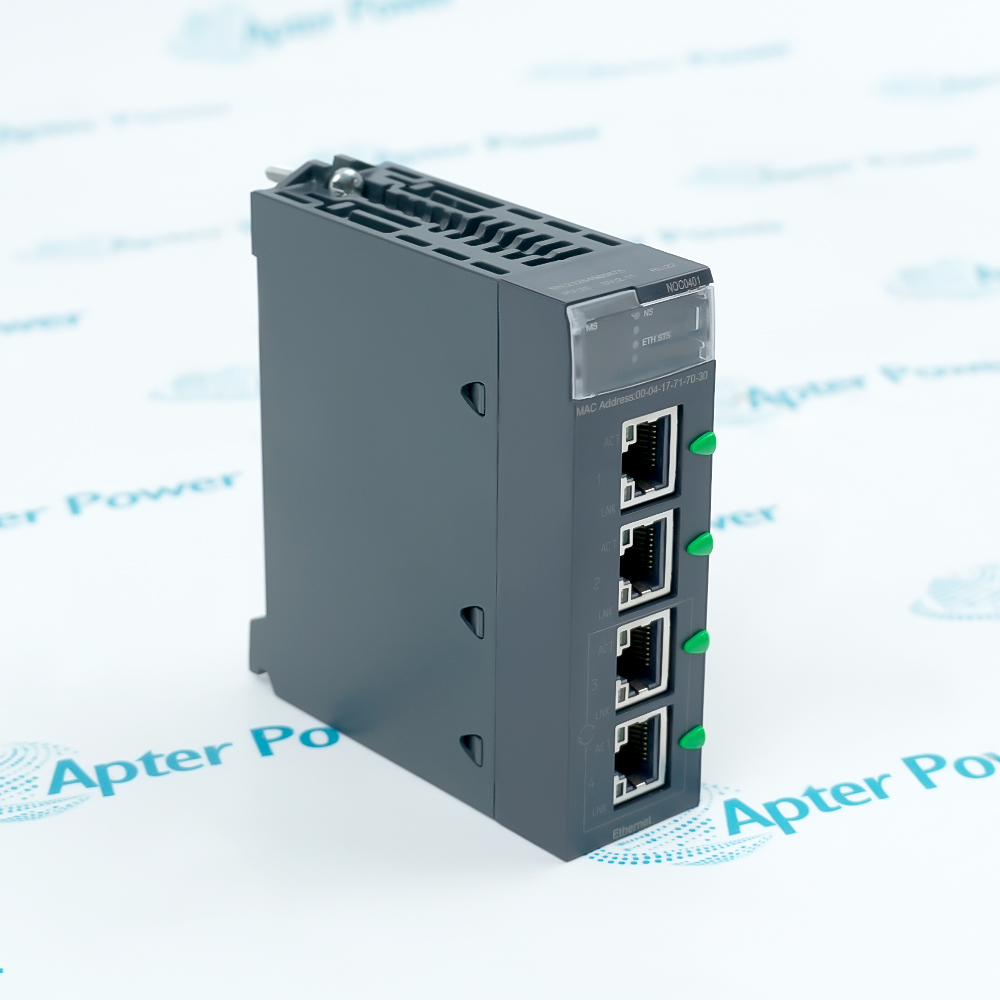
Features:
- Four-port Ethernet: four 10/100BASE-T RJ45 interfaces support controller, device and service connections.
- Dual industrial protocols: supports Modbus TCP and EtherNet/IP communication.
- Managed network services: includes RSTP, port mirroring, FDR, SNMP and web diagnostics.
The module combines an M340 rack interface with a four-port industrial Ethernet switch.
Firmware 2.01 or later adds the documented SMTP and NTP services represented by the BMXNOC0401.2 catalogue entry.
A successful exchange restores the saved network plan, I/O scan and project diagnostics without duplicate addressing or unintended topology changes.
Apter Power supports Schneider Electric BMXNOC0401 Ethernet TCP/IP Network Module quotations, technical documentation, procurement support and system-matching guidance.
Schneider Electric BMXNOC0401 Ethernet TCP/IP Network Module Manuals,Datasheets,Link
Important Notice: Apter Power provides these resources for exact-model documentation, quotation and engineering review.
- Modbus TCP: supports client and server messaging for compatible devices.
- EtherNet/IP: supports documented I/O scanning and explicit messaging.
- Switching: four 10/100 RJ45 ports provide the local network interface.
- Resilience: RSTP supports a managed redundant topology.
- Firmware boundary: version 2.01 or later is represented as BMXNOC0401.2.
- Added services: the later firmware supports SMTP and NTP.
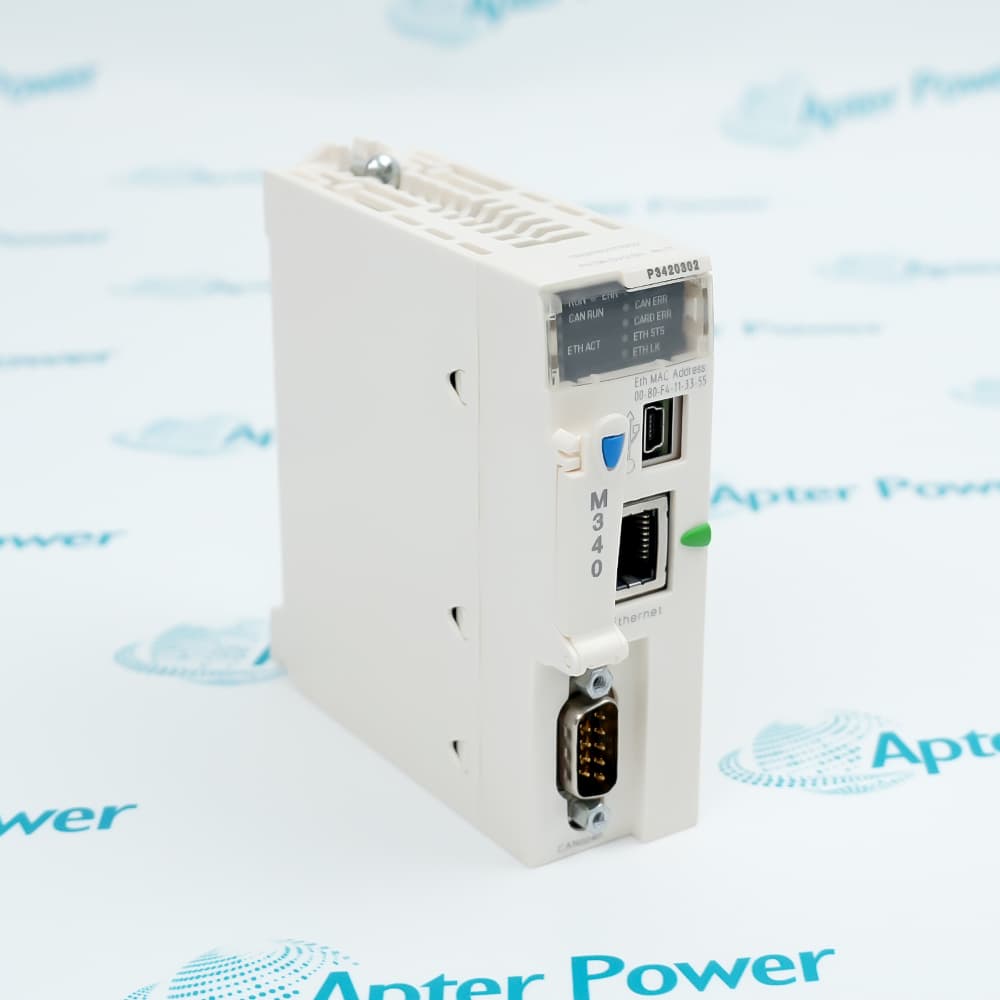
- CPU fit: use a supported BMXP342-series CPU and matching Control Expert catalogue.
- Project record: retain IP, scan and communication settings before exchange.
- Port state: check link, speed and error counters for each used connection.
- Address review: exclude duplicate IP addresses before reconnecting field devices.
- I/O scan: compare configured devices with live connection status.
- Recovery proof: test RSTP, web diagnostics and controller communications after restart.
- M340 distributed I/O: exchanges cyclic data with supported EtherNet/IP or Modbus TCP devices.
- Controller integration: links an M340 rack with supervisory, peer and service networks.
- Managed ring networks: uses RSTP where the documented topology requires resilience.
- Maintenance access: provides diagnostic web, SNMP and port-mirroring support for network troubleshooting.