Honeywell C300 and TDC 2000/3000: Control Cards, Reliability and Migration
About the author
Written by Leonia, Marketing Director of Apter Power
Leonia's LinkedIn:
Leonia brings 10+ years of automation sales experience, spanning PLC, DCS system integration across Asia, Europe, American. Having delivered 500+ lines for oil & gas clients, she knows where control architectures stall and how to pre-empt costly downtime.
Unplanned control interruptions in continuous process plants rarely stay confined to one cabinet. A controller card reset can push a unit into unstable operation, create off-spec material, and consume the maintenance window you were saving for higher-value work. That reality keeps Honeywell C300 spare parts on the agenda for many sites, including those already planning modernization. The practical aim is continuity: rapid restoration of stable control today, plus a controlled path from legacy TDC environments to an Experion C300 architecture that fits current lifecycle and security expectations.
Why Honeywell C300 and TDC 2000/3000 Matter in Modern Process Plants
TDC 2000/3000 systems remain in service because they are embedded into how plants run: established control strategies, tuned loops, proven alarm philosophies, and operator muscle memory. Replacing that operational knowledge is a project on its own, separate from installing new hardware.
C300-based Experion systems are common in newer units and expansions because they support current integration patterns, platform diagnostics, and a modernization runway that aligns better with enterprise cybersecurity and lifecycle policies. Many sites now operate mixed generations across the same complex, which makes reliability management a cross-platform discipline. In that mixed reality, Honeywell C300 spare parts planning becomes both an uptime tool and a risk-control mechanism for staged upgrades.
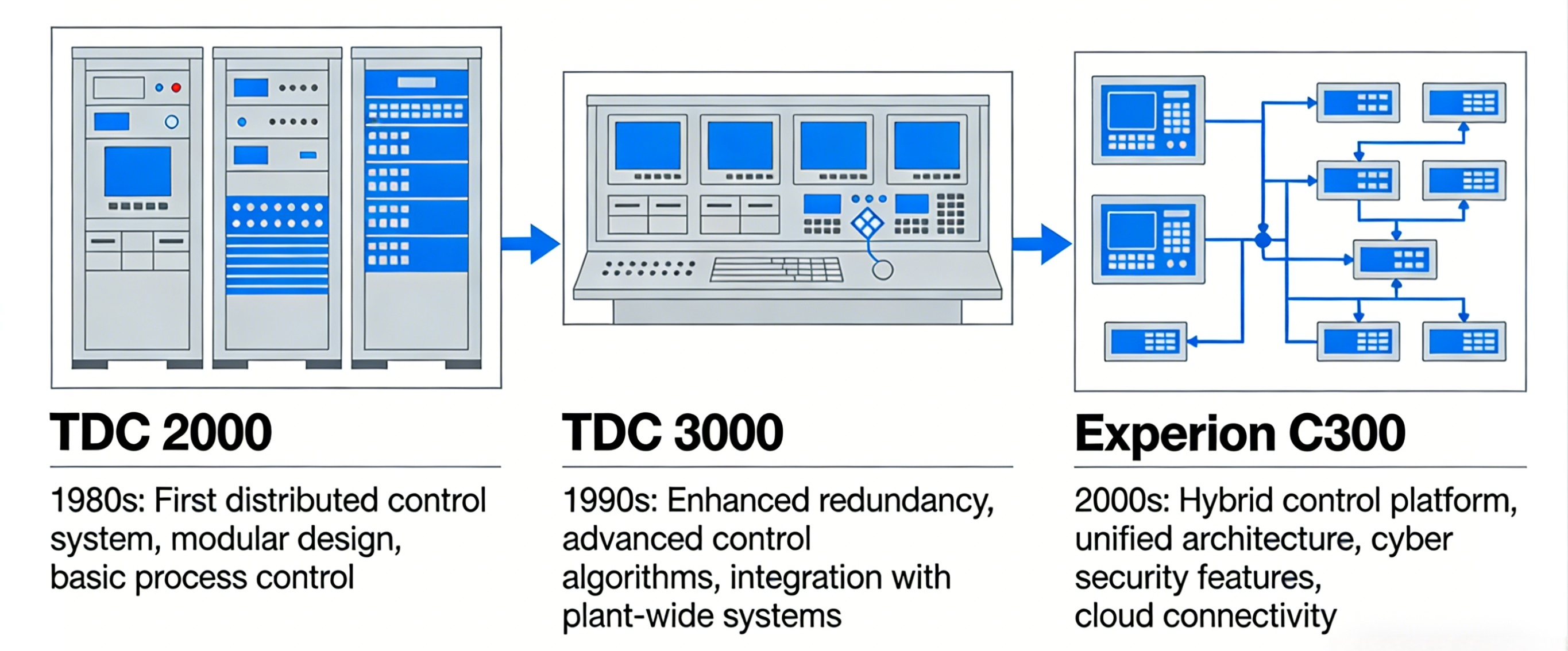
How Did Honeywell DCS Evolve from TDC 2000/3000 to Experion C300?
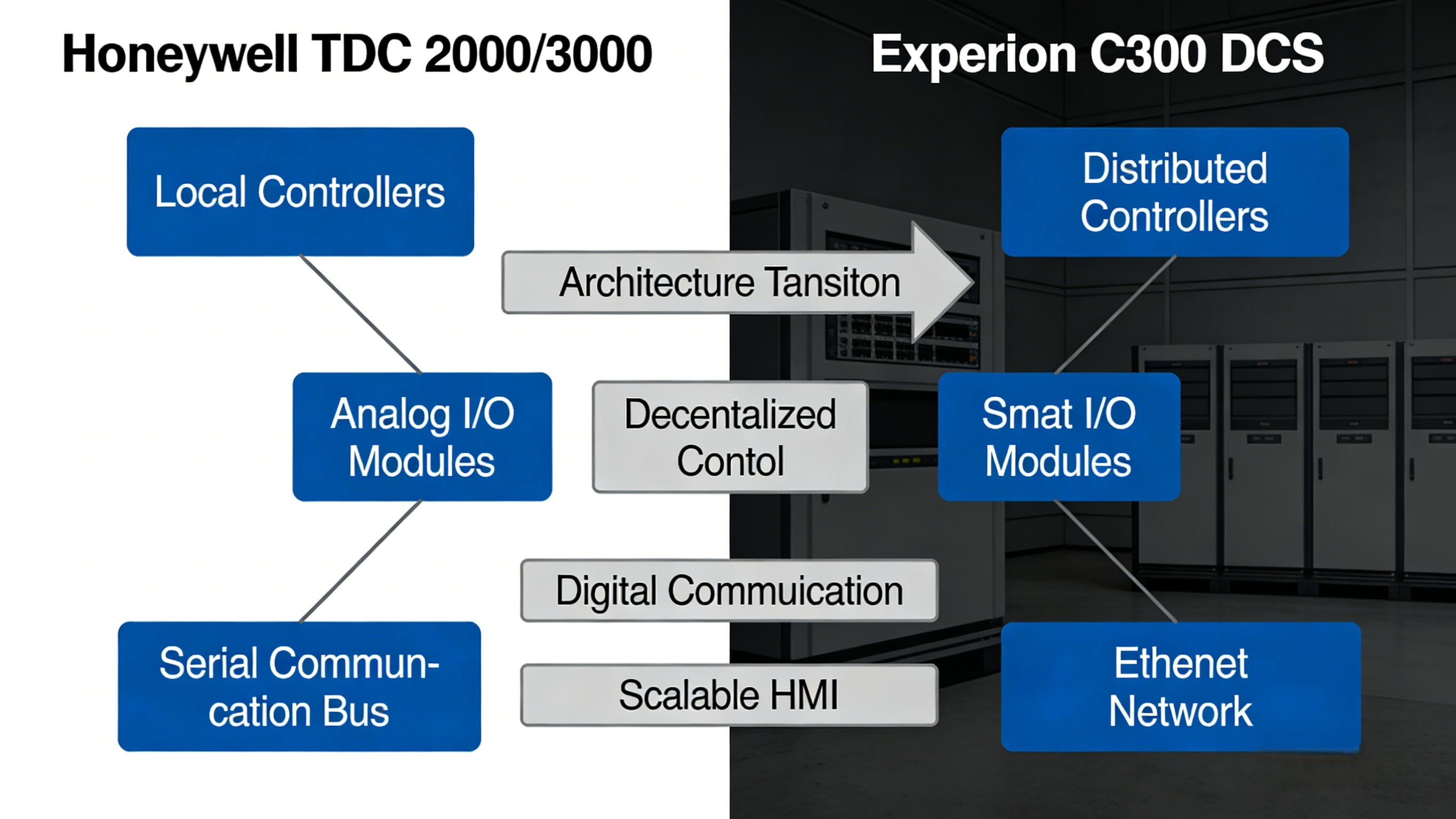
From TDC 2000/3000 to Experion C300, the change shows up in three places that plants feel every day: how control is distributed, how the platform is maintained, and how upgrades are executed.
TDC 2000/3000 established a distributed control approach at an industrial scale, spreading control functions across networked nodes and consoles rather than relying on a single centralized system.
Experion with C300 is built around a modern control execution environment, platform diagnostics, and architectures designed to integrate cleanly with current networks and plant information systems.
Modernization pathways increasingly focus on phased transition, preserving the installed base value in control logic, displays, and operator workflows while infrastructure moves forward.
For many TDC 3000 sites, modernization is driven as much by lifecycle risk as by performance. Spares availability tightens over time, and a single rare electronics failure can become a long outage if a compatible replacement is not on hand. That is why Honeywell C300 spare parts strategy often sits next to the TDC modernization plan in the same steering committee deck.
How Do Honeywell Control Cards and I/O Modules Work in Typical DCS Architectures?
Spare planning gets simpler when you separate roles. Control cards execute control and handle system communications. I/O modules handle field signal interfacing through the termination layer. That split maps directly to what you stock, how you troubleshoot, and how fast you can restore control.
Controller Layer
In many Experion deployments, the C300 controller is the PCNT05 module and is often used in 1:1 redundant pairs in high-consequence units. Switchover is commonly discussed in the hundreds-of-milliseconds range, with 500 ms often cited as a reference. Actual interruption time depends on the implemented architecture and some integration paths, including certain EtherNet/IP arrangements, can behave differently.
For restoration, treat the controller spare as a minimum restore set that matches what is installed. Keep the controller module and the correct termination hardware together. If redundancy is implemented, include the redundancy accessories required to return the pair to a verified redundant state. This is why Honeywell C300 spare parts should be governed as assemblies, not single line items.
I/O and Termination Layer
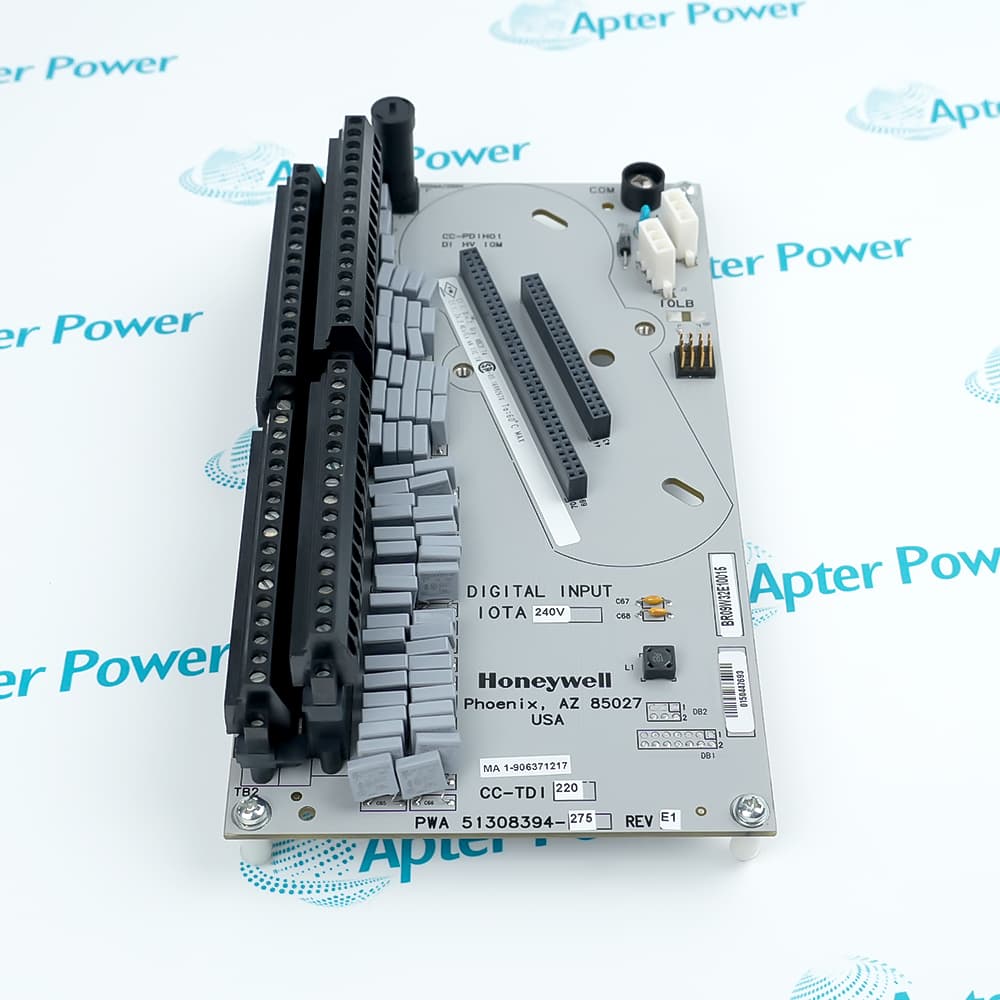
Termination assemblies anchor field wiring and provide the interface point for I/O electronics. I/O modules translate field signals into values the controller can use, and they typically drive the highest spare quantities.
Universal I/O approaches based on Universal Channel Technology can reduce marshalling effort and absorb late I/O type changes through configuration rather than rewiring. In practice, this can shift I/O stocking from many narrowly specific modules toward fewer module families, provided the site stays consistent with its installed termination and connectors.
Architecture Patterns
Most plants fall into a small set of cabinet patterns: single controllers in lower-consequence areas, redundant controller pairs where downtime is intolerable, and hybrid cabinets where legacy practices meet newer I/O approaches. The pattern matters because it changes the minimum restore set and the number of spares you need to keep ready.
What Failures Most Often Take Honeywell DCS Control Cards Down?
Most control-card outages fall into three buckets: cabinet environment issues, power and connection integrity, and lifecycle availability constraints. The symptoms differ between legacy TDC cards and C300 assemblies, but the root causes are usually predictable.
TDC Failure Signals
Legacy TDC cards often fail “soft” before they fail hard. Intermittent communication faults that clear after reseating, nuisance resets that follow a power disturbance or cabinet hot spot, and a rising number of alarms with no clear process correlation are typical early warnings. In many cases, the underlying drivers are contact degradation, aging power components, thermal cycling stress, or component drift. The operational risk spikes when the diagnosis is clear but the correct replacement card is scarce, turning a routine repair into an extended outage.
C300 Reliability Factors
C300 reliability is shaped by both engineering behavior and supply behavior. Redundancy improves tolerance to a single failure, yet it still relies on compatible modules, correct termination, clean connections, and disciplined configuration control. Supply risk is different: revision alignment and availability become the limiting factor, especially when a site has multiple generations installed across units. Treating controller replacements as governed activities, with defined restore sets and compatibility checks, prevents last-minute purchases that arrive incomplete or mismatched and then create secondary faults during installation.
Lifecycle Exposure
Lifecycle risk is best managed as a recovery capability problem. The right questions are practical: how long it takes to restore stable control if this specific card fails, how much exposure lead-time volatility creates for the unit, and whether the spare on the shelf can be installed with confidence in compatibility. When those answers are not documented and verified, the plant is carrying hidden downtime risk even if the system appears stable today.
How Can You Migrate from TDC 2000/3000 to Experion C300?
A practical migration follows a repeatable sequence: define the target C300 architecture per unit, freeze a verified baseline for the next phase, stage the minimum restore sets, then migrate in small blocks with a clear acceptance check.
Define the End-State Per Unit
Write down the target Experion C300 design for each unit, not for the whole site in abstract. Capture the redundancy model, I/O approach, network segmentation, cabinet boundaries, and any required gateways or bridge components. This is also where Honeywell TDC 3000 to Experion C300 upgrade parts should be specified as engineered items tied to the actual cabinet and network design, not as generic shopping terms.
Build a Verified Baseline
Before touching hardware, lock the current state: part number, revision, firmware, cabinet location, and redundancy pairing for every node involved in the next phase. Pair that inventory with configuration backups and a short restore procedure. Baselines are what prevent “surprises” from turning into schedule slips.
Stage Spares for the Migration Window
Treat spares as part of the migration work package. For each phase, define the minimum restore set for the legacy nodes that must stay operable and for the new C300 assemblies being introduced. Stock those sets in advance so a single card failure does not freeze the project. This is where Honeywell C300 spare parts act as scheduled protection rather than emergency inventory.
Migrate in Small, Testable Blocks
Move a defined block of nodes, then validate three things before expanding scope: control stability, alarm behavior, and operator workflow. Once those are stable, proceed to the next block. After each block, update the procedure based on what the team learned, especially around wiring exceptions, termination constraints, and compatibility checks.
How to Build a Spare Parts Strategy for Honeywell C300 & TDC Systems
An effective spares strategy ties three factors into one decision: consequence, lead time, and interchangeability. It also stays aligned with how the plant will actually restore control at 2 a.m. during a running unit.
Build a Critical Spares List for Honeywell DCS
A critical spare parts list for Honeywell DCS systems works best when it is owned jointly by automation and maintenance, with procurement aligned to the same priorities.
Tier
What It Protects
Typical Items
Stocking Logic
A
Unit trip, major constraint, safety critical loops
Common I/O modules, termination accessories, secondary network components
Stock based on installed count, failure history, and vendor lead time
C
Maintainability, planned work efficiency
Non critical peripherals, cables, minor accessories
Stock for planned jobs, keep tight control to avoid dead inventory
Deal with Obsolete TDC Control Cards and Rare C300 Modules
1. Verify identity and revision: Confirm part number, revision, and labeling against the site’s asset record. Capture photos and update the register. This is the first filter against compatibility surprises.
2. Confirm compatibility against the installed environment: Review controller platform details, firmware expectations, redundancy pairing rules, and any known compatibility constraints tied to the site’s software release. For C300 inventories, this is where Honeywell C300 control card replacement parts should be treated as defined assemblies, not as single modules.
3. Prove function before production use: Bench test when practical. If bench testing is not realistic, schedule a controlled swap in a planned window with rollback readiness. A spare that has never been powered and validated is not a spare, it is an assumption.
4. Store for reliability: Implement ESD controls, stable storage conditions, and periodic inspection. Electronics stored for years can degrade through handling and the environment, even when sealed.
What Is the Role of Honeywell DCS Data in Quality, Compliance, and Optimization?
Stable control creates reliable data, and reliable data supports business outcomes that matter to operations leadership. Trend histories support root cause analysis after quality excursions. Alarm and event records support incident investigations and management of change. In refining and petrochemicals, consistent control improves constraint management around cut points, blending properties, reactor profiles, and emissions control.
Data quality depends on platform stability. Frequent controller resets, intermittent I/O behavior, and noisy communications distort baselines and complicate compliance narratives. That is another practical reason plants keep Honeywell C300 spare parts aligned: stable controllers and clean I/O paths produce cleaner evidence and faster resolution when something goes wrong.
Get Tailored Support for Your Honeywell DCS Lifecycle Challenges
A workable lifecycle program ties spares governance to staged modernization and configuration control. Provide a current node inventory, criticality ranking by unit, recent failure history, and the next migration phase scope, including Honeywell TDC 3000 to Experion C300 upgrade parts tied to bridging, terminations, controllers, and I/O strategy. From there, the team can validate the spares list against the implemented architecture, confirm revision alignment, and stage the right restore sets near the workfront. Honeywell C300 spare parts then serve a clear purpose: restoring stable control quickly, without derailing the migration schedule.
FAQs
Q1: Should we stock firmware media or licensing items as part of controller spares?
Yes. Include approved firmware images, configuration archives, and any required licensing or activation records in a controlled “restore package.” Hardware alone does not restore service if software provenance, versions, or credentials are missing during an outage.
Q2: Can refurbished or surplus modules be used safely in critical service?
Yes, if they pass a defined acceptance process. Require traceability, visual inspection, ESD-compliant packaging, functional burn-in where feasible, and verification of part revision against the installed baseline. Treat them as controlled assets, not emergency substitutes.
Q3: Do we need to periodically test spare electronics that sit on the shelf?
Yes. Long-stored electronics can develop latent issues from handling, storage humidity, or connector corrosion. Schedule periodic inspection and a controlled power-on test cadence for critical controller assemblies, then record results to keep spares “ready,” not merely “owned.”
Q4: Is it better to hold one universal spare or multiple specific spares for I/O?
It depends. If your cabinet design uses universal-channel concepts consistently, fewer module families can cover more scenarios. If you have mixed generations and terminations, holding specific spares reduces compatibility risk and speeds restoration under pressure.
Q5: Should we manage spares centrally across the site or locally by unit?
Yes, centralize ownership, but stage locally for execution. Central governance improves standardization, traceability, and budget control. Local staging near critical units shortens response time and avoids cross-site logistics delays during high-consequence events.
Evolution and Strategic Importance
C300 spare parts planning serves a dual purpose
The transition from Honeywell's legacy TDC 2000/3000 systems to modern Experion C300 architectures represents more than a hardware upgrade—it addresses fundamental operational continuity challenges. TDC systems remain embedded in plant operations through established control strategies and operator expertise, while C300 platforms offer superior integration capabilities, diagnostics, and cybersecurity alignment.
Failure Management
Common failure modes stem from cabinet environmental issues, power integrity problems, and lifecycle availability constraints. Critical spares should be governed as complete assemblies—including controllers, termination hardware, and redundancy accessories—rather than individual components. This approach ensures rapid restoration capability during unplanned interruptions, particularly in high-consequence units where downtime is unacceptable.
Governance Framework
Comprehensive governance extends beyond hardware to include firmware images, configuration archives, and licensing documentation. Periodic validation of stored electronics through controlled power-on testing ensures spare readiness, while centralized ownership with local staging optimizes both standardization and response time during high-pressure restoration scenarios.







Leave Your Comment