Ask our team:
  • Phone: +86 181 0690 9650
  • E-Mail sales1@apterpower.com
  • Lifecycle status

    Active / Available from OEM
    Apter Power reviews serial configuration, module identity, terminal condition, and official integration records before quotation.

1734-232ASC

/ 4.9
1001 reviews | Need a Specific Revision?
One full-duplex serial device can exchange delimited ASCII records with a Logix project through 1734-232ASC in a distributed POINT I/O station.
In Stock
Ships by Wednesday, October 28
Fast Shipping Available
Get a quick price for 1734-232ASC
Quantity
*E-mail
Company
*Mobile
*Content
Upload (gif, jpg, jpeg, png, bmp, doc, docx, xls, xlsx, ppt, pdf, csv)

Technical specifications for 1734-232ASC

  • Manufacturer:
    Allen-Bradley
  • Part Number:
    1734-232ASC
  • Product Family:
    Point I/O 1734
  • Product Type:
    POINT I/O RS-232 ASCII Interface Module
  • Stock:
    1
  • Serial interface:
    One full-duplex RS-232 channel
  • Communication rates:
    1200, 2400, 4800, 9600, 19.2, or 38.4 kbit/s
  • Character framing:
    7N2, 7E1, 7O1, 8N1, 8N2, 8E1, 8O1, 7E2, or 7O2
  • Serial data length:
    Up to 128 bytes per receive or transmit record
  • External power:
    10...28.8 V DC; 24 V DC nominal
  • POINTBus current:
    75 mA maximum at 5 V DC
  • Terminal bases:
    1734-TB, 1734-TBS, 1734-TOP, or 1734-TOPS
  • Weight:
    0.028 kg
  • Estimated shipping dimensions:
    5.66x1.21x7.75cm
  • Tariff Code:
    Please confirm the destination before shipping
  • Country of origin:
    United States of America
  • Place of shipment:
    Xiamen,Fujian,China
By purchasing this item, you agree to the Terms & Conditions, ApterPower is not an authorized distributor for listed manufacturers or tradenames and therefore the manufacturer's warranty does not apply. All our products come with ApterPower's 1-year warranty.

More Information

Overview Manuals RS-232 Setup Record Data Fault Recovery Product Applications

Features:

  • Full-duplex RS-232: one ASCII device communication channel
  • Configurable records: framing, delimiters, data type, and byte-swap choices
  • Actionable diagnostics: FIFO, parity, handshake, and new-data status
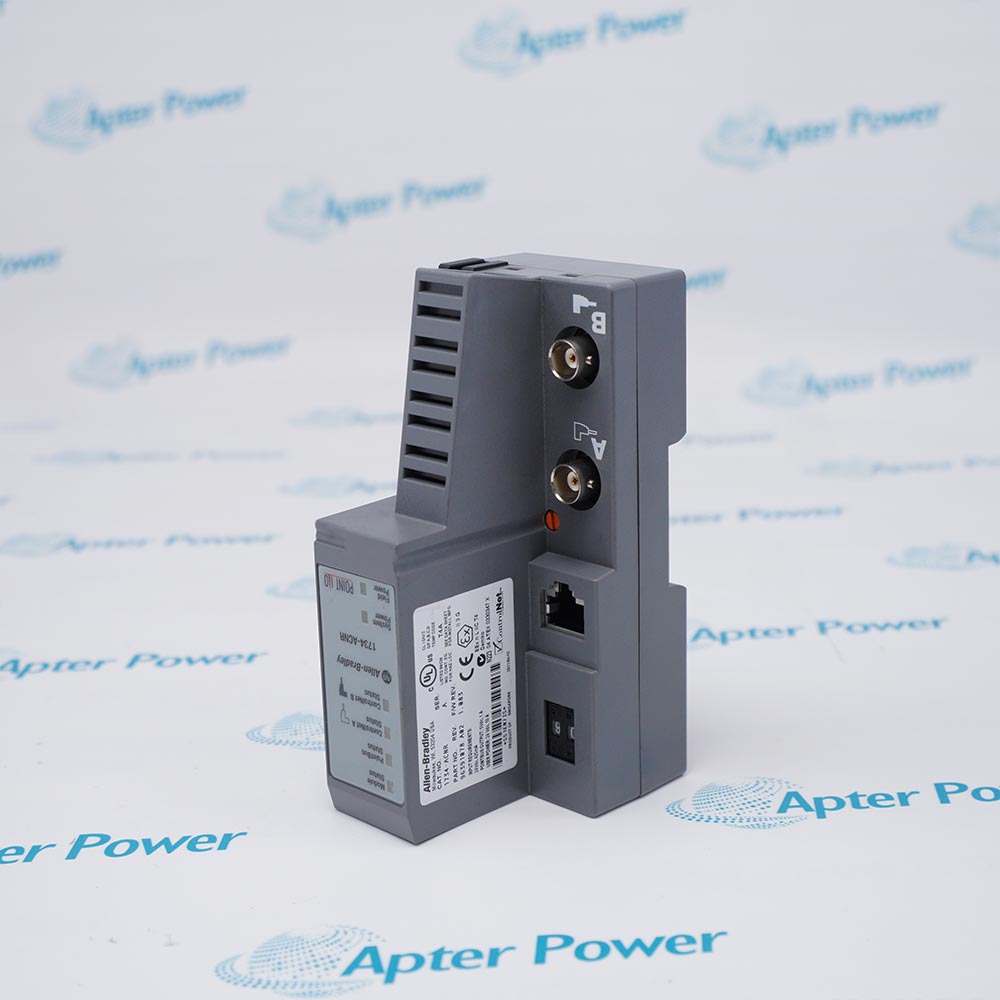
1734-232ASC adds a configurable RS-232 record interface to a POINT I/O node for documented ASCII equipment.

Its 128-byte data handling, selectable delimiters, and multiple string representations let the controller receive and transmit structured serial messages.

A reliable installation records the device framing, cable shield point, terminal base, data layout, handshake policy, and expected fault response before download.

Availability of 1734-232ASC is subject to Apter Power inventory and sourcing confirmation.
Allen-Bradley 1734-232ASC POINT I/O RS-232 ASCII Interface Module Manuals, Datasheets, and Links
Important Notice: Other accessories, manuals, cables, calibration data, software, etc. are not included with this equipment unless listed in the above stock item description. All prices are shown in USD.
  • Baud rate: select one documented rate from 1200 through 38.4 kbit/s.
  • Character format: align data bits, parity, and stop bits with the instrument.
  • Shielding: use shielded cable and ground the shield at one end only.
  • Signal reference: wire Tx, Rx, and signal ground to the official terminal positions.
  • Receive boundary: set start and end delimiter behavior for the actual protocol.
  • Data type: choose array, short string, or string consistently with the controller tags.
  • Byte order: apply swap mode only when the connected data format requires it.
  • Record length: keep receive and transmit payloads within the published 128-byte limit.
  • FIFO flags: distinguish transmit or receive overflow from a framing problem.
  • Parity status: compare the configured character format with the device protocol.
  • Handshake status: review record sequencing and the selected immediate or handshake mode.
  • Recovery test: prove one known receive and transmit message before restoring production traffic.
  • ASCII instruments: exchange records with supported serial measurement devices.
  • Barcode readers: receive delimited identification strings in a POINT I/O station.
  • Serial displays: transmit documented ASCII messages from Logix logic.
  • Legacy interfaces: retain an approved RS-232 device within an EtherNet/IP-accessible POINT I/O architecture.
Description
Serial instruments that do not use an industrial network can enter a POINT I/O architecture through 1734-232ASC. The module converts one full-duplex RS-232 stream into managed transmit and receive records for the Logix application.

Message boundaries on 1734-232ASC are created by the selected framing, delimiters, data type and record length. Port and FIFO status then help the program distinguish new data, overflow, parity and handshake conditions instead of treating the stream as discrete I/O.

Commissioning 1734-232ASC should reproduce the connected device protocol before any controller logic is changed. Tx, Rx, signal ground, one-end shield grounding, character format and representative messages must be checked together against the archived module configuration.
Revisions

Revision Part #

Also known as

1734-232ASC Ser A
1734-232ASC/A, Series A, Rev A
1734-232ASC Ser B
1734-232ASC/B, Series B, Rev B
1734-232ASC Ser C
1734-232ASC/C, Series C, Rev C
Alternative Names
Allen-Bradley 1734-232ASC Rockwell Automation 1734-232ASC AB 1734-232ASC 1734232ASC 1734 232ASC POINT I/O RS-232 ASCII interface
Technical notes
Mismatched framing is the main commissioning risk for 1734-232ASC. Capture a known device message, then align baud rate, character format, delimiters and handshake behavior with the Logix tag layout; stop parameter changes when wiring or signal-ground continuity has not first been proven at the connected instrument.
Exceptional Service

Our Mission

  • 100% Satisfaction

    We believe expertise is priceless. With over 20 years of experience, and top engineers on staff, we can help you solve or avoid problems that threaten your business.
  • Trust Guaranteed

    Not only do we have a vast inventory, our team makes sure every piece of equipment is in working condition. Your purchases are also backed by our Warranty.
  • Expertise

    Time is money, especially when your equipment is down. We work quickly to get your equipment on its way so you can get it back up and running.

FAQS

The following is a list of questions commonly asked by our customers. Please contact us if you have a question about our process that is not answered below.
Why can 1734-232ASC receive characters but never complete a controller record?
Compare the configured start and end delimiters, expected length and device message while monitoring record status; a live port does not prove that the record boundary is valid.
How should a no-response fault be traced when 1734-232ASC transmits a known command?
Check Tx, Rx and signal ground against the instrument pinout, confirm one-end shield grounding, then compare the sent framing with the device protocol.
What causes readable text from 1734-232ASC to appear in the wrong controller bytes?
Review the selected array or string type, byte-order setting and tag layout before altering the external device; preserve a captured reference message for comparison.
When burst traffic fills the receive path of 1734-232ASC, what should be adjusted first?
Inspect FIFO and handshake status, controller servicing of new records and message pacing; do not shorten data blindly while the application still leaves records unread.
How can a replacement 1734-232ASC retain the behavior of an existing ASCII instrument?
Restore the saved module definition, framing, delimiters, handshake mode and tag structure, then prove receive and transmit with the same known messages used before removal.
Why might parity faults on 1734-232ASC continue after the serial cable is replaced?
The device and module may still disagree on data bits, parity or stop bits; compare both configurations and correct one setting at a time.