How VM600 and VibroSmart Enable Predictive Maintenance in Rotating Machinery
About the author
Written by May, Managing Director of Apter Power
May's Facebook:
May has been working at Apter Power for 10 years, where she turns complex power-automation challenges into clear, executable plans.
Drawing on deep product knowledge and field-proven methodologies, she has already supported 2 000+ customers in over 100 countries, maintaining a 96 % satisfaction score.
Rotating machinery usually gives warning signs before a costly failure. Shaft movement, bearing vibration, casing vibration, speed changes, temperature drift, and alarm behavior often shift before a trip occurs. For plants running turbines, compressors, pumps, fans, gearboxes, and generators, the goal is to capture those signals early enough to plan action. Vibro-Meter VM600 systems and VibroSmart distributed modules help maintenance teams move from fault response to data-based predictive maintenance.
The Shift From Reactive to Predictive Maintenance
Reactive maintenance is expensive because the plant learns about a problem at the moment production is already affected. A bearing overheats, a cooling tower fan trips, a gearbox alarm escalates or a turbine protection relay acts. At that point, the team faces lost output, urgent troubleshooting, emergency procurement and possible secondary damage.
Preventive maintenance gives teams a schedule, but the schedule may not match the real condition of the asset. A pump can be opened too early. A fan with a developing gearbox defect may keep running because its inspection date has not arrived. Predictive maintenance uses machine condition data to decide when action is needed.
For rotating equipment, vibration is one of the most useful signals. Shaft-relative vibration, absolute casing vibration, phase, speed, axial position, bearing envelope data and process variables can point to imbalance, misalignment, looseness, rubbing, bearing defects, blade issues or unstable operation. Strong condition monitoring solutions need three capabilities:
Maintenance Need
Practical Plant Requirement
Early fault detection
Capture dynamic vibration, speed and process data with enough resolution
Asset protection
Convert dangerous conditions into alarms, relays or trip logic
Maintenance planning
Preserve trends, spectra, events and operator context for review
Predictive maintenance using Vibro-Meter VM600 makes the most sense on assets where one failure can stop production, damage connected equipment or create a safety risk. Common examples include gas turbines, steam turbines, hydro units, large compressors, generator trains and critical balance-of-plant machines.
In a chemical plant pump example, online condition monitoring helped reduce mean time to repair from 6.5 hours to about 3 hours, with roughly $120,000 saved per failure event. The value came from faster detection, better preparation and shorter downtime, not from software alone.
VM600 Rack Architecture for High-Channel-Count Applications
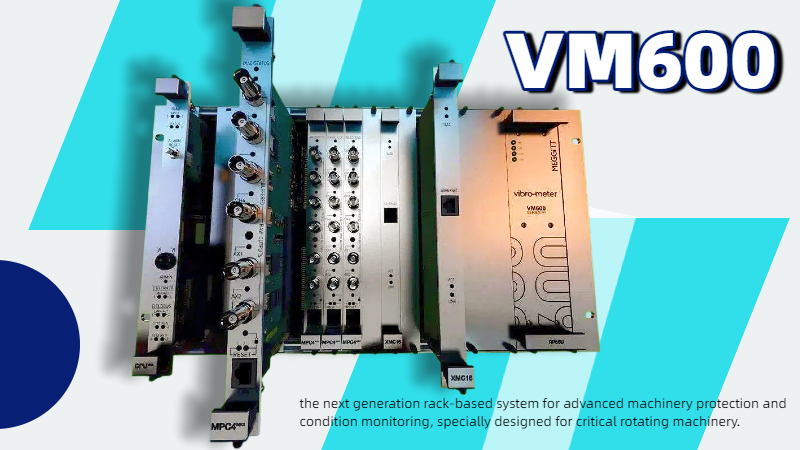
A Vibro-Meter VM600 rack is a centralized monitoring platform for critical rotating assets with many measurement points. It is usually installed in a control cabinet or equipment room and connected to field sensors on turbines, compressors, pumps, fans, generators and auxiliary machines.
The MPC4 / IOC4T module pair provides 4 dynamic channels and 2 auxiliary channels (tachometer inputs) and serves as the core machinery protection module with TÜV-certified SIL 1 safety rating. These auxiliary channels can be used for tachometer or DC inputs, which makes the module pair suitable for vibration, phase, speed and related process context in one rack-based architecture.
When configuring a Vibro-Meter VM600 rack, engineers should start with the machine train rather than the rack layout. Count bearings first. Then define shaft-relative probes, casing vibration points, speed references, axial position inputs, alarm outputs, trip paths and DCS data needs. The rack layout comes after the protection philosophy and measurement plan are clear.
Configuration Area
Engineering Question
Dynamic channels
Which bearings, shafts, casings or gearboxes need continuous monitoring?
Auxiliary channels
Which speed, phase, axial position or process signals are needed?
Protection outputs
Which alarms, relays or 4-20 mA outputs must connect to plant systems?
Diagnostic depth
Which assets need spectra, waveforms, bearing envelope analysis or event review?
Retrofit planning
Can existing sensors, cabinets or wiring be reused safely?
Product model selection depends on the asset and monitoring depth. A high-channel turbine or compressor project may involve MPC4 / IOC4T, XMV16 / XIO16T, XMC16 / XIO16T, CPUM / IOCN and RLC16. For plants maintaining older Vibro-Meter installations, Apter Power can support sourcing for VM600-related modules and spare parts, while engineering teams should still confirm exact part numbers, revisions, and system fit before purchase. In VM600 high-channel vibration systems, the XMV16 / XIO16T pair is important because it provides 16 dynamic vibration channels and 4 tachometer channels. It supports 24-bit data acquisition, a maximum sampling rate of 98 kHz and high-resolution FFT, making it ideal for rolling-element bearing analysis.
Factory cases show why centralized racks remain relevant. At a remote hydroelectric plant in northern Canada, 22 Francis turbines were monitored with rack-based VM600 systems and Vibro-Meter sensors for rotating assets. The application included shaft radial relative vibration, turbine runner band radial clearance, bearing axial absolute vibration and process parameters such as pressure and temperature. Because the plant is far from major service centers, reliable protection and long-term condition trends are operational necessities.
A second brownfield case involved three 500 MW steam turbine generator trains at a large thermal power plant. Each unit had seven bearings and 39 measurement points. The upgrade had to improve condition monitoring without disturbing existing turbine supervisory protection systems, transducers or cabinet space. For maintenance and controls teams, the value was not only better diagnostic visibility, but also lower outage risk, fewer wiring changes and simpler commissioning.
VibroSmart Distributed Modules for Remote Asset Monitoring
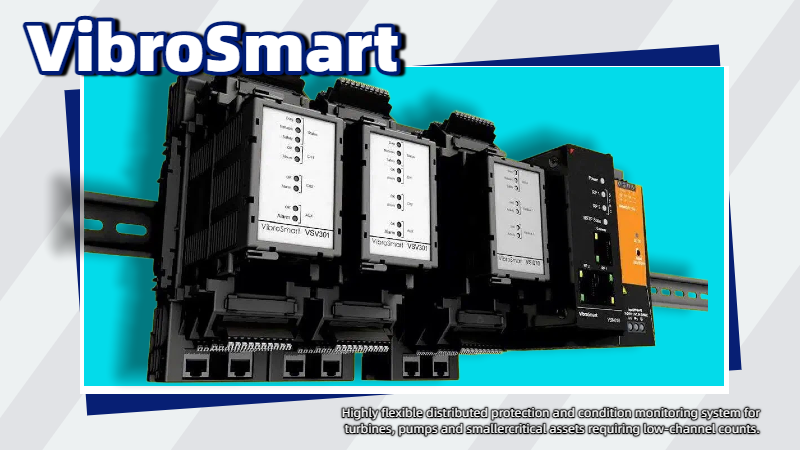
Rack systems fit dense, critical-machine applications. VibroSmart distributed modules fit assets spread across the plant. These modules can be installed close to the machine, reducing long sensor cable runs and making continuous monitoring easier for dispersed equipment.
The VSV301 module has two independent dynamic vibration channels and one auxiliary channel that can be configured as a tachometer or DC input. It can operate as a stand-alone vibration monitoring module or work with other modules in a larger VibroSmart system.
This makes VibroSmart modules for remote monitoring useful for cooling tower fans, induced-draft fans, pumps, gearboxes, smaller turbines and balance-of-plant assets that sit far from the main control room. Common VibroSmart-related model examples include VSV301 + VSB300 for vibration monitoring, VSV300 for vibration applications, VSV310 for additional monitoring needs, VSI010 + VSB010 for communications and VSF00x interface modules.
A petrochemical cooling tower case gives a clear example. The plant used a VibroSmart VSV30x monitoring module on a variable-speed cooling tower fan. One dynamic channel monitored fan vibration with an absolute vibration sensor. Another channel monitored gearbox behavior and blade lift using a relative vibration sensor. The application needed low-noise measurements at very low rotational speeds below 1 Hz, plus adaptive alarms that changed with fan speed.
That case is useful because cooling tower fans are often treated as secondary assets until a failure interrupts production. They operate outdoors, face variable loads and may develop blade, gearbox or structural problems. Periodic handheld data may miss transient behavior during speed changes. Distributed modules for asset protection help teams place monitoring near the asset, keep local alarm logic available and send processed condition data to plant systems.
Temperature ratings should be handled carefully in specifications. VSV301 material supports use in harsh industrial environments and high temperatures up to 70°C. Other VibroSmart overview data commonly lists -20°C to 70°C for several modules. A -40°C claim should be verified by the exact module, terminal base, enclosure and project requirement before purchase or retrofit approval.
System Integration of Condition Monitoring Solutions With Plant DCS
Monitoring data creates value when it reaches the right team in the right format. Operators need clear alarms. Reliability engineers need waveforms, spectra, trends and event history. Controls engineers need clean communication paths. Procurement and maintenance planners need enough evidence to prepare spares before failure. In that planning stage, a supplier such as Apter Power can help teams check availability for monitoring modules, interface cards, sensors, terminal bases, and related automation spares before the outage window becomes urgent.
Integrating Vibro-Meter with plant DCS should be treated as an engineering task, not a final commissioning detail. A good architecture separates three layers:
Layer
Main Function
Primary Users
Field layer
Sensors, probes, accelerometers, speed inputs and terminal bases
Instrument technicians and reliability engineers
Monitoring layer
VM600 racks, VibroSmart measurement blocks and monitoring software
Reliability and rotating-equipment teams
Plant interface layer
DCS, PLC, SCADA, historian and OPC clients
Operators, controls engineers and asset managers
Protection logic should remain clear and auditable. Diagnostic analysis should retain deep data. The DCS should receive selected values that support operation, such as alarm status, bypass state, trip multiply status, processed vibration values and machine health indicators. Raw diagnostic data belongs in the monitoring or historian layer, where specialists can interpret it.
Seamless Data Communication Protocols and Network Layers
VibroSmart VSI010 is a practical bridge between measurement blocks and plant control systems. The VSI010 interface supports up to two serial-based interfaces using Modbus RTU or PROFIBUS DP, one Ethernet-based Modbus TCP interface or one IEC 61850 GOOSE interface at one time. It also includes logic functions that can combine alarm and status information before export.
VibroSmart Modbus and OPC integration should be written with the correct layer in mind. Modbus RTU, Modbus TCP, PROFIBUS DP and IEC 61850 GOOSE are typically fieldbus or control-system integration paths. OPC UA, OPC DA and OPC HDA usually sit at the software, historian or enterprise data layer. Monitoring software can export data through OPC pathways, while VibroSmart systems with VSI010 can export selected values through Modbus, PROFIBUS or IEC 61850 GOOSE.
In plant terms, the DCS should receive what operators can act on. Analysts should keep access to detailed waveforms, spectra, bearing envelope data and event records. This division reduces alarm clutter and still gives the reliability team enough depth for diagnosis.
Unified Plant Management Interfaces
A unified plant interface does not mean every user needs the same screen. A control-room operator may need alarm priority, machine status and trip readiness. A vibration analyst may need order tracking, frequency peaks, demodulated bearing signals and run-up or run-down events. A maintenance planner may need a clear risk ranking and spare-part lead time.
The XMV16 / XIO16T module pair supports this deeper diagnostic layer. It offers 16 dynamic inputs, 24-bit A/D conversion, a maximum sampling rate of 98 kHz, fixed-frequency bandwidth from 40 Hz to 38 kHz and data sampling at 2.56 times the selected bandwidth. Those values explain why a VM600 monitoring layer can support rolling-element bearing analysis and high-performance vibration diagnostics.
For a real plant, the interface should help people decide the next action. A high-high vibration alarm may require immediate operating response. A slowly rising bearing envelope trend may support inspection at the next planned stop. A repeated transient during run-up may point to looseness, alignment or process-induced instability. Good monitoring makes these paths visible.
Transform Your Maintenance Strategy With Smart Monitoring
A strong maintenance strategy begins with asset criticality. Put rack-based VM600 monitoring on high-risk, high-value machines with many channels and strict protection needs. Use VibroSmart architecture on distributed assets where local monitoring reduces wiring cost and improves coverage. Keep DCS integration focused. Feed operators with clear, actionable information, and give specialists access to deeper diagnostic data.
For teams evaluating Vibro-Meter condition monitoring ROI, the measurable return usually comes from five areas:
Faster troubleshooting through historical vibration and event data
Better maintenance timing based on actual machine condition
Lower retrofit risk through the reuse of suitable sensors, cabinets or wiring
Improved spare planning for modules, sensors, terminal bases and communications interfaces
The strongest projects usually have a clear failure history, high downtime cost, limited redundancy or long lead-time parts. When long lead-time parts become part of the business case, Apter Power can help plants look for compatible automation and condition-monitoring spares before a forced outage occurs. A retrofit case at a large thermal power plant shows the logic. The plant upgraded condition monitoring across three 500 MW turbine generator trains while retaining existing protection systems and transducers. The project also reused cabinet space and avoided a special outage. For B2B users, that is the type of value that matters during approval: better machine insight with lower disruption.
For turbine trains, large compressors and generator sets, a Vibro-Meter VM600 rack is usually the stronger fit because it supports centralized, high-channel protection and diagnostics. For cooling tower fans, remote pumps, gearboxes and dispersed balance-of-plant assets, VibroSmart distributed modules can place monitoring closer to the machine. Both systems should connect to the plant DCS, PLC, SCADA or historian at the right data layer so operators see actionable alarms while reliability teams keep access to deeper vibration data.
FAQs
Q1. How does predictive maintenance differ from preventive maintenance?
Preventive maintenance follows time, running-hour or cycle-based schedules. Predictive maintenance uses condition data from the machine to decide when intervention is needed. For rotating assets, that data can include vibration amplitude, spectra, phase, shaft position, bearing envelope readings, speed, temperature and process conditions. Predictive maintenance helps teams act when deterioration appears, which can reduce unnecessary inspections and improve planning before failure.
Q2. What specific data protocols connect condition monitoring systems to a DCS?
Common protocols include Modbus RTU, Modbus TCP, PROFIBUS DP, IEC 61850 GOOSE, OPC UA, OPC DA and OPC HDA. The best choice depends on the integration layer. Fieldbus protocols are useful for alarms, processed values and status registers. OPC interfaces are better for historians, diagnostic tools and wider data platforms. For VibroSmart, VSI010 is the key fieldbus interface.
Q3. What is the typical sampling rate of VM600 for rolling element bearing monitoring?
There is no single fixed sampling rate for every VM600 application. For XMV16 / XIO16T extended vibration monitoring, public data lists 24-bit A/D conversion and a maximum sampling rate of 98 kHz. The same data lists fixed-frequency bandwidth from 40 Hz to 38 kHz, with data sampling at 2.56 times the selected bandwidth. The final setup should match bearing defect frequencies, speed range, sensor type and diagnostic objective.
Q4. Can VibroSmart modules operate reliably at extreme temperatures like -40°C?
Do not assume -40°C for every VibroSmart module. Public VSV301 data supports harsh industrial use and high temperatures up to 70°C. Other VibroSmart material commonly lists -20°C to 70°C for several modules. Some sensor chains can have wider temperature ranges, but module ratings should be checked by exact model, terminal base, enclosure and hazardous-area requirement before specification.
Q5. Which Rotating Assets Are Better Suited for VM600 Versus VibroSmart?
VM600 is usually better for critical, high-channel assets such as turbines, large compressors and generator trains. VibroSmart is often a better fit for distributed machines such as cooling tower fans, pumps, gearboxes and balance-of-plant assets that need monitoring closer to the equipment.
Predictive Monitoring for Rotating Assets
Building a Smarter Maintenance Framework for Critical Assets
As rotating equipment becomes increasingly important to production continuity, relying only on scheduled inspections is no longer sufficient. Industrial facilities need continuous insight into machine health to detect abnormal conditions before they develop into major failures. By combining centralized monitoring platforms with distributed measurement technologies, plants can improve reliability, enhance safety, and reduce unplanned downtime. Typical solutions such as the Vibro-Meter VM600 system and VibroSmart modules provide the foundation for modern predictive maintenance strategies:
Centralized and Distributed Monitoring for Complete Asset Protection
Different rotating assets require different monitoring approaches. Critical machines with numerous measurement points benefit from centralized architectures, while remote equipment requires flexible and localized solutions. Combining both strategies allows plants to achieve wider coverage and stronger equipment reliability. VM600 rack systems and VibroSmart modules provide practical examples of how condition monitoring can be adapted to various industrial applications. By detecting abnormal conditions earlier, plants can reduce downtime and improve maintenance efficiency.
Seamless Integration and Data-Driven Maintenance Optimization
Condition monitoring creates the greatest value when machine information is effectively shared with plant automation systems. Communication interfaces such as the VibroSmart VSI010 enable reliable connectivity with DCS, PLC, SCADA, and historian platforms, ensuring that operators and reliability engineers receive the information they need. Advanced modules like MPC4/IOC4T and XMV16/XIO16T provide detailed vibration analysis and historical trends that support predictive maintenance. This approach helps facilities optimize spare parts planning, shorten troubleshooting time, extend equipment life, and improve overall operational performance.








Leave Your Comment