Ask our team:
  • Phone: +86 181 0690 9650
  • E-Mail sales1@apterpower.com
  • Lifecycle status

    Active / Available from OEM
    Apter Power checks firmware, network topology, SD recovery, and local-bank records for maintenance-focused procurement.

1769-L30ER

/ 4.9
1001 reviews | Need a Specific Revision?
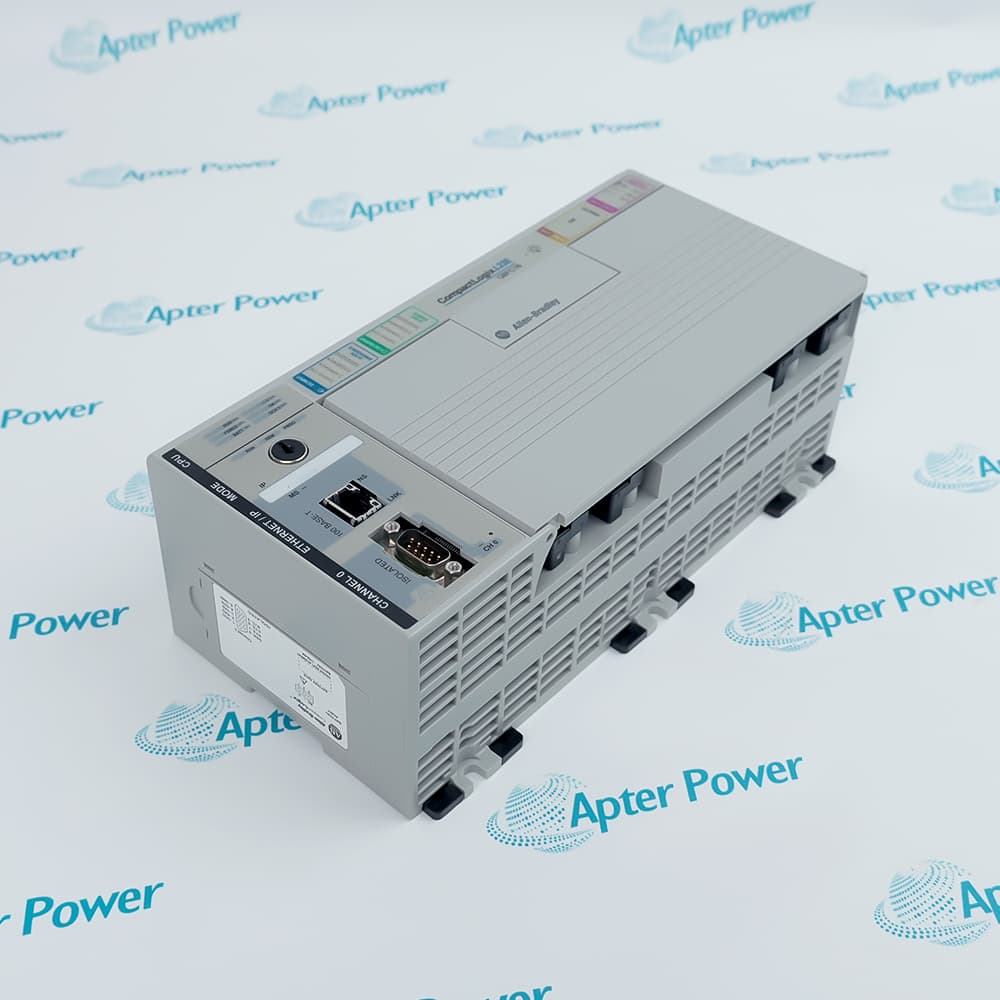
Compact machine control uses 1769-L30ER for standard Logix execution, a small local I/O bank and one switched EtherNet/IP interface.
In Stock
Ships by Wednesday, October 28
Fast Shipping Available
Get a quick price for 1769-L30ER
Quantity
*E-mail
Company
*Mobile
*Content
Upload (gif, jpg, jpeg, png, bmp, doc, docx, xls, xlsx, ppt, pdf, csv)

Technical specifications for 1769-L30ER

  • Manufacturer:
    Allen-Bradley
  • Part Number:
    1769-L30ER
  • Product Family:
    CompactLogix
  • Product Type:
    CompactLogix 5370 L3 EtherNet/IP Controller
  • Stock:
    1
  • User memory:
    1 MB
  • EtherNet/IP nodes:
    16 maximum
  • Local Compact I/O:
    8 modules maximum
  • Integrated motion:
    Not supported
  • Ethernet ports:
    2 ports sharing one IP address
  • Nonvolatile memory:
    1784-SD1 supplied; 1784-SD2 optional
  • Weight:
    0.31 kg
  • Estimated shipping dimensions:
    11.8x5.5x10.5cm
  • Tariff Code:
    8537101190
  • Country of origin:
    USA
  • Place of shipment:
    Xiamen,Fujian,China
By purchasing this item, you agree to the Terms & Conditions, ApterPower is not an authorized distributor for listed manufacturers or tradenames and therefore the manufacturer's warranty does not apply. All our products come with ApterPower's 1-year warranty.

More Information

Overview Manuals Local I/O Ethernet Plan Recovery Product Applications

Features:

  • 1 MB controller: standard logic and communication capacity
  • Compact I/O scale: up to eight local 1769 modules
  • EtherNet/IP access: two switched ports with a 16-node project limit
1769-L30ER targets compact machines that need the L3 architecture without integrated motion.

Its two network connectors simplify linear or ring wiring, but they remain one logical interface and one IP address.

A dependable spare record combines firmware, SD image, node count, I/O-bank drawing, power calculation, and current project archive.

Availability of 1769-L30ER is subject to Apter Power inventory and sourcing confirmation.

Verified resources for 1769-L30ER:

Important Notice: Other accessories, manuals, cables, calibration data, software, etc. are not included with this equipment unless listed in the above stock item description. All prices are shown in USD.

  • Controller position: install it as the leftmost module in the local bank.
  • Module count: limit the system to eight supported local Compact I/O modules.
  • Power: calculate distance rating and current on both supply rails.
  • Clearance: maintain 50 mm above, below, and at both sides.
  • Addressing: both Ethernet ports use the same controller IP address.
  • Topology: apply supported linear, star, or DLR architecture.
  • Node budget: keep directly configured EtherNet/IP devices within 16.
  • Recovery: retain address, firmware, SD, and network drawings together.
  • Project: save the validated application and the required programming-software release.
  • Firmware: record the installed revision and electronic keying assumptions.
  • SD media: document image, load mode, and ownership of the 1784-SD1 or 1784-SD2 card.
  • Acceptance: define network, I/O, HMI, alarm, and rollback checks for the controller exchange.
  • Compact machinery: execute standard Logix control with local Compact I/O.
  • Distributed I/O: coordinate supported EtherNet/IP adapters within the node budget.
  • Drive integration: exchange standard control and diagnostic data with compatible drives.
  • Cell control: combine logic, HMI, and messaging without integrated motion axes.
Description
A compact machine that does not require integrated motion can use 1769-L30ER as the entry CompactLogix 5370 controller. Its local 1769 bank and EtherNet/IP device tree support standard logic, distributed I/O, messaging and non-motion drive coordination.

Both Ethernet connectors on 1769-L30ER belong to one embedded switch and one controller IP identity. That arrangement can support approved topologies, but it cannot be divided into independently addressed machine and plant networks by assigning a second IP to the other jack.

Before 1769-L30ER is commissioned, verify the local bank power and placement, controller firmware, project node tree and SD recovery image. The machine network should then be tested within the published device budget rather than expanded until communication becomes unstable.
Revisions

Revision Part #

Also known as

1769-L30ER Series A
1769-L30ER/A, Series A
Alternative Names
Allen-Bradley 1769-L30ER Rockwell Automation 1769-L30ER AB 1769-L30ER 1769L30ER 1769 L30ER CompactLogix 5370 one-megabyte controller
Technical notes
The primary network mistake with 1769-L30ER is treating its two Ethernet jacks as separate interfaces. Both ports share one controller IP address; document the intended topology and device tree, and stop connection to two independent subnets unless an approved external architecture provides the required separation.
Exceptional Service

Our Mission

  • 100% Satisfaction

    We believe expertise is priceless. With over 20 years of experience, and top engineers on staff, we can help you solve or avoid problems that threaten your business.
  • Trust Guaranteed

    Not only do we have a vast inventory, our team makes sure every piece of equipment is in working condition. Your purchases are also backed by our Warranty.
  • Expertise

    Time is money, especially when your equipment is down. We work quickly to get your equipment on its way so you can get it back up and running.

FAQS

The following is a list of questions commonly asked by our customers. Please contact us if you have a question about our process that is not answered below.
Why can connecting the two ports of 1769-L30ER to separate subnets create unstable communication?
They belong to one switched controller interface and share one IP identity; restore the approved topology and use external routing or segmentation when required.
What should be reviewed before another local module is added beside 1769-L30ER?
Check the remaining module allowance, supply distance, both rail-current budgets, module support and physical bank order before changing the project.
How can network expansion cause intermittent device loss on 1769-L30ER?
Audit the directly configured node tree, connection demand, RPI settings and switch diagnostics, then remove stale devices or redesign the architecture if resources are exhausted.
Why might an SD card fail to restore a replacement 1769-L30ER?
Compare the saved image with controller firmware, load mode and project revision, and preserve a protected backup before attempting another recovery.
Can 1769-L30ER coordinate integrated motion axes when standard drives already communicate over EtherNet/IP?
No. Standard drive messaging does not add integrated-axis capability; use a controller catalog officially designed for motion if the project requires coordinated axes.
What should be checked when a Logix project will not download to 1769-L30ER after service?
Reconcile firmware, the supported engineering release, controller definition, node tree and SD contents before converting or forcing the project.