Ask our team:
  • Phone: +86 181 0690 9650
  • E-Mail sales1@apterpower.com
  • Lifecycle status

    Active / Available from OEM
    Apter Power reviews controller identity, motion records, condition, official documentation, quotation, and sourcing details.

1769-L30ERM

/ 4.9
1001 reviews | Need a Specific Revision?
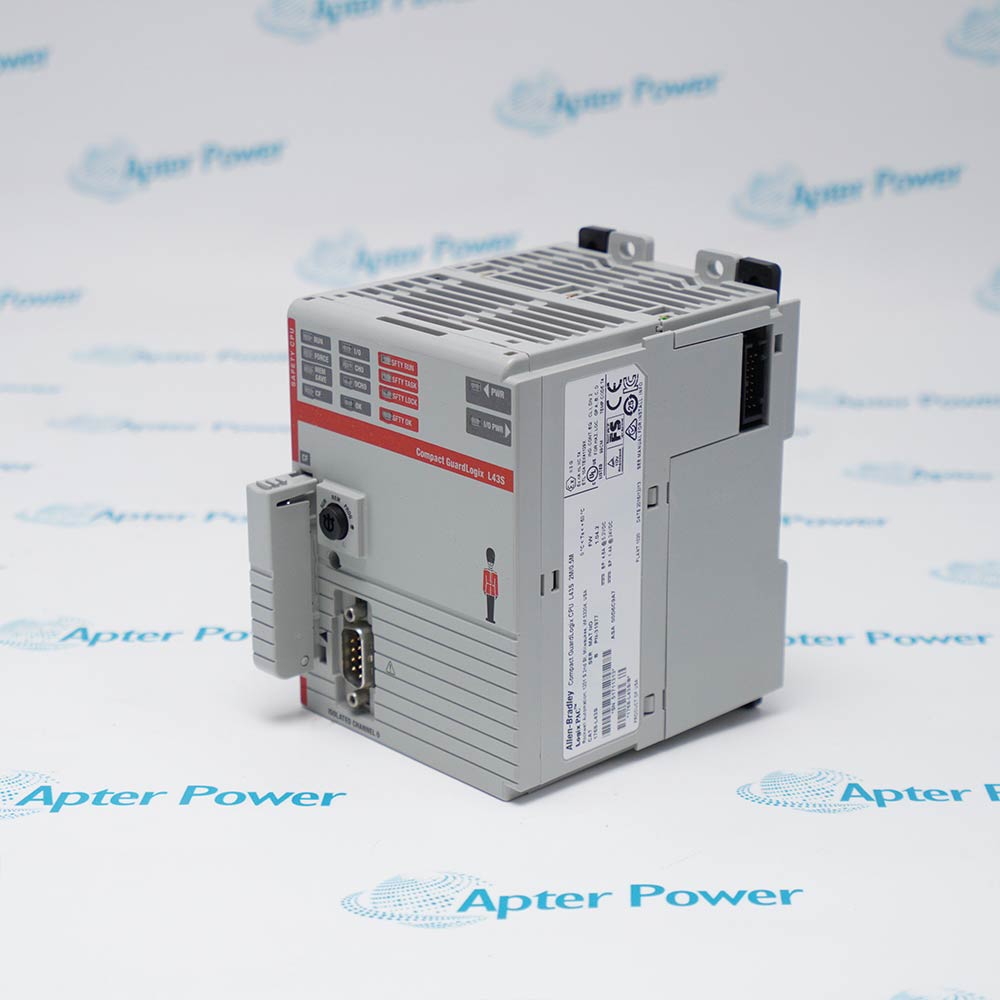
Four-axis Integrated Motion is the defining role of Allen-Bradley 1769-L30ERM, a CompactLogix 5370 controller for synchronized drive coordination and local Compact I/O.
In Stock
Ships by Wednesday, October 28
Fast Shipping Available
Get a quick price for 1769-L30ERM
Quantity
*E-mail
Company
*Mobile
*Content
Upload (gif, jpg, jpeg, png, bmp, doc, docx, xls, xlsx, ppt, pdf, csv)

Technical specifications for 1769-L30ERM

  • Manufacturer:
    Allen-Bradley
  • Part Number:
    1769-L30ERM
  • Product Family:
    CompactLogix
  • Product Type:
    CompactLogix 5370 1 MB Motion Controller
  • Stock:
    1
  • User memory:
    1 MB
  • Maximum local I/O modules:
    8
  • Maximum EtherNet/IP nodes:
    16
  • Integrated motion axes:
    4
  • Ethernet ports:
    2
  • Programming port:
    USB
  • Controller connections:
    256
  • TCP connections:
    120
  • Removable storage:
    1784-SD1 or 1784-SD2
  • Power consumption:
    4.5 W
  • Operating temperature:
    0...60 °C
  • Weight:
    0.68 lbs (0.31 kg)
  • Estimated shipping dimensions:
    13.2x5.5x10.5cm
  • Tariff Code:
    8537101190
  • Country of origin:
    Multiple
  • Place of shipment:
    Xiamen,Fujian,China
By purchasing this item, you agree to the Terms & Conditions, ApterPower is not an authorized distributor for listed manufacturers or tradenames and therefore the manufacturer's warranty does not apply. All our products come with ApterPower's 1-year warranty.

More Information

Overview Manuals Four-Axis Motion I/O Power Project Compatibility Product Applications

Features:

  • Four-axis motion tier: the exact catalog defines a compact Integrated Motion scope
  • Shared controller project: conventional logic and synchronized drive objects operate together
  • Recovery-sensitive role: firmware, time synchronization, and axis records are essential service assets
1769-L30ERM is intended for control systems that need a limited number of EtherNet/IP motion axes without separating machine logic into another controller.

The motion designation matters more than a shared CompactLogix appearance because a non-motion controller cannot assume the same project role.

The most useful pre-purchase evidence is a controlled record of axis assignments, supported drives, and the software environment used by the installed machine.

Apter Power can coordinate official-document checks, quotation, and procurement support for 1769-L30ERM.
Allen-Bradley 1769-L30ERM CompactLogix 5370 1 MB Motion Controller Manuals, Datasheets, Links
Important Notice: Other accessories, manuals, cables, calibration data, software, etc. are not included with this equipment unless listed in the above stock item description. All prices are shown in USD.
  • Axis allocation: remain within the published four-axis Integrated Motion capacity.
  • Drive identity: preserve each supported drive catalog, firmware, feedback type, and controller ownership.
  • Mechanical definition: retain scaling, limits, home behavior, gearing, and coordinated-axis relationships.
  • Acceptance path: test individual axes before releasing coordinated machine motion.
  • Module sequence: keep the approved catalog order and distance-rating arrangement.
  • Bus calculation: total the current demand of the controller-side local module bank.
  • Power placement: add or retain supplies only where the documented bank design permits.
  • Project alignment: match physical modules, slot definitions, and electronic keying before startup.
  • Controller firmware: match the major revision required by the approved Logix project.
  • Engineering software: retain the supported Studio 5000 environment and project source.
  • Drive profiles: keep Add-On Profiles and device firmware consistent with the axis configuration.
  • Recovery media: control SD-card use so an unapproved image cannot overwrite the production project.
  • Integrated motion systems: coordinate as many as four supported motion axes over EtherNet/IP.
  • Combined logic and motion: execute machine sequence and drive control in one Logix project.
  • Networked controller systems: exchange data with supported I/O, drives, and supervisory devices.
  • Compact I/O architectures: operate an approved local module bank within the controller limits.
Description
1769-L30ERM brings general Logix control and Integrated Motion over EtherNet/IP into the same CompactLogix 5370 controller. Its published capacity suits projects that remain within four coordinated motion axes and the associated local and network architecture.

Machine sequence, drive ownership, and time synchronization meet inside the 1769-L30ERM project. This allows motion commands and conventional automation logic to share controller data, but it also makes the controller record inseparable from the supported drive and firmware environment.

For a motion-system purchase, 1769-L30ERM should be evaluated from the installed axis roles and recovery plan rather than from I/O count alone. A valid spare must be able to restore both controller execution and the established synchronized-motion behavior.
Revisions

Revision Part #

Also known as

1769-L30ERM Series A
1769-L30ERM/A, Series A
Alternative Names
Allen-Bradley 1769-L30ERM motion controller Rockwell Automation 1769-L30ERM AB 1769 L30ERM 1769L30ERM CompactLogix CompactLogix 5370 four-axis controller 1769-L30ERM 1769-L30ERM 1 MB PLC
Technical notes
After a project download, axes on 1769-L30ERM can remain inhibited when drive firmware, electronic keying, or CIP Sync no longer matches the approved motion design. Compare those three conditions with the saved project before retuning an axis; stop if ownership or safety state is unresolved.
Exceptional Service

Our Mission

  • 100% Satisfaction

    We believe expertise is priceless. With over 20 years of experience, and top engineers on staff, we can help you solve or avoid problems that threaten your business.
  • Trust Guaranteed

    Not only do we have a vast inventory, our team makes sure every piece of equipment is in working condition. Your purchases are also backed by our Warranty.
  • Expertise

    Time is money, especially when your equipment is down. We work quickly to get your equipment on its way so you can get it back up and running.

FAQS

The following is a list of questions commonly asked by our customers. Please contact us if you have a question about our process that is not answered below.
Why can drives stay inhibited after a verified project is loaded into 1769-L30ERM?
Check controller and drive firmware, electronic keying, CIP Sync, axis ownership, safety state, network addressing, and run mode before enabling or retuning motion.
What should be preserved before replacing 1769-L30ERM during a short outage?
Back up the approved project, axis and tuning data, home and limit settings, drive catalogs, firmware, time-sync topology, I/O map, and a known machine baseline.
Can a non-motion CompactLogix controller replace 1769-L30ERM when the discrete I/O count is identical?
No automatic equivalence follows from I/O count. The replacement must officially support the required axes, drives, firmware, software, synchronization, and project behavior.
How should a fifth planned axis affect selection of 1769-L30ERM?
Stop the selection because the documented controller scope is four axes, then review an officially supported controller tier and its network, memory, drive, and enclosure requirements.
What can cause one axis on 1769-L30ERM to move correctly while coordinated motion faults?
Compare CIP Sync status, group membership, update periods, gearing, cam definitions, drive faults, network path, and the mechanical reference used by the coordinated instruction.
Which staged checks reduce risk after installing a sourced 1769-L30ERM?
Verify identity and firmware, restore the controlled project, prove I/O and network health, test disabled-axis diagnostics, then run single-axis and coordinated tests under the approved safety procedure.